
病毒 miRNA 改变宿主细胞 miRNA 谱并调节先天免疫反应。
Viral miRNAs Alter Host Cell miRNA Profiles and Modulate Innate Immune Responses.
机构信息
Department of Periodontics-Mucosal Immunology Laboratory, College of Dentistry, University of Illinois at Chicago, Chicago, IL, United States.
Department of Microbiology and Immunology, University of Illinois at Chicago, Chicago, IL, United States.
出版信息
Front Immunol. 2018 Mar 6;9:433. doi: 10.3389/fimmu.2018.00433. eCollection 2018.
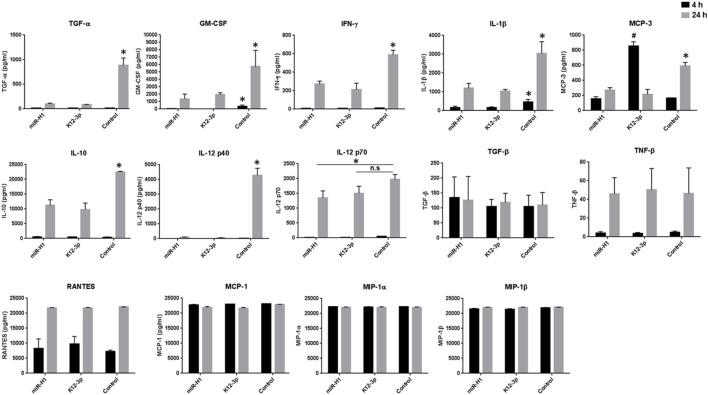
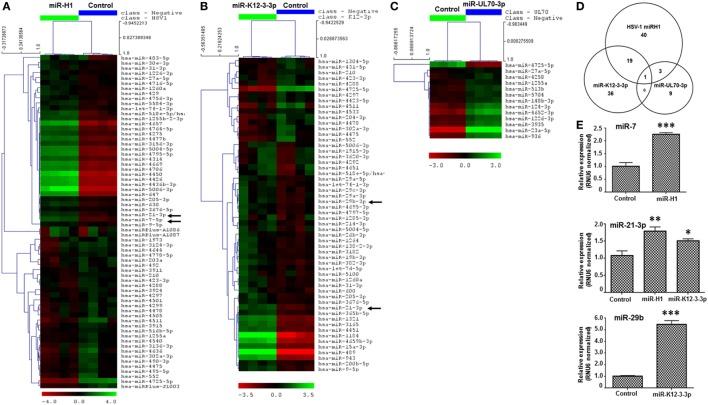
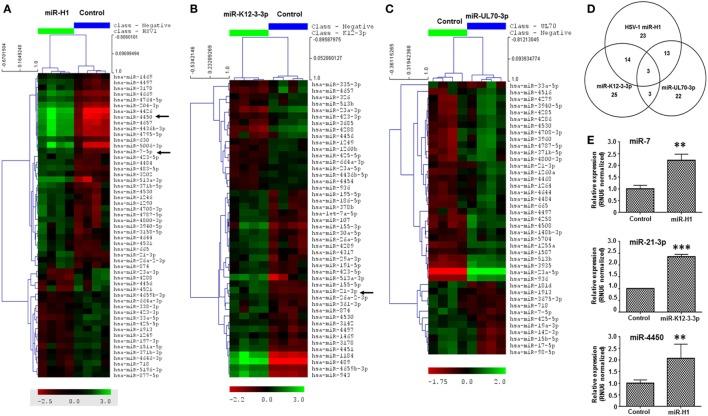
Prevalence of the members of herpesvirus family in oral inflammatory diseases is increasingly acknowledged suggesting their likely role as an etiological factor. However, the underlying mechanisms remain obscure. In our recent miRNA profiling of healthy and diseased human tooth pulps, elevated expression of human herpesvirus encoded viral microRNAs (v-miRs) were identified. Based on the fold induction and significance values, we selected three v-miRs namely miR-K12-3-3p [Kaposi sarcoma-associated virus (KSHV)], miR-H1 [herpes simplex virus 1 (HSV1)], and miR-UL-70-3p [human cytomegalovirus (HCMV)] to further examine their impact on host cellular functions. We examined their impact on cellular miRNA profiles of primary human oral keratinocytes (HOK). Our results show differential expression of several host miRNAs in v-miR-transfected HOK. High levels of v-miRs were detected in exosomes derived from v-miR transfected HOK as well as the KSHV-infected cell lines. We show that HOK-derived exosomes release their contents into macrophages (Mφ) and alter expression of endogenous miRNAs. Concurrent expression analysis of precursor (pre)-miRNA and mature miRNA suggest transcriptional or posttranscriptional impact of v-miRs on the cellular miRNAs. Employing bioinformatics, we predicted several pathways targeted by deregulated cellular miRNAs that include cytoskeletal organization, endocytosis, and cellular signaling. We validated three novel targets of miR-K12-3-3p and miR-H1 that are involved in endocytic and intracellular trafficking pathways. To evaluate the functional consequence of this regulation, we performed phagocytic uptake of labeled bacteria and noticed significant attenuation in miR-H1 and miR-K12-3-3p but not miR-UL70-3p transfected primary human Mφ. Multiple cytokine analysis of challenged Mφ revealed marked reduction of secreted cytokine levels with important roles in innate and adaptive immune responses suggesting a role of v-miRs in immune subversion. Our findings reveal that oral disease associated v-miRs can dysregulate functions of key host cells that shape oral mucosal immunity thus exacerbating disease severity and progression.
疱疹病毒家族成员在口腔炎症性疾病中的流行程度日益得到认可,这表明它们可能是一种病因。然而,其潜在机制仍不清楚。在我们最近对健康和患病人类牙髓的 miRNA 谱分析中,发现了人类疱疹病毒编码的病毒 microRNA(v-miR)的高表达。根据倍数诱导和显著性值,我们选择了三种 v-miR,即 miR-K12-3-3p(卡波西肉瘤相关病毒(KSHV))、miR-H1(单纯疱疹病毒 1(HSV1))和 miR-UL-70-3p(人类巨细胞病毒(HCMV)),以进一步研究它们对宿主细胞功能的影响。我们研究了它们对原代人口腔角质形成细胞(HOK)的细胞 miRNA 谱的影响。我们的结果显示,转染 v-miR 的 HOK 中几种宿主 miRNA 的表达差异。在转染 v-miR 的 HOK 以及感染 KSHV 的细胞系衍生的外泌体中检测到高水平的 v-miR。我们表明,HOK 衍生的外泌体将其内容物释放到巨噬细胞(Mφ)中,并改变内源性 miRNA 的表达。前体(pre)-miRNA 和成熟 miRNA 的同时表达分析表明,v-miR 对细胞 miRNA 的影响是转录或转录后。利用生物信息学,我们预测了受调节的细胞 miRNA 靶向的几个途径,包括细胞骨架组织、内吞作用和细胞信号转导。我们验证了 miR-K12-3-3p 和 miR-H1 的三个新靶点,它们参与内吞和细胞内运输途径。为了评估这种调节的功能后果,我们对标记细菌进行了吞噬摄取,并注意到 miR-H1 和 miR-K12-3-3p 的转染明显减弱,但 miR-UL70-3p 转染的原代人 Mφ 则不然。受挑战的 Mφ 的多种细胞因子分析显示,分泌细胞因子的水平显著降低,在先天和适应性免疫反应中具有重要作用,这表明 v-miR 在免疫颠覆中起作用。我们的发现表明,与口腔疾病相关的 v-miR 可扰乱关键宿主细胞的功能,从而塑造口腔黏膜免疫,从而加剧疾病的严重程度和进展。



 Zotero 插件