
下一代测序分析人类 TCRγδ+ T 细胞受体库揭示了衰老过程中记忆群体中 Vγ 和 Vδ 使用的变化。
Next-Generation Sequencing Analysis of the Human TCRγδ+ T-Cell Repertoire Reveals Shifts in Vγ- and Vδ-Usage in Memory Populations upon Aging.
机构信息
Laboratory for Medical Immunology, Department of Immunology, Erasmus University Medical Center, Rotterdam, Netherlands.
Department of Hematology, Erasmus University Medical Center, Rotterdam, Netherlands.
出版信息
Front Immunol. 2018 Mar 6;9:448. doi: 10.3389/fimmu.2018.00448. eCollection 2018.
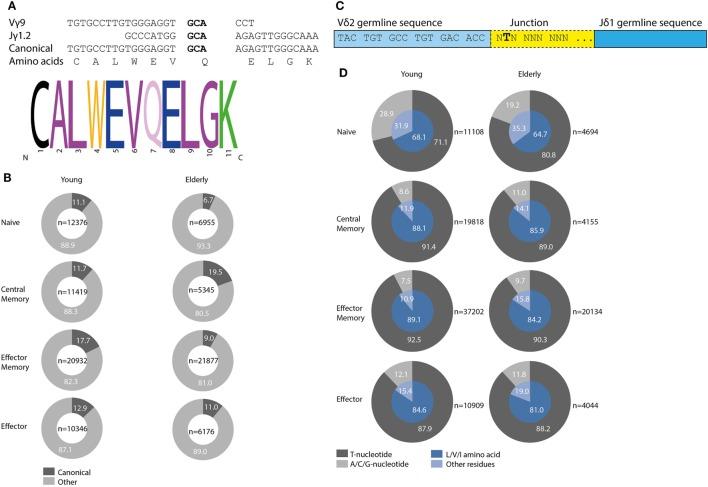
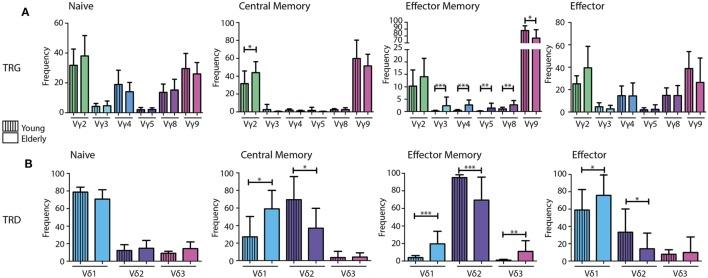
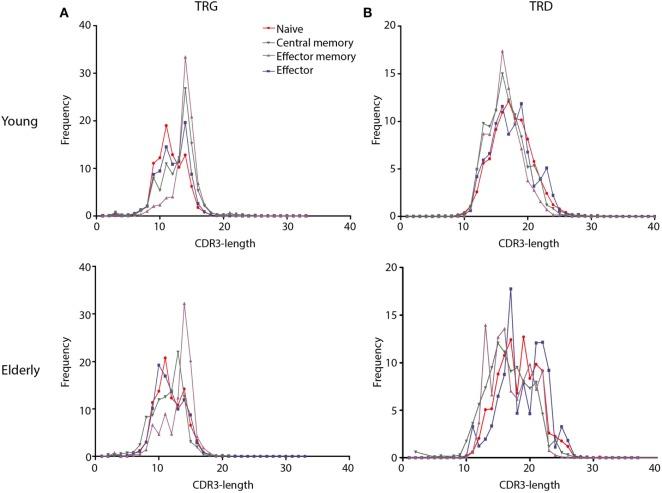
Immunological aging remodels the immune system at several levels. This has been documented in particular for the T-cell receptor (TCR)αβ+ T-cell compartment, showing reduced naive T-cell outputs and an accumulation of terminally differentiated clonally expanding effector T-cells, leading to increased proneness to autoimmunity and cancer development at older age. Even though TCRαβ+ and TCRγδ+ T-cells follow similar paths of development involving V(D)J-recombination of TCR genes in the thymus, TCRγδ+ T-cells tend to be more subjected to peripheral rather than central selection. However, the impact of aging in shaping of the peripheral TRG/TRD repertoire remains largely elusive. Next-generation sequencing analysis methods were optimized based on a spike-in method using plasmid vector DNA-samples for accurate TRG/TRD receptor diversity quantification, resulting in optimally defined primer concentrations, annealing temperatures and cycle numbers. Next, TRG/TRD repertoire diversity was evaluated during TCRγδ+ T-cell ontogeny, showing a broad, diverse repertoire in thymic and cord blood samples with Gaussian CDR3-length distributions, in contrast to the more skewed repertoire in mature circulating TCRγδ+ T-cells in adult peripheral blood. During aging the naive repertoire maintained its diversity with Gaussian CDR3-length distributions, while in the central and effector memory populations a clear shift from young (Vγ9/Vδ2 dominance) to elderly (Vγ2/Vδ1 dominance) was observed. Together with less clear Gaussian CDR3-length distributions, this would be highly suggestive of differentially heavily selected repertoires. Despite the apparent age-related shift from Vγ9/Vδ2 to Vγ2/Vδ1, no clear aging effect was observed on the Vδ2 invariant T nucleotide and canonical Vγ9-Jγ1.2 selection determinants. A more detailed look into the healthy TRG/TRD repertoire revealed known cytomegalovirus-specific TRG/TRD clonotypes in a few donors, albeit without a significant aging-effect, while -specific clonotypes were absent. Notably, in effector subsets of elderly individuals, we could identify reported TRG and TRD receptor chains from TCRγδ+ T-cell large granular lymphocyte leukemia proliferations, which typically present in the elderly population. Collectively, our results point to relatively subtle age-related changes in the human TRG/TRD repertoire, with a clear shift in Vγ/Vδ usage in memory cells upon aging.
免疫衰老在多个层面重塑免疫系统。这在 T 细胞受体 (TCR)αβ+ T 细胞群中得到了特别的证明,表现为幼稚 T 细胞输出减少和终末分化的克隆扩增效应 T 细胞积累,导致老年时自身免疫和癌症发展的易感性增加。尽管 TCRαβ+ 和 TCRγδ+ T 细胞遵循类似的发育途径,包括在胸腺中 TCR 基因的 V(D)J 重组,但 TCRγδ+ T 细胞往往更容易受到外周而不是中枢选择的影响。然而,衰老对塑造外周 TRG/TRD 受体库的影响在很大程度上仍难以捉摸。下一代测序分析方法是基于使用质粒载体 DNA 样本的 Spike-in 方法进行优化的,用于准确量化 TRG/TRD 受体多样性,从而得到最佳定义的引物浓度、退火温度和循环数。接下来,在 TCRγδ+ T 细胞发育过程中评估了 TRG/TRD 受体库的多样性,结果显示在胸腺和脐带血样本中存在广泛多样的受体库,具有高斯 CDR3 长度分布,而在成人外周血中成熟的循环 TCRγδ+ T 细胞中则存在更为偏斜的受体库。在衰老过程中,幼稚受体库保持其多样性,具有高斯 CDR3 长度分布,而在中央和效应记忆群体中,从年轻(Vγ9/Vδ2 优势)到老年(Vγ2/Vδ1 优势)的明显转变。加上不太明显的高斯 CDR3 长度分布,这将高度提示差异选择的受体库。尽管明显存在从 Vγ9/Vδ2 到 Vγ2/Vδ1 的与年龄相关的转变,但在 Vδ2 不变的 T 核苷酸和典型的 Vγ9-Jγ1.2 选择决定因素上没有观察到明显的衰老效应。对健康的 TRG/TRD 受体库进行更详细的研究发现,在少数供体中存在已知的巨细胞病毒特异性 TRG/TRD 克隆型,尽管没有明显的衰老效应,但不存在 -特异性克隆型。值得注意的是,在老年个体的效应子亚群中,我们可以从 TCRγδ+ T 细胞大颗粒淋巴细胞白血病增殖中鉴定出报道的 TRG 和 TRD 受体链,这些通常存在于老年人群中。总的来说,我们的研究结果表明,人类 TRG/TRD 受体库的年龄相关性变化相对较小,在记忆细胞中 Vγ/Vδ 的使用在衰老时发生明显转变。


 Zotero 插件