
短链脂肪酸对脂多糖或肿瘤坏死因子α诱导的内皮细胞活化的时间和浓度依赖性影响。
Time and Concentration Dependent Effects of Short Chain Fatty Acids on Lipopolysaccharide- or Tumor Necrosis Factor α-Induced Endothelial Activation.
作者信息
Li Meng, van Esch Betty C A M, Henricks Paul A J, Garssen Johan, Folkerts Gert
机构信息
Division of Pharmacology, Utrecht Institute for Pharmaceutical Sciences, Faculty of Science, Utrecht University, Utrecht, Netherlands.
Immunology, Nutricia Research, Utrecht, Netherlands.
出版信息
Front Pharmacol. 2018 Mar 19;9:233. doi: 10.3389/fphar.2018.00233. eCollection 2018.
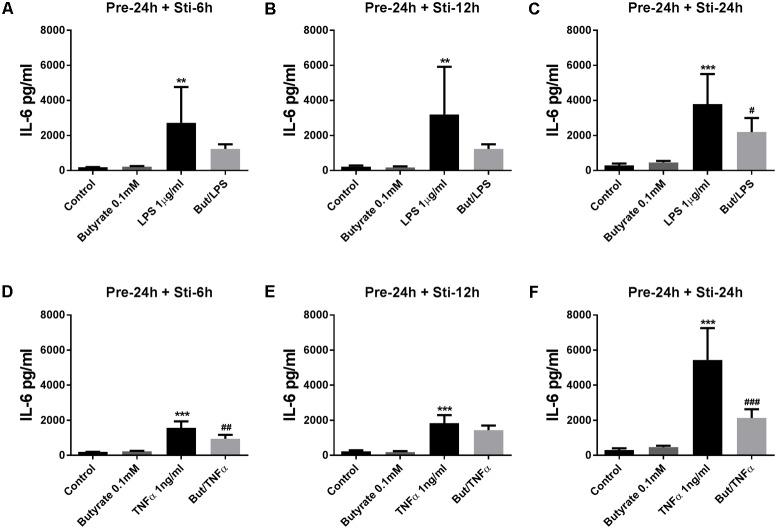
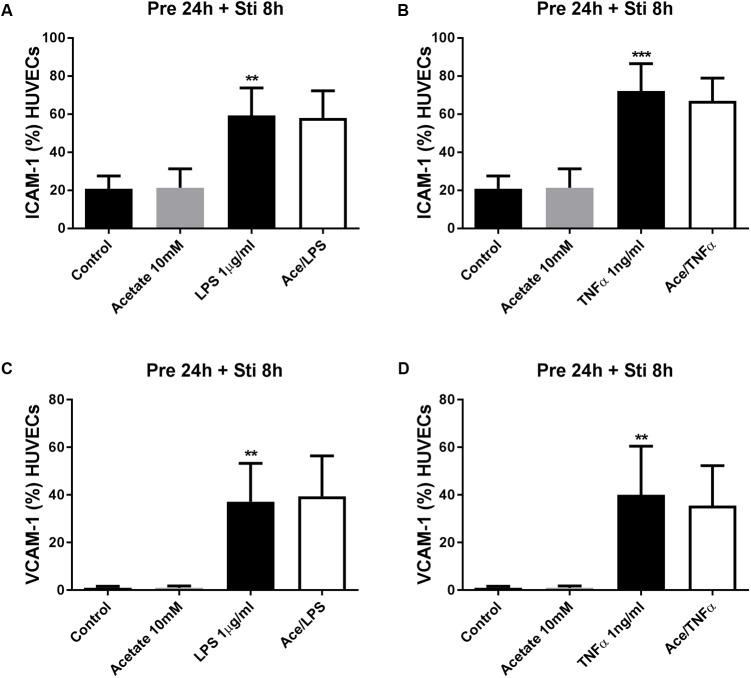
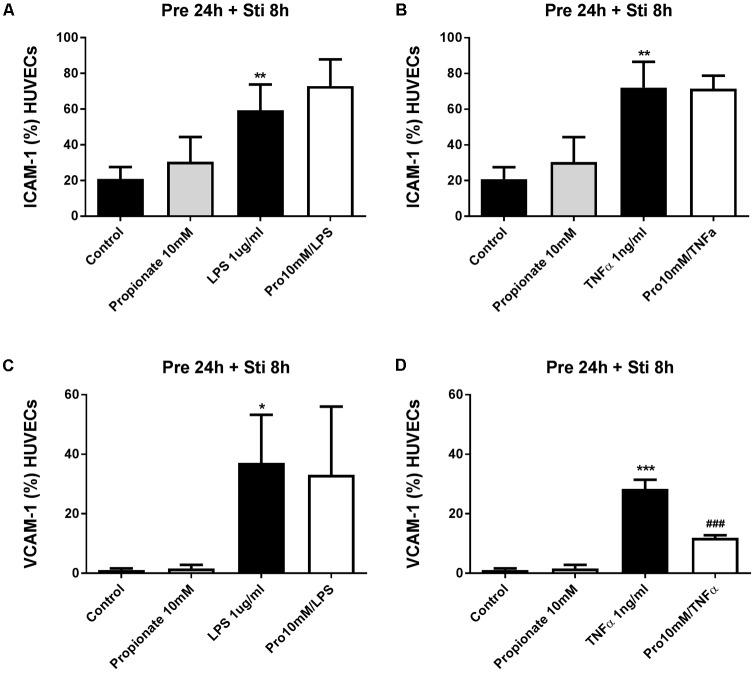
Endothelial activation is characterized by excessive production of cytokines and chemokines as well as adhesion molecules expression which is involved in the development of atherosclerosis. The aim of our study is to investigate the effects of short chain fatty acids (SCFA) on lipopolysaccharide (LPS) or tumor necrosis factor alpha (TNFα)-induced endothelial activation. Human umbilical vein endothelial cells (HUVEC) were pre-treated with acetate (10 mM), butyrate (0.1 mM) or propionate (0.3 mM) for 1, 16, or 24 h and then stimulated with LPS (1 or 10 μg/ml) or TNFα (100 pg/ml or 1 ng/ml) for 6, 12, or 24 h. Cytokines in the supernatant were measured by ELISA. HUVEC were pre-treated with acetate (10 mM), butyrate (5 mM) or propionate (10 mM) for 24 h and then stimulated with LPS (1 μg/ml) or TNFα (1 ng/ml) for 8 h. The expression of the adhesion molecules intracellular adhesion molecule-1 (ICAM-1) and vascular cell adhesion molecule-1 (VCAM-1) was detected by flow cytometry. The human blood mononuclear cell adhesive level to HUVEC monolayer was measured. LPS and TNFα induced a significant increase in the release of interleukin-6 (IL-6) and IL-8. Acetate, butyrate and propionate reduced IL-6 and IL-8 levels and the magnitude was dependent on the incubation times. LPS or TNFα increased ICAM-1 and VCAM-1 expression. Pre-incubation with acetate had no effect. In contrast, butyrate and propionate decreased VCAM-1 expression in TNFα stimulated cells but showed no effects on ICAM-1 expression. Butyrate significantly inhibited the adhesion of mononuclear cells to an endothelial monolayer and propionate was less effective. SCFA, including acetate, butyrate and propionate, influenced LPS- or TNFα-induced endothelial activation by inhibiting the production of IL-6 and IL-8, and reducing the expression of VCAM-1 and subsequent cell adhesion. Results were dependent on the concentrations and pre-incubation time of each SCFA and stimulation time of LPS or TNFα.
内皮细胞活化的特征是细胞因子、趋化因子过度产生以及参与动脉粥样硬化发展的黏附分子表达。我们研究的目的是探究短链脂肪酸(SCFA)对脂多糖(LPS)或肿瘤坏死因子α(TNFα)诱导的内皮细胞活化的影响。人脐静脉内皮细胞(HUVEC)用乙酸盐(10 mM)、丁酸盐(0.1 mM)或丙酸盐(0.3 mM)预处理1、16或24小时,然后用LPS(1或10 μg/ml)或TNFα(100 pg/ml或1 ng/ml)刺激6、12或24小时。通过酶联免疫吸附测定法(ELISA)测量上清液中的细胞因子。HUVEC用乙酸盐(10 mM)、丁酸盐(5 mM)或丙酸盐(10 mM)预处理24小时,然后用LPS(1 μg/ml)或TNFα(1 ng/ml)刺激8小时。通过流式细胞术检测黏附分子细胞间黏附分子-1(ICAM-1)和血管细胞黏附分子-(VCAM-1)的表达。测量人血单核细胞对HUVEC单层的黏附水平。LPS和TNFα显著增加白细胞介素-6(IL-6)和IL-8的释放。乙酸盐、丁酸盐和丙酸盐降低IL-6和IL-8水平,且降低幅度取决于孵育时间。LPS或TNFα增加ICAM-1和VCAM-1的表达。用乙酸盐预孵育没有效果。相反,丁酸盐和丙酸盐降低TNFα刺激细胞中VCAM-1的表达,但对ICAM-1的表达没有影响。丁酸盐显著抑制单核细胞向内皮细胞单层的黏附,丙酸盐的作用较弱。包括乙酸盐、丁酸盐和丙酸盐在内的SCFA通过抑制IL-6和IL-8的产生以及降低VCAM-1的表达和随后的细胞黏附来影响LPS或TNFα诱导的内皮细胞活化。结果取决于每种SCFA的浓度、预孵育时间以及LPS或TNFα的刺激时间。





 Zotero 插件