
了解老年人对接受远程医疗的准备情况:混合方法研究。
Understanding Older People's Readiness for Receiving Telehealth: Mixed-Method Study.
作者信息
van Houwelingen Cornelis Tm, Ettema Roelof Ga, Antonietti Michelangelo Gef, Kort Helianthe Sm
机构信息
Technology for Healthcare Innovations Research Group, Research Centre for Healthy and Sustainable Living, University of Applied Sciences Utrecht, Utrecht, Netherlands.
Clinical Health Sciences, Faculty of Medicine, University Medical Center Utrecht, Utrecht, Netherlands.
出版信息
J Med Internet Res. 2018 Apr 6;20(4):e123. doi: 10.2196/jmir.8407.
BACKGROUND
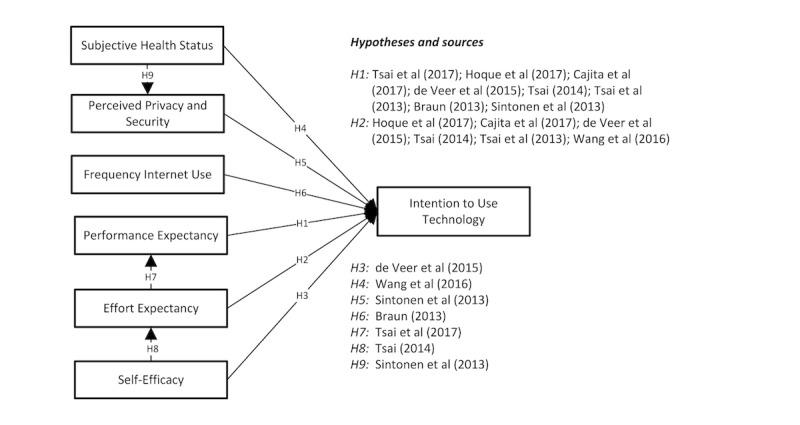
The Dutch Ministry of Health has formulated ambitious goals concerning the use of telehealth, leading to subsequent changes compared with the current health care situation, in which 93% of care is delivered face-to-face. Since most care is delivered to older people, the prospect of telehealth raises the question of whether this population is ready for this new way of receiving care. To study this, we created a theoretical framework consisting of 6 factors associated with older people's intention to use technology.
OBJECTIVE
The objective of this study was to understand community-dwelling older people's readiness for receiving telehealth by studying their intention to use videoconferencing and capacities for using digital technology in daily life as indicators.
METHODS
A mixed-method triangulation design was used. First, a cross-sectional survey study was performed to investigate older people's intention to use videoconferencing, by testing our theoretical framework with a multilevel path analysis (phase 1). Second, for deeper understanding of older people's actual use of digital technology, qualitative observations of older people executing technological tasks (eg, on a computer, cell phone) were conducted at their homes (phase 2).
RESULTS
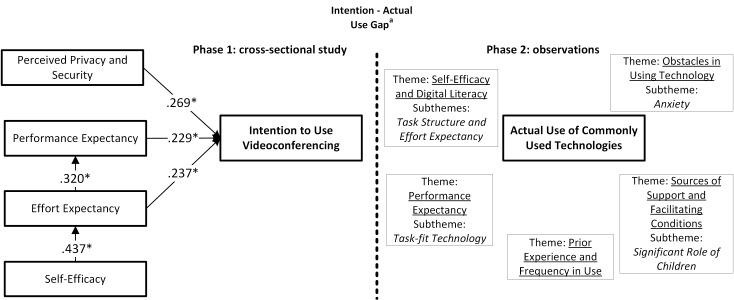
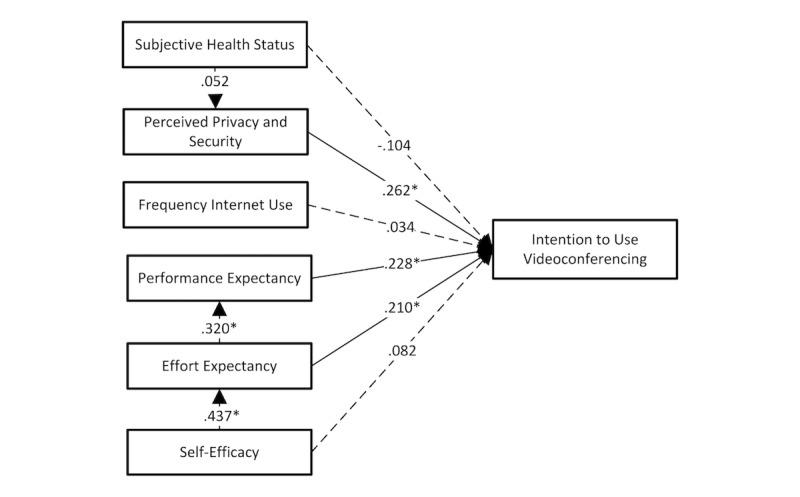
In phase 1, a total of 256 people aged 65 years or older participated in the survey study (50.0% male; median age, 70 years; Q1-Q3: 67-76). Using a significance level of .05, we found seven significant associations regarding older people's perception of videoconferencing. Older people's (1) intention to use videoconferencing was predicted by their performance expectancy (odds ratio [OR] 1.26, 95% CI 1.13-1.39), effort expectancy (OR 1.23, 95% CI 1.07-1.39), and perceived privacy and security (OR 1.30, 95% CI 1.17-1.43); (2) their performance expectancy was predicted by their effort expectancy (OR 1.38, 95% CI 1.24-1.52); and (3) their effort expectancy was predicted by their self-efficacy (OR 1.55, 95% CI 1.42-1.68). In phase 2, a total of 6 men and 9 women aged between 65 and 87 years participated in the qualitative observation study. Of the primary themes, 5 themes were identified that could provide greater understanding of older people's capacities and incapacities in using digital technology: (1) "self-efficacy and digital literacy," (2) "obstacles to using technology," (3) "prior experience and frequency of use," (4) "sources of support and facilitating conditions," and (5) "performance expectancy." These 5 themes recurred in all 15 observations.
CONCLUSIONS
Performance expectancy, effort expectancy, and perceived privacy and security are direct predictors of older people's intention to use videoconferencing. Self-efficacy appeared to play a role in both older people's intention to use, as well as their actual use of technology. The path analysis revealed that self-efficacy was significantly associated with older people's effort expectancy. Furthermore, self-efficacy and digital literacy appeared to play a major role in older people's capacities to make use of digital technology.
背景
荷兰卫生部制定了有关远程医疗使用的宏伟目标,与目前93%的医疗服务为面对面提供的医疗保健状况相比,这将带来后续变化。由于大多数医疗服务是提供给老年人的,远程医疗的前景引发了这样一个问题,即这一人群是否准备好接受这种新的医疗方式。为了研究这一问题,我们创建了一个由与老年人使用技术意愿相关的6个因素组成的理论框架。
目的
本研究的目的是通过将社区居住老年人使用视频会议的意愿和日常生活中使用数字技术的能力作为指标进行研究,来了解他们接受远程医疗的准备情况。
方法
采用混合方法三角测量设计。首先,进行了一项横断面调查研究,通过多级路径分析对我们的理论框架进行测试,以调查老年人使用视频会议的意愿(第1阶段)。其次,为了更深入地了解老年人对数字技术的实际使用情况,在老年人家里对他们执行技术任务(如在电脑、手机上)的情况进行了定性观察(第2阶段)。
结果
在第1阶段,共有256名65岁及以上的老年人参与了调查研究(男性占50.0%;年龄中位数为70岁;四分位距:67 - 76岁)。使用0.05的显著性水平,我们发现了7个与老年人对视频会议的认知有关的显著关联。老年人(1)使用视频会议的意愿由其绩效期望(优势比[OR]1.26,95%置信区间1.13 - 1.39)、努力期望(OR 1.23,95%置信区间1.07 - 1.39)以及感知隐私和安全性(OR 1.30,95%置信区间1.17 - 1.43)预测;(2)其绩效期望由努力期望预测(OR 1.38,95%置信区间1.24 - 1.52);(3)其努力期望由自我效能预测(OR 1.55,95%置信区间1.42 - 1.68)。在第2阶段,共有6名男性和9名年龄在65至87岁之间的女性参与了定性观察研究。在主要主题中,确定了5个主题,这些主题可以更深入地了解老年人在使用数字技术方面的能力和不足:(1)“自我效能和数字素养”,(2)“使用技术的障碍”,(3)“先前经验和使用频率”,(4)“支持来源和促进条件”,以及(5)“绩效期望”。这5个主题在所有15次观察中都有出现。
结论
绩效期望、努力期望以及感知隐私和安全性是老年人使用视频会议意愿的直接预测因素。自我效能似乎在老年人使用技术的意愿以及实际使用中都发挥了作用。路径分析表明,自我效能与老年人的努力期望显著相关。此外,自我效能和数字素养似乎在老年人使用数字技术的能力方面发挥了主要作用。
 Zotero 插件