
PAM:用于成像、单分子和荧光群体数据综合分析的框架。
PAM: A Framework for Integrated Analysis of Imaging, Single-Molecule, and Ensemble Fluorescence Data.
机构信息
Department of Physical Chemistry, Center for Integrated Protein Science Munich (CIPSM), Nanosystems Initiative Munich (NIM) and Center for Nanoscience (CeNS), Ludwig-Maximilians-Universität, Munich, Germany.
Dynamic Bioimaging Lab, Biomedical Research Institute (BIOMED), Advanced Optical Microscopy Centre, Faculty of Medicine and Life Sciences, Hasselt University, Diepenbeek, Belgium; Laboratory for Photochemistry and Spectroscopy, Molecular Imaging and Photonics Division, KU Leuven, Heverlee, Belgium.
出版信息
Biophys J. 2018 Apr 10;114(7):1518-1528. doi: 10.1016/j.bpj.2018.02.035.
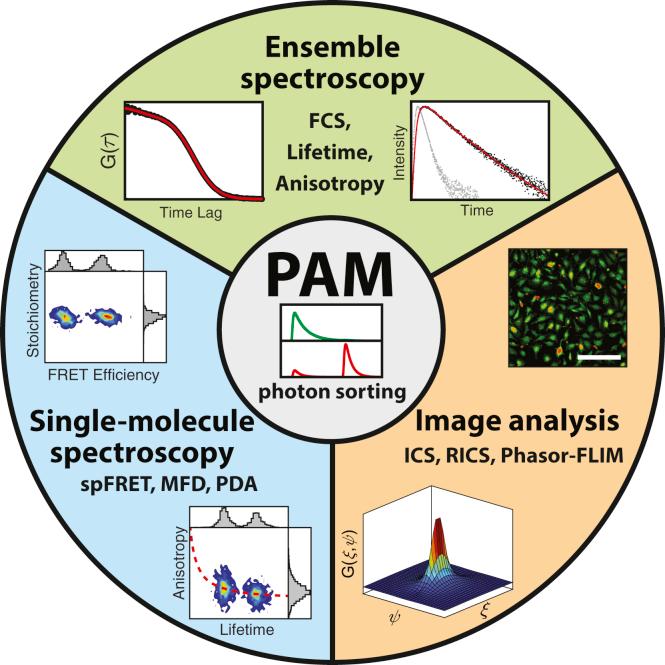
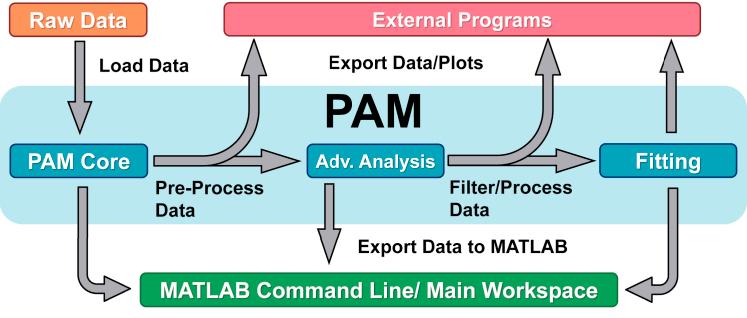
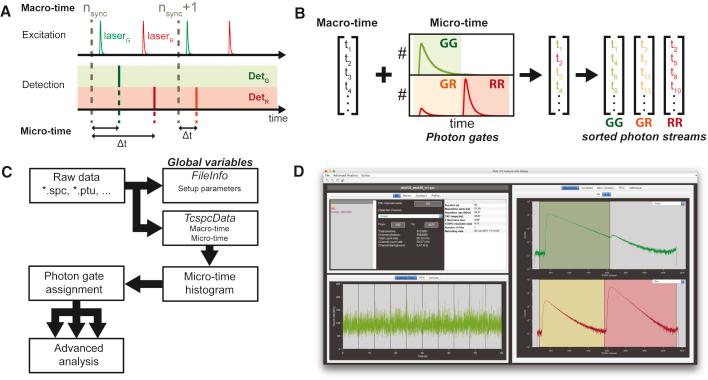
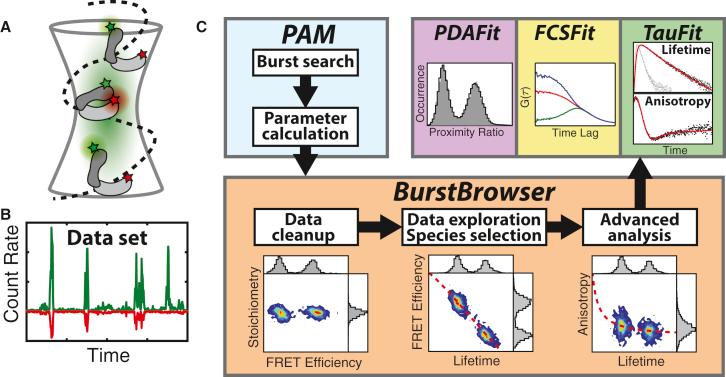
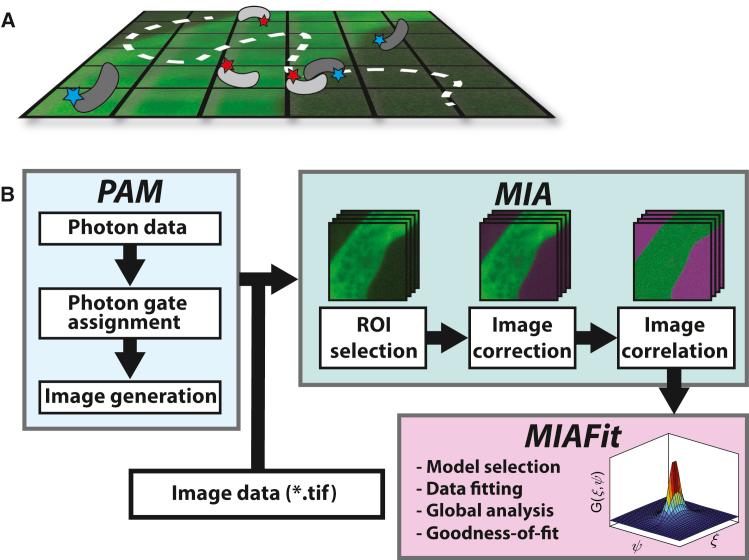
Fluorescence microscopy and spectroscopy data hold a wealth of information on the investigated molecules, structures, or organisms. Nowadays, the same fluorescence data set can be analyzed in many ways to extract different properties of the measured sample. Yet, doing so remains slow and cumbersome, often requiring incompatible software packages. Here, we present PAM (pulsed interleaved excitation analysis with MATLAB), an open-source software package written in MATLAB that offers a simple and efficient workflow through its graphical user interface. PAM is a framework for integrated and robust analysis of fluorescence ensemble, single-molecule, and imaging data. Although it was originally developed for the analysis of pulsed interleaved excitation experiments, PAM has since been extended to support most types of data collection modalities. It combines a multitude of powerful analysis algorithms, ranging from time- and space-correlation analysis, over single-molecule burst analysis, to lifetime imaging microscopy, while offering intrinsic support for multicolor experiments. We illustrate the key concepts and workflow of the software by discussing data handling and sorting and provide step-by-step descriptions for the individual usage cases.
荧光显微镜和光谱学数据包含了有关所研究分子、结构或生物体的丰富信息。如今,同一个荧光数据集可以通过多种方式进行分析,以提取被测样品的不同特性。然而,这样做仍然很慢且繁琐,通常需要不兼容的软件包。在这里,我们介绍 PAM(用 MATLAB 进行的脉冲交错激发分析),这是一个用 MATLAB 编写的开源软件包,通过其图形用户界面提供了简单而高效的工作流程。PAM 是一个集成和稳健的荧光整体、单分子和成像数据分析框架。尽管它最初是为分析脉冲交错激发实验而开发的,但 PAM 此后已扩展到支持大多数类型的数据采集模式。它结合了许多强大的分析算法,从时间和空间相关分析,到单分子爆发分析,再到寿命成像显微镜,同时为多色实验提供内在支持。我们通过讨论数据处理和排序来阐明软件的关键概念和工作流程,并为各个用例提供逐步描述。


 Zotero 插件