
一种使用吲哚菁绿标记的血小板内皮细胞黏附分子抗体检测小鼠口腔癌的实时近红外荧光成像方法。
A Real-Time Near-Infrared Fluorescence Imaging Method for the Detection of Oral Cancers in Mice Using an Indocyanine Green-Labeled Podoplanin Antibody.
作者信息
Ito Akihiro, Ohta Mitsuhiko, Kato Yukinari, Inada Shunko, Kato Toshio, Nakata Susumu, Yatabe Yasushi, Goto Mitsuo, Kaneda Norio, Kurita Kenichi, Nakanishi Hayao, Yoshida Kenji
机构信息
1 Graduate School of Pharmaceutical Sciences, Meijo University, Nagoya, Japan.
2 Department of Pathology and Molecular Diagnostics, Aichi Cancer Center Central Hospital, Nagoya, Japan.
出版信息
Technol Cancer Res Treat. 2018 Jan 1;17:1533033818767936. doi: 10.1177/1533033818767936.
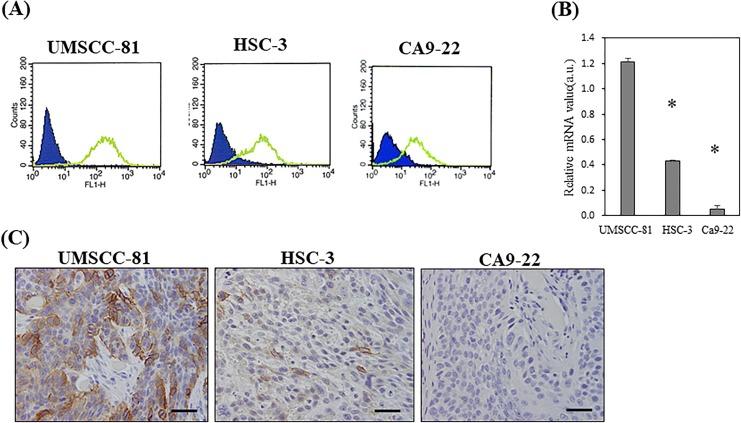
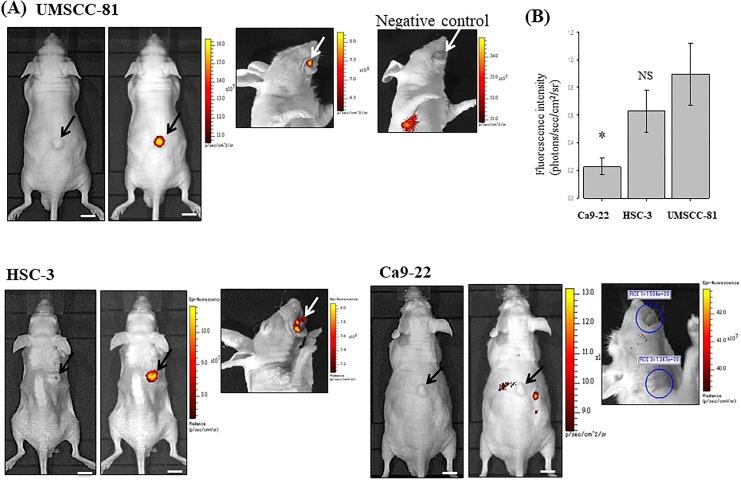
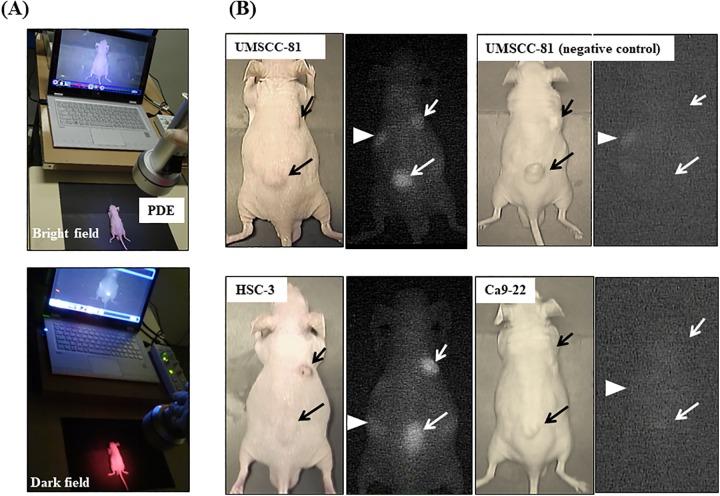
Podoplanin is distinctively overexpressed in oral squamous cell carcinoma than oral benign neoplasms and plays a crucial role in the pathogenesis and metastasis of oral squamous cell carcinoma but its diagnostic application is quite limited. Here, we report a new near-infrared fluorescence imaging method using an indocyanine green (ICG)-labeled anti-podoplanin antibody and a desktop/a handheld ICG detection device for the visualization of oral squamous cell carcinoma-xenografted tumors in nude mice. Both near-infrared imaging methods using a desktop (in vivo imaging system: IVIS) and a handheld device (photodynamic eye: PDE) successfully detected oral squamous cell carcinoma tumors in nude mice in a podoplanin expression-dependent manner with comparable sensitivity. Of these 2 devices, only near-infrared imaging methods using a handheld device visualized oral squamous cell carcinoma xenografts in mice in real time. Furthermore, near-infrared imaging methods using the handheld device (PDE) could detect smaller podoplanin-positive oral squamous cell carcinoma tumors than a non-near-infrared, autofluorescence-based imaging method. Based on these results, a near-infrared imaging method using an ICG-labeled anti-podoplanin antibody and a handheld detection device (PDE) allows the sensitive, semiquantitative, and real-time imaging of oral squamous cell carcinoma tumors and therefore represents a useful tool for the detection and subsequent monitoring of malignant oral neoplasms in both preclinical and some clinical settings.
与口腔良性肿瘤相比,血小板源性生长因子受体配体(Podoplanin)在口腔鳞状细胞癌中明显过表达,并且在口腔鳞状细胞癌的发病机制和转移过程中发挥关键作用,但其诊断应用相当有限。在此,我们报告一种新的近红外荧光成像方法,该方法使用吲哚菁绿(ICG)标记的抗血小板源性生长因子受体配体(Podoplanin)抗体和台式/手持式ICG检测设备,用于可视化裸鼠体内移植的口腔鳞状细胞癌肿瘤。使用台式设备(体内成像系统:IVIS)和手持式设备(光动力眼:PDE)的两种近红外成像方法均以血小板源性生长因子受体配体(Podoplanin)表达依赖的方式成功检测到裸鼠体内的口腔鳞状细胞癌肿瘤,且灵敏度相当。在这两种设备中,只有使用手持式设备的近红外成像方法能够实时可视化小鼠体内移植的口腔鳞状细胞癌。此外,与基于非近红外自发荧光的成像方法相比,使用手持式设备(PDE)的近红外成像方法能够检测到更小的血小板源性生长因子受体配体(Podoplanin)阳性口腔鳞状细胞癌肿瘤。基于这些结果,使用ICG标记的抗血小板源性生长因子受体配体(Podoplanin)抗体和手持式检测设备(PDE)的近红外成像方法能够对口腔鳞状细胞癌肿瘤进行灵敏、半定量和实时成像,因此是在临床前和某些临床环境中检测及后续监测口腔恶性肿瘤的有用工具。



 Zotero 插件