
发育过程中铅暴露对大脑的性别依赖性影响。
Sex-Dependent Effects of Developmental Lead Exposure on the Brain.
作者信息
Singh Garima, Singh Vikrant, Sobolewski Marissa, Cory-Slechta Deborah A, Schneider Jay S
机构信息
Department of Pathology, Anatomy and Cell Biology, Thomas Jefferson University, Philadelphia, PA, United States.
Department of Environmental Medicine, University of Rochester Medical Center, Rochester, NY, United States.
出版信息
Front Genet. 2018 Mar 16;9:89. doi: 10.3389/fgene.2018.00089. eCollection 2018.
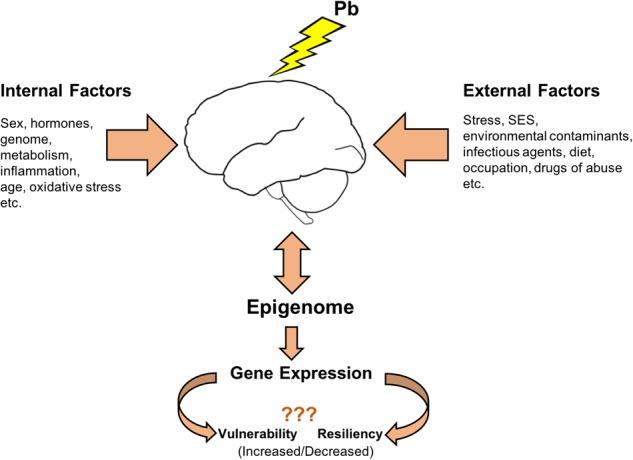
The role of sex as an effect modifier of developmental lead (Pb) exposure has until recently received little attention. Lead exposure in early life can affect brain development with persisting influences on cognitive and behavioral functioning, as well as, elevated risks for developing a variety of diseases and disorders in later life. Although both sexes are affected by Pb exposure, the incidence, manifestation, and severity of outcomes appears to differ in males and females. Results from epidemiologic and animal studies indicate significant effect modification by sex, however, the results are not consistent across studies. Unfortunately, only a limited number of human epidemiological studies have included both sexes in independent outcome analyses limiting our ability to draw definitive conclusions regarding sex-differentiated outcomes. Additionally, due to various methodological differences across studies, there is still not a good mechanistic understanding of the molecular effects of lead on the brain and the factors that influence differential responses to Pb based on sex. In this review, focused on prenatal and postnatal Pb exposures in humans and animal models, we discuss current literature supporting sex differences in outcomes in response to Pb exposure and explore some of the ideas regarding potential molecular mechanisms that may contribute to sex-related differences in outcomes from developmental Pb exposure. The sex-dependent variability in outcomes from developmental Pb exposure may arise from a combination of complex factors, including, but not limited to, intrinsic sex-specific molecular/genetic mechanisms and external risk factors including sex-specific responses to environmental stressors which may act through shared epigenetic pathways to influence the genome and behavioral output.
性别作为发育性铅(Pb)暴露的效应修饰因素,直到最近才受到较少关注。早年铅暴露会影响大脑发育,对认知和行为功能产生持续影响,还会增加晚年患多种疾病和病症的风险。虽然两性都会受到铅暴露的影响,但结果的发生率、表现和严重程度在男性和女性中似乎有所不同。流行病学和动物研究结果表明性别有显著的效应修饰作用,然而,各研究结果并不一致。不幸的是,只有有限数量的人类流行病学研究在独立结果分析中纳入了两性,这限制了我们就性别差异结果得出明确结论的能力。此外,由于各研究存在各种方法学差异,对于铅对大脑的分子效应以及基于性别的铅差异反应影响因素,仍缺乏良好的机制理解。在本综述中,聚焦于人类和动物模型中的产前和产后铅暴露,我们讨论了支持铅暴露结果存在性别差异的当前文献,并探讨了一些关于潜在分子机制的观点,这些机制可能导致发育性铅暴露结果中的性别相关差异。发育性铅暴露结果的性别依赖性变异性可能源于多种复杂因素的组合,包括但不限于内在的性别特异性分子/遗传机制和外部风险因素,包括对环境应激源的性别特异性反应,这些反应可能通过共同的表观遗传途径影响基因组和行为输出。

 Zotero 插件