
细胞代谢和氧化应激作为小型犬和大型犬长寿的一个可能决定因素。
Cellular metabolism and oxidative stress as a possible determinant for longevity in small breed and large breed dogs.
机构信息
Colgate University, Department of Biology, Hamilton, New York, United States of America.
Colgate University, Department of Mathematics, Hamilton, New York, United States of America.
出版信息
PLoS One. 2018 Apr 25;13(4):e0195832. doi: 10.1371/journal.pone.0195832. eCollection 2018.
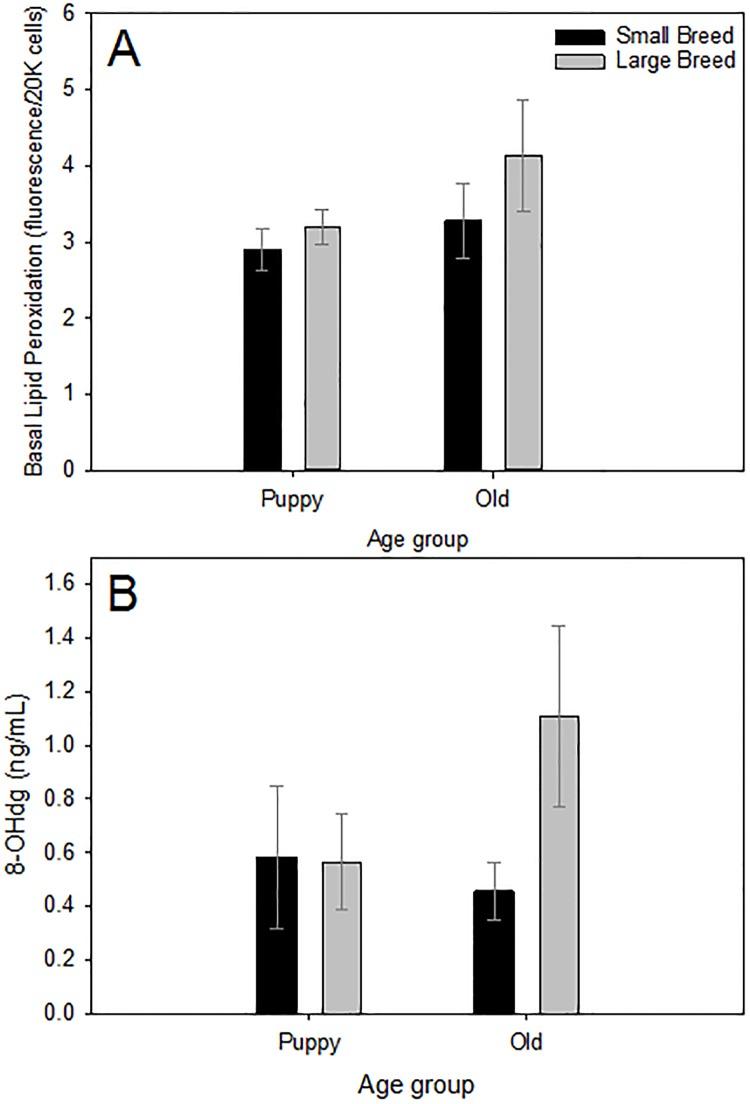
Among species, larger animals tend to live longer than smaller ones, however, the opposite seems to be true for dogs-smaller dogs tend to live significantly longer than larger dogs across all breeds. We were interested in the mechanism that may allow for small breeds to age more slowly compared with large breeds in the context of cellular metabolism and oxidative stress. Primary dermal fibroblasts from small and large breed dogs were grown in culture. We measured basal oxygen consumption (OCR), proton leak, and glycolysis using a Seahorse XF96 oxygen flux analyzer. Additionally, we measured rates of reactive species (RS) production, reduced glutathione (GSH) content, mitochondrial content, lipid peroxidation (LPO) damage and DNA (8-OHdg) damage. Our data suggests that as dogs of both size classes age, proton leak is significantly higher in older dogs, regardless of size class. We found that all aspects of glycolysis were significantly higher in larger breeds compared with smaller breeds. We found significant differences between age classes in GSH concentration, and a negative correlation between DNA damage in puppies and mean breed lifespan. Interestingly, RS production showed no differences across size and age class. Thus, large breed dogs may have higher glycolytic rates, and DNA damage, suggesting a potential mechanism for their decreased lifespan compared with small breed dogs.
在不同物种中,体型较大的动物往往比体型较小的动物寿命更长,然而,在狗身上似乎正好相反——所有品种的小型犬的寿命都明显长于大型犬。我们对可能导致小型犬在细胞代谢和氧化应激方面比大型犬衰老速度更慢的机制很感兴趣。从小型犬和大型犬身上采集原代真皮成纤维细胞进行培养。我们使用 Seahorse XF96 氧气通量分析仪测量基础耗氧量 (OCR)、质子漏和糖酵解。此外,我们还测量了活性物质 (RS) 产生、还原型谷胱甘肽 (GSH) 含量、线粒体含量、脂质过氧化 (LPO) 损伤和 DNA (8-OHdg) 损伤的速率。我们的数据表明,随着体型大小不同的犬龄增长,质子漏在老年犬中显著增加,而与体型大小无关。我们发现,与小型犬相比,大型犬的糖酵解各方面都显著更高。我们发现 GSH 浓度在年龄组之间存在显著差异,幼犬的 DNA 损伤与平均品种寿命呈负相关。有趣的是,RS 产生在体型和年龄组之间没有差异。因此,大型犬的糖酵解率和 DNA 损伤可能更高,这表明与小型犬相比,它们的寿命缩短可能存在潜在机制。


 Zotero 插件