
在再生障碍性贫血中,缺乏 HLA 的造血干细胞通过无驱动突变实现持续的克隆性造血。
Sustained clonal hematopoiesis by HLA-lacking hematopoietic stem cells without driver mutations in aplastic anemia.
机构信息
Department of Hematology and.
Department of Clinical Laboratory Sciences, Graduate School of Medical Sciences, and.
出版信息
Blood Adv. 2018 May 8;2(9):1000-1012. doi: 10.1182/bloodadvances.2017013953.
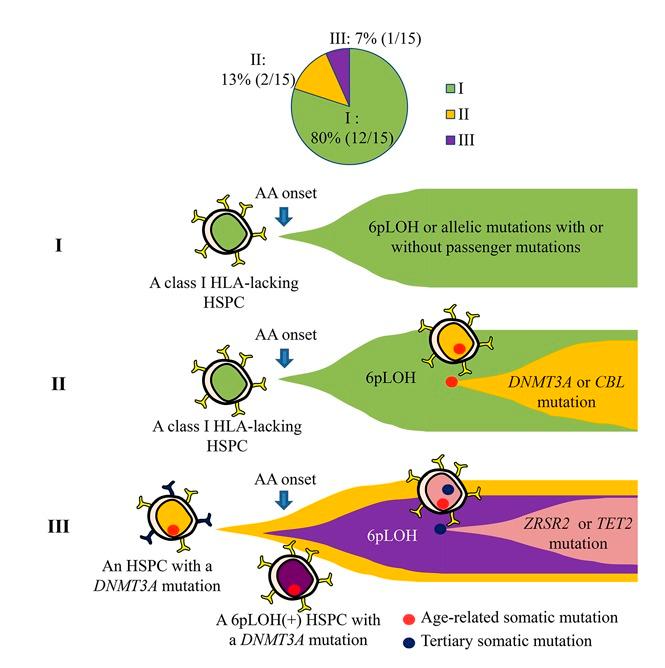
Clonal hematopoiesis by hematopoietic stem progenitor cells (HSPCs) that lack an HLA class I allele (HLA HSPCs) is common in patients with acquired aplastic anemia (AA); however, it remains unknown whether the cytotoxic T lymphocyte (CTL) attack that allows for survival of HLA HSPCs is directed at nonmutated HSPCs or HSPCs with somatic mutations or how escaped HLA HSPC clones support sustained hematopoiesis. We investigated the presence of somatic mutations in HLA granulocytes obtained from 15 AA patients in long-term remission (median, 13 years; range, 2-30 years). Targeted sequencing of HLA granulocytes revealed somatic mutations (, n = 2; , , and , n = 1) in 3 elderly patients between 79 and 92 years of age, but not in 12 other patients aged 27 to 74 years (median, 51.5 years). The chronological and clonogenic analyses of the 3 cases revealed that mutation in 1 case, which occurred in an HLA HSPC with a mutation, was the only mutation associated with expansion of the HSPC clone. Whole-exome sequencing of the sorted HLA granulocytes confirmed the absence of any driver mutations in 5 patients who had a particularly large loss of heterozygosity in chromosome 6p (6pLOH) clone size. Flow-fluorescence in situ hybridization analyses of sorted HLA and HLA granulocytes showed no telomere attrition in HLA granulocytes. The findings suggest that HLA HSPC clones that escape CTL attack are essentially free from somatic mutations related to myeloid malignancies and are able to support long-term clonal hematopoiesis without developing driver mutations in AA patients unless HLA loss occurs in HSPCs with somatic mutations.
造血干细胞祖细胞(HSPCs)缺乏 HLA Ⅰ类等位基因(HLA HSPCs)的克隆性造血在获得性再生障碍性贫血(AA)患者中很常见;然而,尚不清楚允许 HLA HSPCs 存活的细胞毒性 T 淋巴细胞(CTL)攻击是针对未突变的 HSPCs 还是具有体细胞突变的 HSPCs,以及逃避的 HLA HSPC 克隆如何支持持续的造血。我们研究了来自 15 例长期缓解(中位时间为 13 年;范围为 2-30 年)AA 患者的 HLA 粒细胞中是否存在体细胞突变。HLA 粒细胞的靶向测序显示,3 例年龄在 79 至 92 岁的老年患者( ,n=2; , ,和 ,n=1)存在体细胞突变,但 12 例年龄在 27 至 74 岁的其他患者(中位年龄为 51.5 岁)不存在。3 例病例的时间和克隆分析显示,1 例病例中的 突变,发生在具有 突变的 HLA HSPC 中,是与 HSPC 克隆扩张相关的唯一突变。对分选的 HLA 粒细胞进行全外显子组测序,证实了 5 例患者中不存在任何驱动突变,这些患者在 6p 染色体(6pLOH)克隆大小上存在特别大的杂合性丢失。对分选的 HLA 和 HLA 粒细胞进行流式荧光原位杂交分析显示,HLA 粒细胞中不存在端粒损耗。这些发现表明,逃避 CTL 攻击的 HLA HSPC 克隆基本上没有与髓系恶性肿瘤相关的体细胞突变,并且能够在不发生驱动突变的情况下支持长期的克隆性造血,除非 HLA 丢失发生在具有体细胞突变的 HSPCs 中。
 Zotero 插件