
单细胞转录组学解析再生障碍性贫血中造血细胞破坏和 T 细胞的参与。
Single-cell transcriptomics dissects hematopoietic cell destruction and T-cell engagement in aplastic anemia.
机构信息
State Key Laboratory of Experimental Hematology, National Clinical Research Center for Blood Diseases, Institute of Hematology and Blood Diseases Hospital.
Center for Stem Cell Medicine and Department of Stem Cell & Regenerative Medicine, and.
出版信息
Blood. 2021 Jul 8;138(1):23-33. doi: 10.1182/blood.2020008966.
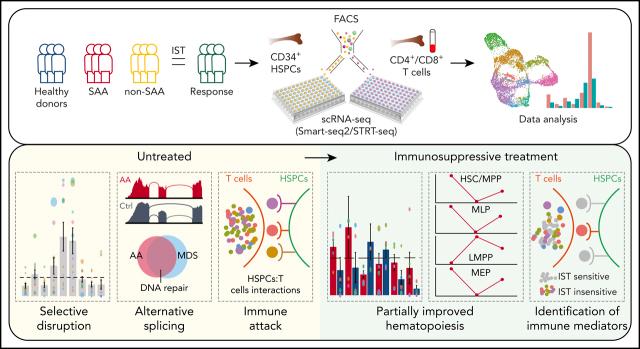
Aplastic anemia (AA) is a T cell-mediated autoimmune disorder of the hematopoietic system manifested by severe depletion of the hematopoietic stem and progenitor cells (HSPCs). Nonetheless, our understanding of the complex relationship between HSPCs and T cells is still obscure, mainly limited by techniques and the sparsity of HSPCs in the context of bone marrow failure. Here we performed single-cell transcriptome analysis of residual HSPCs and T cells to identify the molecular players from patients with AA. We observed that residual HSPCs in AA exhibited lineage-specific alterations in gene expression and transcriptional regulatory networks, indicating a selective disruption of distinct lineage-committed progenitor pools. In particular, HSPCs displayed frequently altered alternative splicing events and skewed patterns of polyadenylation in transcripts related to DNA damage and repair, suggesting a likely role in AA progression to myelodysplastic syndromes. We further identified cell type-specific ligand-receptor interactions as potential mediators for ongoing HSPCs destruction by T cells. By tracking patients after immunosuppressive therapy (IST), we showed that hematopoiesis remission was incomplete accompanied by IST insensitive interactions between HSPCs and T cells as well as sustained abnormal transcription state. These data collectively constitute the transcriptomic landscape of disrupted hematopoiesis in AA at single-cell resolution, providing new insights into the molecular interactions of engaged T cells with residual HSPCs and render novel therapeutic opportunities for AA.
再生障碍性贫血(AA)是一种由 T 细胞介导的造血系统自身免疫性疾病,表现为造血干细胞和祖细胞(HSPCs)严重耗竭。尽管如此,我们对 HSPCs 和 T 细胞之间复杂关系的理解仍然很模糊,主要受到技术和骨髓衰竭背景下 HSPCs 稀疏性的限制。在这里,我们对剩余的 HSPCs 和 T 细胞进行了单细胞转录组分析,以鉴定来自 AA 患者的分子参与者。我们观察到,AA 中残留的 HSPCs 在基因表达和转录调控网络中表现出谱系特异性改变,表明不同谱系定向祖细胞池的选择性破坏。特别是,HSPCs 显示出与 DNA 损伤和修复相关的转录物中频繁改变的选择性剪接事件和聚腺苷酸化模式的倾斜,这表明它们可能在 AA 向骨髓增生异常综合征进展中起作用。我们进一步鉴定了细胞类型特异性的配体-受体相互作用,作为 T 细胞持续破坏 HSPCs 的潜在介质。通过跟踪接受免疫抑制治疗(IST)后的患者,我们表明造血缓解不完全,伴随着 HSPCs 和 T 细胞之间的 IST 不敏感相互作用以及持续的异常转录状态。这些数据共同构成了 AA 中以单细胞分辨率破坏的造血转录组景观,为参与的 T 细胞与残留的 HSPCs 之间的分子相互作用提供了新的见解,并为 AA 提供了新的治疗机会。
 Zotero 插件