
通过点亮型聚电解质间纳米复合物对微小RNA替代疗效进行原位监测及精确成像引导的癌症治疗
In Situ Monitoring of MicroRNA Replacement Efficacy and Accurate Imaging-Guided Cancer Therapy through Light-Up Inter-Polyelectrolyte Nanocomplexes.
作者信息
Deng Xiongwei, Yin Zhaoxia, Lu Jianqing, Li Xianlei, Shao Leihou, Zhao Caiyan, Yang Yishu, Hu Qin, Wu Yan, Sheng Wang
机构信息
College of Life Science and Bioengineering Beijing University of Technology No. 100 Pingleyuan Beijing 100124 P. R. China.
National Center for Nanoscience and Technology No. 11 Beiyitiao Zhongguancun Beijing 100190 P. R. China.
出版信息
Adv Sci (Weinh). 2018 Jan 19;5(4):1700542. doi: 10.1002/advs.201700542. eCollection 2018 Apr.
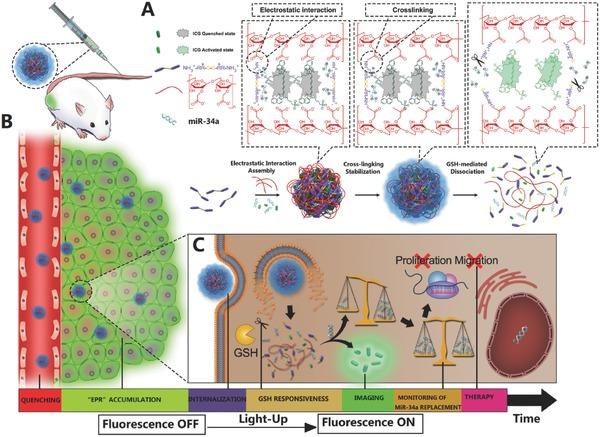
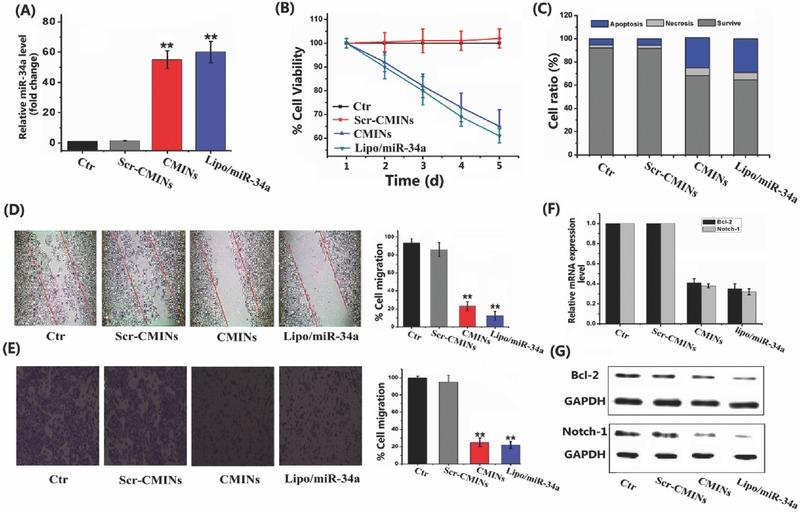
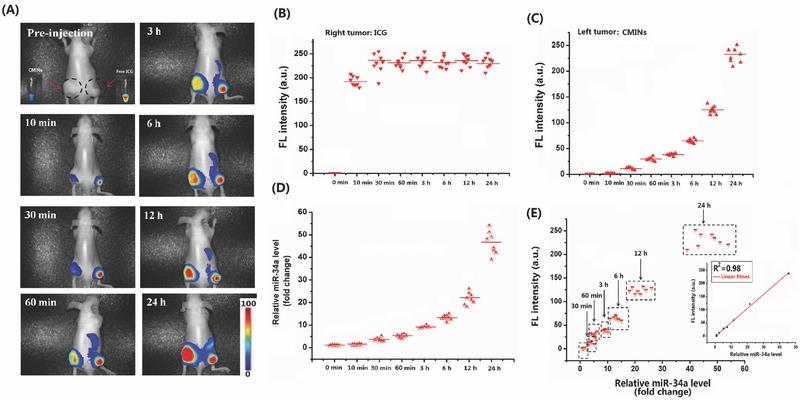
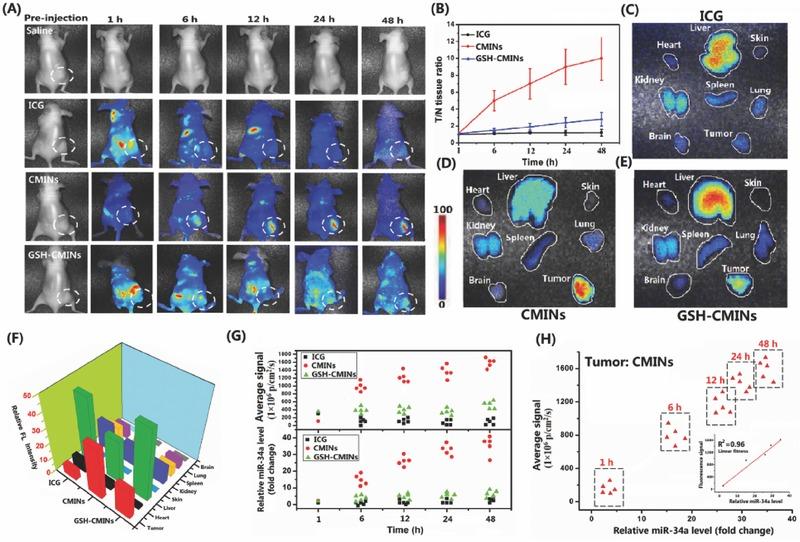
Replacement of downregulated tumor-suppressive microRNA (Ts-miRNA) is recognized as an alternative approach for tumor gene therapy. However, in situ monitoring of miRNA replacement efficacy in a real-time manner via noninvasive imaging is continually challenging. Here, glutathione (GSH)-activated light-up peptide-polysaccharide-inter-polyelectrolyte nanocomplexes are established through self-assembly of carboxymethyl dextran with disulfide-bridged ("S-S") oligoarginine peptide (S-Arg), in which microRNA-34a (miR-34a) and indocyanine green (ICG) are simultaneously embedded and the nanocomplexes are subsequently stabilized by intermolecular cross-linking. Upon confinement within the robust nanocomplexes, the near-infrared fluorescence (NIRF) of ICG is considerably quenched ("off") due to the aggregation-caused quenching effect. However, after intracellular delivery, the disulfide bond in S-Arg can be cleaved by intracellular GSH, which leads to the dissociation of nanocomplexes and triggers the simultaneous release of miR-34a and ICG. The NIRF of ICG is concomitantly activated through dequenching of the aggregated ICG. Very interestingly, a good correlation between time-dependent increase in NIRF intensity and miR-34a replacement efficacy is found in nanocomplexes-treated tumor cells and tumor tissues through either intratumoral or intravenous injections. Systemic nanocomplexes-mediated miR-34a replacement significantly suppresses the growth of HepG-2- and MDA-MB-231-derived tumor xenografts, and provides a pronounced survival benefit in these animal models.
下调的肿瘤抑制性微小RNA(Ts-miRNA)的替代被认为是肿瘤基因治疗的一种替代方法。然而,通过非侵入性成像实时原位监测miRNA替代效果仍然具有挑战性。在这里,通过羧甲基葡聚糖与二硫键桥接的(“S-S”)寡聚精氨酸肽(S-Arg)自组装建立了谷胱甘肽(GSH)激活的发光肽-多糖-聚电解质纳米复合物,其中微小RNA-34a(miR-34a)和吲哚菁绿(ICG)同时嵌入,随后通过分子间交联使纳米复合物稳定。由于聚集诱导的猝灭效应,ICG的近红外荧光(NIRF)在被包裹在坚固的纳米复合物中时会显著猝灭(“关闭”)。然而,在细胞内递送后,S-Arg中的二硫键可以被细胞内的GSH裂解,这导致纳米复合物的解离并触发miR-34a和ICG的同时释放。ICG的NIRF通过聚集的ICG的去猝灭而同时被激活。非常有趣的是,通过瘤内或静脉注射,在纳米复合物处理的肿瘤细胞和肿瘤组织中发现NIRF强度随时间的增加与miR-34a替代效果之间存在良好的相关性。全身纳米复合物介导的miR-34a替代显著抑制了HepG-2和MDA-MB-231衍生的肿瘤异种移植的生长,并在这些动物模型中提供了显著的生存益处。




 Zotero 插件