
在去势抵抗性前列腺癌模型中,赖氨酸特异性去甲基化酶1(LSD1)抑制可减弱雄激素受体V7剪接变体的激活。
LSD1 inhibition attenuates androgen receptor V7 splice variant activation in castration resistant prostate cancer models.
作者信息
Regufe da Mota Sergio, Bailey Sarah, Strivens Rosemary A, Hayden Annette L, Douglas Leon R, Duriez Patrick J, Borrello M Teresa, Benelkebir Hanae, Ganesan A, Packham Graham, Crabb Simon J
机构信息
Cancer Sciences Unit and Cancer Research UK Centre, University of Southampton, Southampton General Hospital, Somers Cancer Research Building, Mailpoint 824, Southampton, SO16 6YD UK.
Protein Core Facility, Cancer Research UK and Experimental Cancer Medicine Centres, University of Southampton, Southampton General Hospital, Southampton, SO16 6YD UK.
出版信息
Cancer Cell Int. 2018 May 9;18:71. doi: 10.1186/s12935-018-0568-1. eCollection 2018.
BACKGROUND
Castrate resistant prostate cancer (CRPC) is often driven by constitutively active forms of the androgen receptor such as the V7 splice variant (AR-V7) and commonly becomes resistant to established hormonal therapy strategies such as enzalutamide as a result. The lysine demethylase LSD1 is a co-activator of the wild type androgen receptor and a potential therapeutic target in hormone sensitive prostate cancer. We evaluated whether LSD1 could also be therapeutically targeted in CRPC models driven by AR-V7.
METHODS
We utilised cell line models of castrate resistant prostate cancer through over expression of AR-V7 to test the impact of chemical LSD1 inhibition on AR activation. We validated findings through depletion of LSD1 expression and in prostate cancer cell lines that express AR-V7.
RESULTS
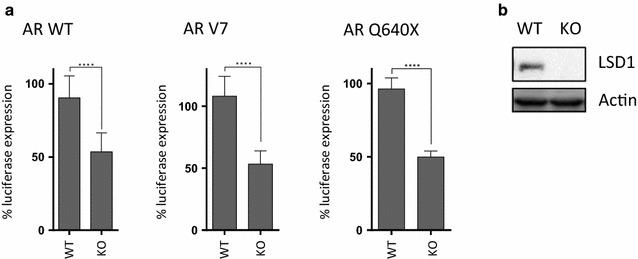
Chemical inhibition of LSD1 resulted in reduced activation of the androgen receptor through both the wild type and its AR-V7 splice variant forms. This was confirmed and validated in luciferase reporter assays, in LNCaP and 22Rv1 prostate cancer cell lines and in LSD1 depletion experiments.
CONCLUSION
LSD1 contributes to activation of both the wild type and V7 splice variant forms of the androgen receptor and can be therapeutically targeted in models of CRPC. Further development of this approach is warranted.
背景
去势抵抗性前列腺癌(CRPC)通常由雄激素受体的组成型活性形式驱动,如V7剪接变体(AR-V7),因此通常会对已确立的激素治疗策略(如恩杂鲁胺)产生耐药性。赖氨酸去甲基化酶LSD1是野生型雄激素受体的共激活因子,也是激素敏感性前列腺癌的潜在治疗靶点。我们评估了在由AR-V7驱动的CRPC模型中,LSD1是否也可作为治疗靶点。
方法
我们通过过表达AR-V7建立去势抵抗性前列腺癌细胞系模型,以测试化学抑制LSD1对AR激活的影响。我们通过敲低LSD1表达并在表达AR-V7的前列腺癌细胞系中验证了研究结果。
结果
化学抑制LSD1导致雄激素受体通过野生型及其AR-V7剪接变体形式的激活减少。这在荧光素酶报告基因检测、LNCaP和22Rv1前列腺癌细胞系以及LSD1敲低实验中得到了证实和验证。
结论
LSD1有助于雄激素受体野生型和V7剪接变体形式的激活,并且在CRPC模型中可作为治疗靶点。这种方法值得进一步开发。



 Zotero 插件