
活性氧介导的肿瘤微环境转化:耐辐射胃癌的机制。
Reactive Oxygen Species-Mediated Tumor Microenvironment Transformation: The Mechanism of Radioresistant Gastric Cancer.
机构信息
Department of Radiation and Medical Oncology, Zhongnan Hospital, Wuhan University, Wuhan, Hubei 430071, China.
Department of Clinical Oncology, First Affiliated Hospital, Medical School of Xi'an Jiaotong University, Xi'an, Shanxi 710061, China.
出版信息
Oxid Med Cell Longev. 2018 Mar 27;2018:5801209. doi: 10.1155/2018/5801209. eCollection 2018.
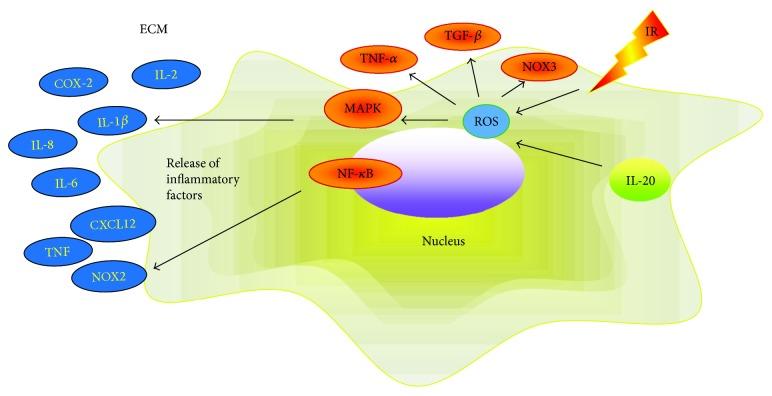
Radioresistance is one of the primary causes responsible for therapeutic failure and recurrence of cancer. It is well documented that reactive oxygen species (ROS) contribute to the initiation and development of gastric cancer (GC), and the levels of ROS are significantly increased in patients with GC accompanied with abnormal expressions of multiple inflammatory factors. It is also well documented that ROS can activate cancer cells and inflammatory cells, stimulating the release of a variety of inflammatory cytokines, which subsequently mediates the tumor microenvironment (TME) and promotes cancer stem cell (CSC) maintenance as well as renewal and epithelial-mesenchymal transition (EMT), ultimately resulting in radioresistance and recurrence of GC.
放射抗拒是导致癌症治疗失败和复发的主要原因之一。有大量文献证明,活性氧(ROS)参与了胃癌(GC)的发生和发展,并且 GC 患者体内的 ROS 水平显著升高,同时伴有多种炎症因子的异常表达。同样有大量文献证明,ROS 可以激活癌细胞和炎症细胞,刺激多种炎症细胞因子的释放,进而调节肿瘤微环境(TME),促进癌症干细胞(CSC)的维持、更新和上皮-间充质转化(EMT),最终导致 GC 的放射抗拒和复发。


 Zotero 插件