
从高通量原位电子 cryotomography 和亚断层平均中洞察细菌鞭毛马达的进化。
Insights into the evolution of bacterial flagellar motors from high-throughput in situ electron cryotomography and subtomogram averaging.
机构信息
Department of Life Sciences, Imperial College London, London SW7 2AZ, England.
出版信息
Acta Crystallogr D Struct Biol. 2018 Jun 1;74(Pt 6):585-594. doi: 10.1107/S2059798318007945.
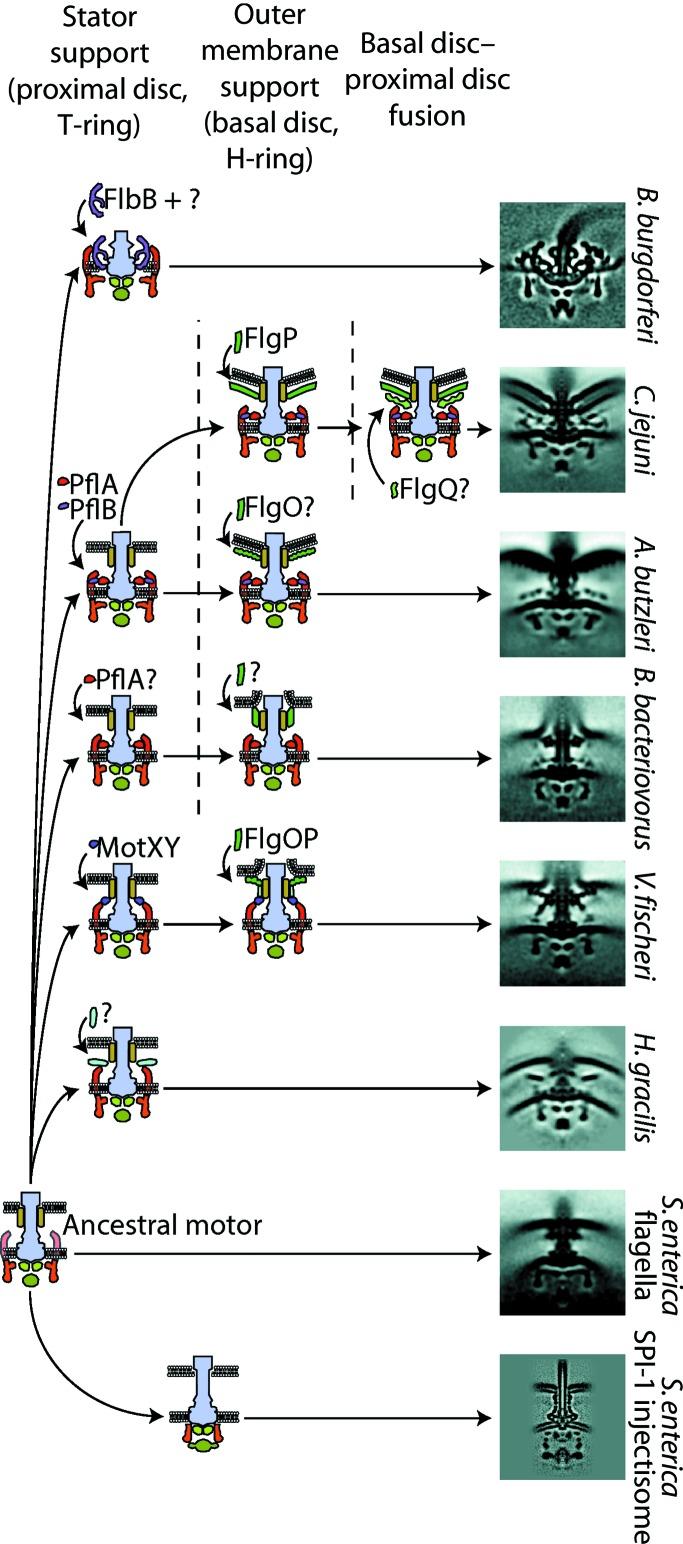
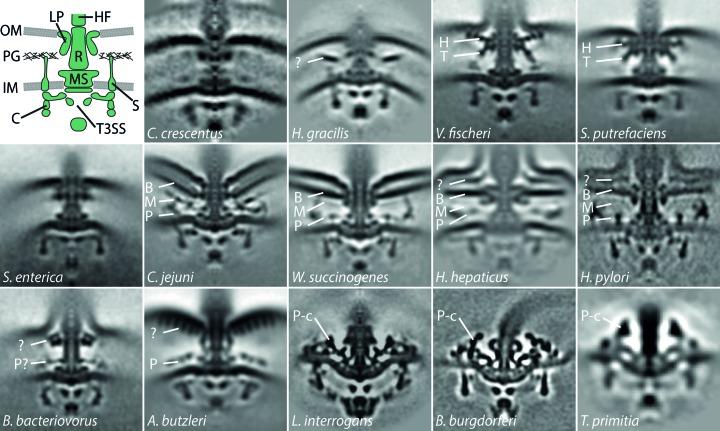
In situ structural information on molecular machines can be invaluable in understanding their assembly, mechanism and evolution. Here, the use of electron cryotomography (ECT) to obtain significant insights into how an archetypal molecular machine, the bacterial flagellar motor, functions and how it has evolved is described. Over the last decade, studies using a high-throughput, medium-resolution ECT approach combined with genetics, phylogenetic reconstruction and phenotypic analysis have revealed surprising structural diversity in flagellar motors. Variations in the size and the number of torque-generating proteins in the motor visualized for the first time using ECT has shown that these variations have enabled bacteria to adapt their swimming torque to the environment. Much of the structural diversity can be explained in terms of scaffold structures that facilitate the incorporation of additional motor proteins, and more recent studies have begun to infer evolutionary pathways to higher torque-producing motors. This review seeks to highlight how the emerging power of ECT has enabled the inference of ancestral states from various bacterial species towards understanding how, and `why', flagellar motors have evolved from an ancestral motor to a diversity of variants with adapted or modified functions.
原位结构信息对于理解分子机器的组装、机制和进化具有重要价值。本文描述了利用电子断层摄影术(ECT)深入了解典型的分子机器——细菌鞭毛马达的功能及其进化方式。在过去十年中,使用高通量、中等分辨率 ECT 方法结合遗传学、系统发育重建和表型分析的研究揭示了鞭毛马达在结构上具有惊人的多样性。ECT 首次可视化了马达中产生扭矩的蛋白质的大小和数量的变化,表明这些变化使细菌能够根据环境调整其游动扭矩。结构多样性的大部分可以用支架结构来解释,这些支架结构促进了额外的马达蛋白的掺入,最近的研究开始推断产生更高扭矩的马达的进化途径。本文综述了新兴的 ECT 技术如何从不同的细菌物种中推断出祖先状态,以了解鞭毛马达是如何以及“为什么”从一个祖先的马达进化为具有适应性或修饰功能的各种变体。



 Zotero 插件