
转化生长因子-β/磷酸化Smad信号通路在人类肝脏纤维癌发生过程中的临床病理意义
Clinico-Pathological Importance of TGF-β/Phospho-Smad Signaling during Human Hepatic Fibrocarcinogenesis.
作者信息
Yoshida Katsunori, Matsuzaki Koichi, Murata Miki, Yamaguchi Takashi, Suwa Kanehiko, Okazaki Kazuichi
机构信息
Department of Gastroenterology and Hepatology, Kansai Medical University 2-5-1, Shin-Machi, Hirakata, Osaka 573-1010, Japan.
出版信息
Cancers (Basel). 2018 Jun 5;10(6):183. doi: 10.3390/cancers10060183.
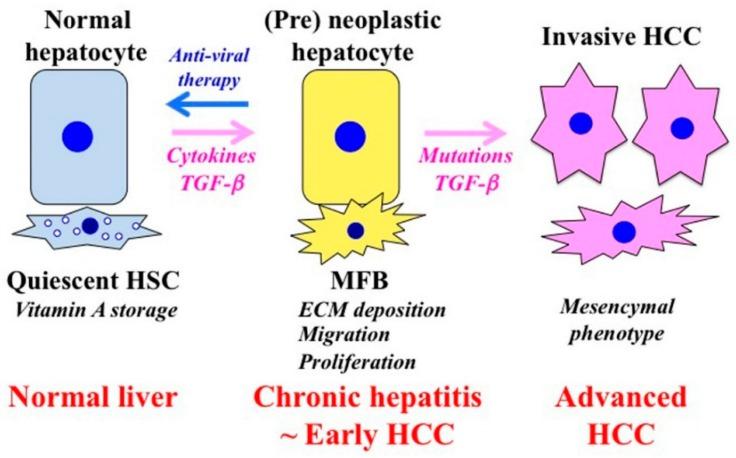
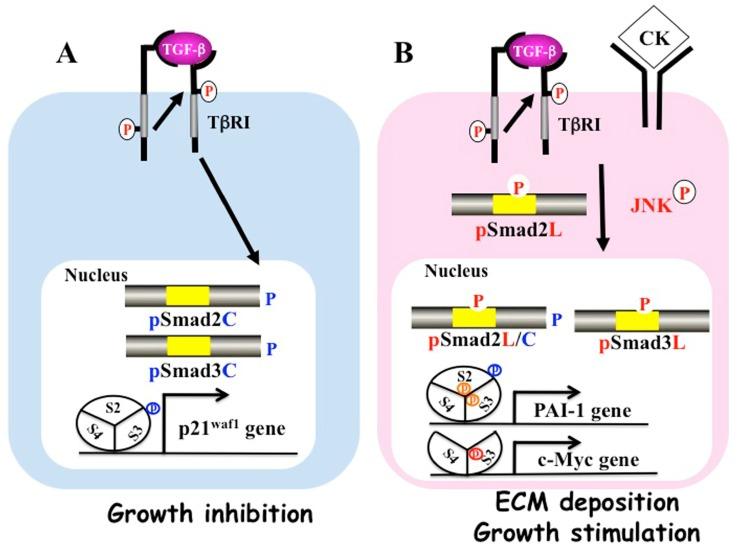
Chronic viral hepatitis is a global public health problem, with approximately 570 million persons chronically infected. Hepatitis B and C viruses increase the risk of morbidity and mortality from liver cirrhosis, hepatocellular carcinoma (HCC), and extrahepatic complications that develop. Hepatitis virus infection induces transforming growth factor (TGF)-β, which influences microenvironments within the infected liver. TGF-β promotes liver fibrosis by up-regulating extracellular matrix production by hepatic stellate cells. TGF-β is also up-regulated in patients with HCC, in whom it contributes importantly to bringing about a favorable microenvironment for tumor growth. Thus, TGF-β is thought to be a major factor regulating liver fibrosis and carcinogenesis. Since TGF-β carries out regulatory signaling by influencing the phosphorylation of Smads, we have generated several kinds of phospho-specific antibodies to Smad2/3. Using these, we have identified three types of phospohorylated forms: COOH-terminally phosphorylated Smad2/3 (pSmad2C and pSmad3C), linker phosphorylated Smad2/3 (pSmad2L and pSmad3L), and dually phosphorylated Smad3 (pSmad2L/C and pSmad3L/C). TGF-β-mediated pSmad2/3C signaling terminates cell proliferation; on the other hand, cytokine-induced pSmad3L signaling accelerates cell proliferation and promotes fibrogenesis. This review addresses TGF-β/Smad signal transduction in chronic liver injuries and carcinogenic processes. We also discuss the reversibility of Smad signaling after antiviral therapy.
慢性病毒性肝炎是一个全球性的公共卫生问题,约有5.7亿人受到慢性感染。乙型和丙型肝炎病毒会增加肝硬化、肝细胞癌(HCC)以及所发生的肝外并发症导致的发病和死亡风险。肝炎病毒感染会诱导转化生长因子(TGF)-β,其会影响受感染肝脏内的微环境。TGF-β通过上调肝星状细胞的细胞外基质产生来促进肝纤维化。TGF-β在HCC患者中也会上调,在这些患者中,它对为肿瘤生长营造有利的微环境起着重要作用。因此,TGF-β被认为是调节肝纤维化和致癌作用的主要因素。由于TGF-β通过影响Smads的磷酸化来进行调节信号传导,我们已经产生了几种针对Smad2/3的磷酸特异性抗体。利用这些抗体,我们鉴定出了三种磷酸化形式:COOH末端磷酸化的Smad2/3(pSmad2C和pSmad3C)、连接区磷酸化的Smad2/3(pSmad2L和pSmad3L)以及双磷酸化的Smad3(pSmad2L/C和pSmad3L/C)。TGF-β介导的pSmad2/3C信号传导会终止细胞增殖;另一方面,细胞因子诱导的pSmad3L信号传导会加速细胞增殖并促进纤维化形成。本综述阐述了慢性肝损伤和致癌过程中的TGF-β/Smad信号转导。我们还讨论了抗病毒治疗后Smad信号传导的可逆性。
 Zotero 插件