
虚弱是否是跨时间预测死亡率的稳定因素?来自认知功能和衰老研究的证据。
Is frailty a stable predictor of mortality across time? Evidence from the Cognitive Function and Ageing Studies.
机构信息
Department of Infectious Disease Epidemiology, School of Public Health, Imperial College London, London, UK.
School of Health Sciences, University of East Anglia, Norwich, UK.
出版信息
Age Ageing. 2018 Sep 1;47(5):721-727. doi: 10.1093/ageing/afy077.
BACKGROUND
age-specific mortality reduction has been accompanied by a decrease in the prevalence of some diseases and an increase in others. Whether populations are becoming 'healthier' depends on which aspect of health is being considered. Frailty has been proposed as an integrative measure to quantify health status.
OBJECTIVE
to investigate changes in the near-term lethality of frailty before and after a 20-year interval using the frailty index (FI), a summary of age-related health deficit accumulation.
DESIGN
baseline data from the Cognitive Function and Ageing Studies (CFAS) in 1991 (n = 7,635) and 2011 (n = 7,762).
SETTING
three geographically distinct UK centres (Newcastle, Cambridgeshire and Nottingham).
SUBJECTS
individuals aged 65 and over (both institutionalised and community-living).
METHODS
a 30-item frailty score was used, which includes morbidities, risk factors and subjective measures of disability. Missing items were imputed using multiple imputations by chained equations. Binomial regression was used to investigate the relationship between frailty, age, sex and cohort. Two-year mortality was modelled using logistic regression.
RESULTS
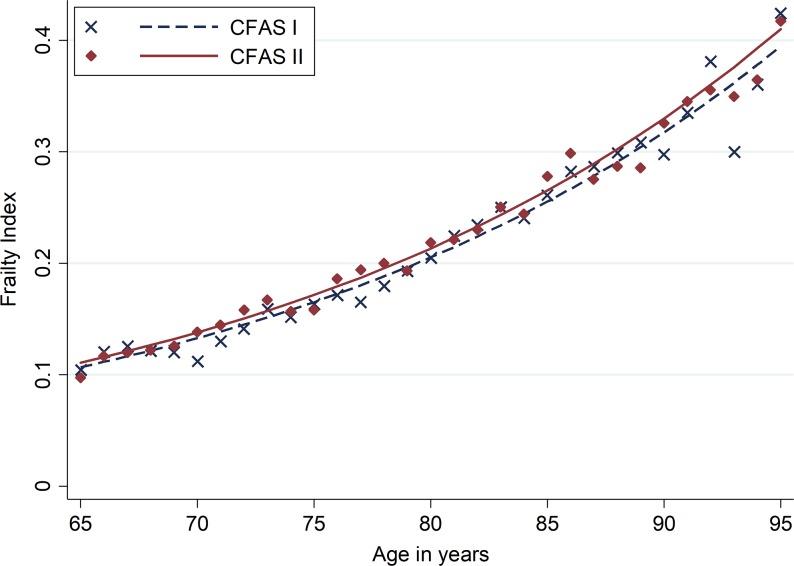
mean frailty was slightly higher in CFAS II (0.19, 95% confidence interval (CI): 0.19-0.20) than CFAS I (0.18, 95% CI: 0.17-0.18). Two-year mortality in CFAS I was higher than in CFAS II (odds ratio (OR) = 1.16, 95% CI: 1.03-1.30). The association between frailty and 2-year mortality was non-linear with an OR of ~1.6 for each 0.10 increment in the FI.
CONCLUSIONS
the relationship between frailty and mortality did not significantly differ across the studies. Severe frailty as an indicator of mortality is shown to be a stable construct.
背景
特定年龄段死亡率的降低伴随着某些疾病的患病率下降和其他疾病的患病率上升。人口是否变得“更健康”取决于所考虑的健康方面。衰弱已被提议作为一种综合衡量标准来量化健康状况。
目的
使用衰弱指数(FI),即年龄相关健康缺陷积累的综合指标,研究 20 年间隔前后衰弱的近期致死率变化。
设计
1991 年(n=7635)和 2011 年(n=7762)认知功能与衰老研究(CFAS)的基线数据。
地点
英国三个地理位置不同的中心(纽卡斯尔、剑桥和诺丁汉)。
研究对象
年龄在 65 岁及以上的个体(包括住院和社区居住者)。
方法
使用 30 项衰弱评分,包括病态、危险因素和残疾的主观测量。使用链方程的多重插补法对缺失项进行插补。使用二项式回归研究衰弱、年龄、性别和队列之间的关系。使用逻辑回归模型预测两年死亡率。
结果
CFAS II 的平均衰弱程度略高于 CFAS I(0.19,95%置信区间(CI):0.19-0.20)(0.18,95% CI:0.17-0.18)。CFAS I 的两年死亡率高于 CFAS II(优势比(OR)=1.16,95% CI:1.03-1.30)。衰弱与两年死亡率之间的关系是非线性的,FI 每增加 0.10,OR 约为 1.6。
结论
衰弱与死亡率之间的关系在两项研究中没有显著差异。严重衰弱作为死亡率的指标被证明是一个稳定的结构。

 Zotero 插件