
韩国青少年的正常血清丙氨酸转氨酶与非酒精性脂肪性肝病:一项使用2010 - 2015年韩国国家健康与营养检查调查(KNHANES)数据的横断面研究
Normal serum alanine aminotransferase and non-alcoholic fatty liver disease among Korean adolescents: a cross-sectional study using data from KNHANES 2010-2015.
作者信息
Kang Yunkoo, Park Sowon, Kim Seung, Koh Hong
机构信息
Department of Pediatrics, Severance Children's Hospital, Severance Pediatric Liver Disease Research Group, Yonsei University College of Medicine, 50-1 Yonsei-ro, Seodaemun-gu, Seoul, 03722, Republic of Korea.
出版信息
BMC Pediatr. 2018 Jul 5;18(1):215. doi: 10.1186/s12887-018-1202-z.
BACKGROUND
Non-alcoholic fatty liver disease (NAFLD) is complicated disease and increasing worldwide. Previously, many studies of NALFD prevalences have used alanine aminotransferase (ALT) of > 40 U/L to define NAFLD, although that is too high to be reliable among adolescents. This study aimed to define the upper normal limit of ALT among Korean adolescents, and use it to estimate the prevalence of NAFLD, based on data from the Korea National Health and Nutrition Examination Survey (KNHANES).
METHODS
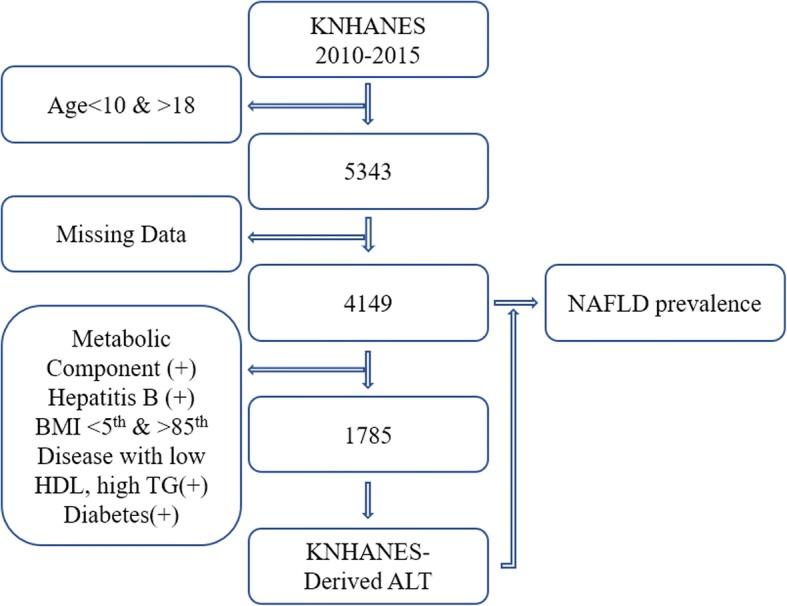
Data were obtained from 1785 healthy adolescents (916 boys and 869 girls, 10-18 years old) who participated in the KNHANES during 2010-2015. The International Diabetes Federation metabolic syndrome criteria for adolescents were used to exclude participants with metabolic syndrome components. Furthermore, participants who previously had diseases related to low HDL levels, high TG levels, diabetes, or very low/high body mass index and hepatitis B were excluded. The 95th percentiles level of ALT from healthy participants were evaluated. The definition of NAFLD was overweight status (≥85th percentile of body mass index) plus elevated ALT levels (95th percentile).
RESULTS
The upper normal ALT were 24.1 U/L for boys and 17.7 U/L for girls. Based on these values, the estimated prevalences of NAFLD in 2015 were 8.9% among adolescents.
CONCLUSION
Defining the upper normal limit of ALT can be adjusted for each sex and ethnics in the general population. ALT laboratory thresholds used for children should be re-examined. The physicians should be aware not to underdiagnose NAFLD patient even ALT level is < 40 U/L.
背景
非酒精性脂肪性肝病(NAFLD)是一种复杂的疾病,在全球范围内呈上升趋势。此前,许多关于NAFLD患病率的研究使用丙氨酸氨基转移酶(ALT)>40 U/L来定义NAFLD,尽管这一数值对于青少年来说过高,不可靠。本研究旨在根据韩国国家健康与营养检查调查(KNHANES)的数据,确定韩国青少年ALT的正常上限,并以此估计NAFLD的患病率。
方法
数据来自2010 - 2015年期间参加KNHANES的1785名健康青少年(916名男孩和869名女孩,年龄10 - 18岁)。采用国际糖尿病联盟青少年代谢综合征标准排除有代谢综合征组分的参与者。此外,排除既往有与低高密度脂蛋白水平、高甘油三酯水平、糖尿病或极低/高体重指数相关疾病以及乙肝的参与者。评估健康参与者ALT的第95百分位数水平。NAFLD的定义为超重状态(体重指数≥第85百分位数)加上ALT水平升高(第95百分位数)。
结果
男孩ALT正常上限为24.1 U/L,女孩为17.7 U/L。基于这些数值,2015年青少年中NAFLD的估计患病率为8.9%。
结论
可以针对一般人群中的不同性别和种族调整ALT正常上限的定义。应重新审视用于儿童的ALT实验室阈值。医生应意识到即使ALT水平<40 U/L,也不应漏诊NAFLD患者。


 Zotero 插件