
小胶质细胞TREM2/DAP12信号通路:神经疾病中的双刃剑
Microglial TREM2/DAP12 Signaling: A Double-Edged Sword in Neural Diseases.
作者信息
Konishi Hiroyuki, Kiyama Hiroshi
机构信息
Department of Functional Anatomy and Neuroscience, Nagoya University Graduate School of Medicine, Nagoya University, Nagoya, Japan.
出版信息
Front Cell Neurosci. 2018 Aug 6;12:206. doi: 10.3389/fncel.2018.00206. eCollection 2018.
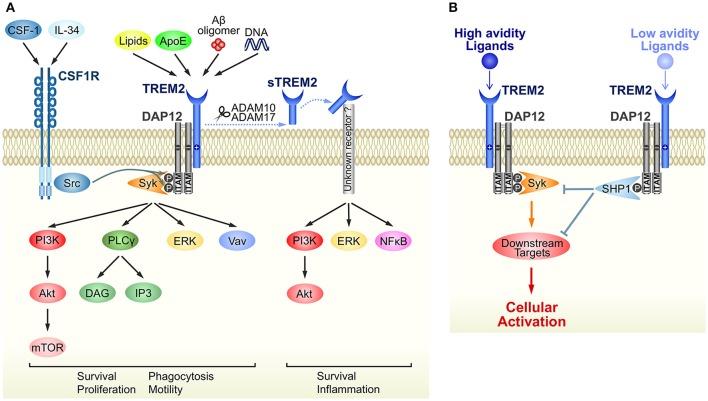
Microglia are activated after neuronal injury and in neurodegenerative diseases, and trigger neuroinflammation in the central nervous system (CNS). Microglia-derived neuroinflammation has both beneficial and detrimental effects on neurons. Because the timing and magnitude of microglial activation is thought to be a critical determinant of neuronal fate, understanding the molecular mechanisms underlying microglial activation is required to enable establishment of microglia-targeted therapies for neural diseases. Plasma membrane receptors play primary roles as activators of microglia and in this review, we focus on a receptor complex involving triggering receptor expressed on myeloid cells 2 (TREM2) and DNAX-activating protein of 12 kDa (DAP12), both of which are causative genes for Nasu-Hakola disease, a dementia with bone cysts. Recent transcriptome approaches demonstrated TREM2/DAP12 signaling as the principal regulator that transforms microglia from a homeostatic to a neural disease-associated state. Furthermore, animal model studies revealed critical roles for TREM2/DAP12 in the regulation of microglial activity, including survival, phagocytosis, and cytokine production, not only in Alzheimer's disease but also in other neural diseases, such as Parkinson's disease, demyelinating disease, ischemia, and peripheral nerve injury. Intriguingly, while TREM2/DAP12-mediated microglial activation is detrimental for some diseases, including peripheral nerve injury, it is beneficial for other diseases. As the role of activated microglia differs among disease models, TREM2/DAP12 signaling may result in different outcomes in different diseases. In this review we discuss recent perspectives on the role of TREM2/DAP12 in microglia and their contribution to neural diseases.
小胶质细胞在神经元损伤后以及神经退行性疾病中被激活,并在中枢神经系统(CNS)中引发神经炎症。小胶质细胞衍生的神经炎症对神经元既有有益影响,也有有害影响。由于小胶质细胞激活的时间和程度被认为是神经元命运的关键决定因素,因此需要了解小胶质细胞激活的分子机制,以便建立针对神经疾病的小胶质细胞靶向治疗方法。质膜受体作为小胶质细胞的激活剂发挥主要作用,在本综述中,我们重点关注一种受体复合物,该复合物涉及髓样细胞表达的触发受体2(TREM2)和12 kDa的DNAX激活蛋白(DAP12),这两个基因都是纳苏-哈科拉病(一种伴有骨囊肿的痴呆症)的致病基因。最近的转录组学方法表明,TREM2/DAP12信号传导是将小胶质细胞从稳态转变为与神经疾病相关状态的主要调节因子。此外,动物模型研究揭示了TREM2/DAP12在调节小胶质细胞活性中的关键作用,包括存活、吞噬作用和细胞因子产生,不仅在阿尔茨海默病中,而且在其他神经疾病中,如帕金森病、脱髓鞘疾病、缺血和周围神经损伤。有趣的是,虽然TREM2/DAP12介导的小胶质细胞激活对某些疾病(包括周围神经损伤)有害,但对其他疾病有益。由于激活的小胶质细胞在不同疾病模型中的作用不同,TREM2/DAP12信号传导在不同疾病中可能会导致不同的结果。在本综述中,我们讨论了关于TREM2/DAP12在小胶质细胞中的作用及其对神经疾病贡献的最新观点。

 Zotero 插件