
折叠蛋白的无限组装:在进化、疾病和工程中的应用。
Infinite Assembly of Folded Proteins in Evolution, Disease, and Engineering.
机构信息
Department of Structural Biology, Weizmann Institute of Science, Rehovot, 7610001, Israel.
出版信息
Angew Chem Int Ed Engl. 2019 Apr 16;58(17):5514-5531. doi: 10.1002/anie.201806092. Epub 2019 Feb 20.
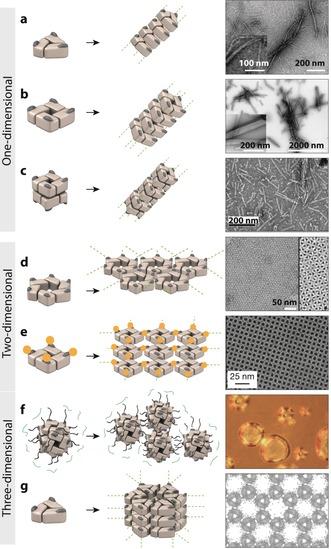
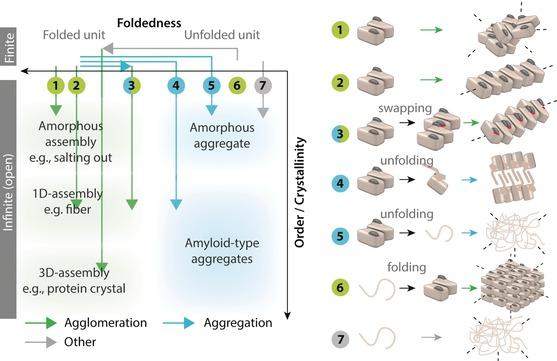
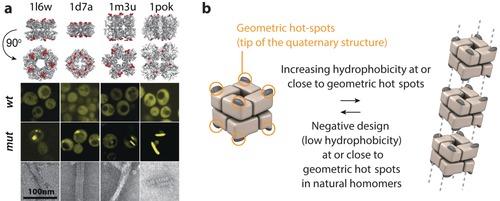
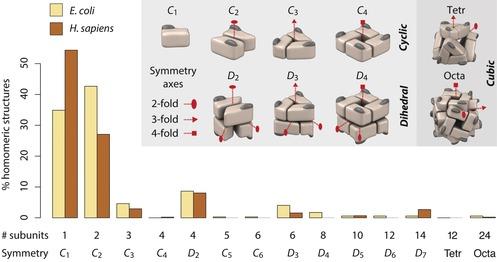
Mutations and changes in a protein's environment are well known for their potential to induce misfolding and aggregation, including amyloid formation. Alternatively, such perturbations can trigger new interactions that lead to the polymerization of folded proteins. In contrast to aggregation, this process does not require misfolding and, to highlight this difference, we refer to it as agglomeration. This term encompasses the amorphous assembly of folded proteins as well as the polymerization in one, two, or three dimensions. We stress the remarkable potential of symmetric homo-oligomers to agglomerate even by single surface point mutations, and we review the double-edged nature of this potential: how aberrant assemblies resulting from agglomeration can lead to disease, but also how agglomeration can serve in cellular adaptation and be exploited for the rational design of novel biomaterials.
蛋白质环境中的突变和变化众所周知会导致错误折叠和聚集,包括淀粉样形成。或者,这种干扰可以触发新的相互作用,导致折叠蛋白质的聚合。与聚集不同,这个过程不需要错误折叠,为了突出这种差异,我们称之为凝聚。这个术语包括折叠蛋白质的无定形组装以及一维、二维或三维的聚合。我们强调对称同寡聚体通过单个表面点突变凝聚的显著潜力,并回顾了这种潜力的双刃剑性质:凝聚产生的异常组装如何导致疾病,但也说明了凝聚如何在细胞适应中发挥作用,并可用于新型生物材料的合理设计。



 Zotero 插件