
多壁碳纳米管肺部沉积 1 年后诱发的肺部组织病理学和毒性的物理化学预测因子分析:在小鼠体内的 11 种不同多壁碳纳米管的实验研究
Physicochemical predictors of Multi-Walled Carbon Nanotube-induced pulmonary histopathology and toxicity one year after pulmonary deposition of 11 different Multi-Walled Carbon Nanotubes in mice.
机构信息
National Research Centre for the Working Environment, Copenhagen Ø, Denmark.
National Institute of Occupational Health, Oslo, Norway.
出版信息
Basic Clin Pharmacol Toxicol. 2019 Feb;124(2):211-227. doi: 10.1111/bcpt.13119. Epub 2018 Oct 18.
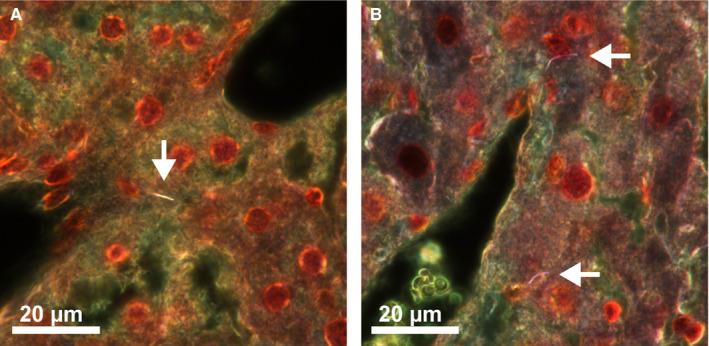
Multi-walled carbon nanotubes (MWCNT) are widely used nanomaterials that cause pulmonary toxicity upon inhalation. The physicochemical properties of MWCNT vary greatly, which makes general safety evaluation challenging to conduct. Identification of the toxicity-inducing physicochemical properties of MWCNT is therefore of great importance. We have evaluated histological changes in lung tissue 1 year after a single intratracheal instillation of 11 well-characterized MWCNT in female C57BL/6N BomTac mice. Genotoxicity in liver and spleen was evaluated by the comet assay. The dose of 54 μg MWCNT corresponds to three times the estimated dose accumulated during a work life at a NIOSH recommended exposure limit (0.001 mg/m ). Short and thin MWCNT were observed as agglomerates in lung tissue 1 year after exposure, whereas thicker and longer MWCNT were detected as single fibres, suggesting biopersistence of both types of MWCNT. The thin and entangled MWCNT induced varying degree of pulmonary inflammation, in terms of lymphocytic aggregates, granulomas and macrophage infiltration, whereas two thick and straight MWCNT did not. By multiple regression analysis, larger diameter and higher content of iron predicted less histopathological changes, whereas higher cobalt content significantly predicted more histopathological changes. No MWCNT-related fibrosis or tumours in the lungs or pleura was found. One thin and entangled MWCNT induced increased levels of DNA strand breaks in liver; however, no physicochemical properties could be related to genotoxicity. This study reveals physicochemical-dependent difference in MWCNT-induced long-term, pulmonary histopathological changes. Identification of diameter size and cobalt content as important for MWCNT toxicity provides clues for designing MWCNT, which cause reduced human health effects following pulmonary exposure.
多壁碳纳米管(MWCNT)是广泛使用的纳米材料,吸入后会引起肺毒性。MWCNT 的物理化学性质差异很大,这使得进行一般安全性评估具有挑战性。因此,确定引起 MWCNT 毒性的物理化学性质非常重要。我们评估了 11 种经过充分表征的 MWCNT 在雌性 C57BL/6N BomTac 小鼠单次气管内滴注 1 年后肺组织的组织学变化。彗星试验评估了肝和脾的遗传毒性。54μg MWCNT 的剂量相当于在 NIOSH 推荐暴露限值(0.001mg/m )下工作一生期间估计积累剂量的三倍。暴露 1 年后,在肺组织中观察到短而细的 MWCNT 聚集体,而较厚和较长的 MWCNT 则作为单纤维检测到,这表明两种类型的 MWCNT 都具有生物持久性。薄而缠结的 MWCNT 引起了不同程度的肺炎症,表现为淋巴细胞聚集、肉芽肿和巨噬细胞浸润,而两根较厚且直的 MWCNT 则没有。通过多元回归分析,较大的直径和较高的铁含量预示着较少的组织病理学变化,而较高的钴含量则显著预示着更多的组织病理学变化。在肺或胸膜中未发现与 MWCNT 相关的纤维化或肿瘤。一根细而缠结的 MWCNT 导致肝中 DNA 链断裂水平升高;然而,没有物理化学性质可以与遗传毒性相关。这项研究揭示了 MWCNT 诱导的长期肺组织病理学变化的物理化学依赖性差异。确定直径大小和钴含量作为 MWCNT 毒性的重要因素,为设计在肺暴露后减少对人类健康影响的 MWCNT 提供了线索。


 Zotero 插件