
高钾血症心力衰竭患者中用帕替洛默和螺内酯治疗的成本效益分析。
Cost-Effectiveness Analysis of Patiromer and Spironolactone Therapy in Heart Failure Patients with Hyperkalemia.
机构信息
Department of Pharmacy, University of Washington, 1959 NE Pacific St, HSB H375-P, Box 357630, Seattle, WA, 98195-7630, USA.
Division of Cardiology, Stony Brook University, Stony Brook, NY, USA.
出版信息
Pharmacoeconomics. 2018 Dec;36(12):1463-1473. doi: 10.1007/s40273-018-0709-3.
BACKGROUND AND OBJECTIVE
Certain patients with heart failure (HF) are unable to tolerate spironolactone therapy due to hyperkalemia. Patiromer is a novel agent used to treat hyperkalemia and has been shown to be efficacious, safe, and well-tolerated. The potential clinical outcomes and economic value of using patiromer and spironolactone in patients with HF unable to otherwise tolerate spironolactone due to hyperkalemia are unclear. The objective of this analysis was to model the potential pharmacoeconomic value of using patiromer and spironolactone in patients with a history of hyperkalemia that prevents them from utilizing spironolactone.
METHODS
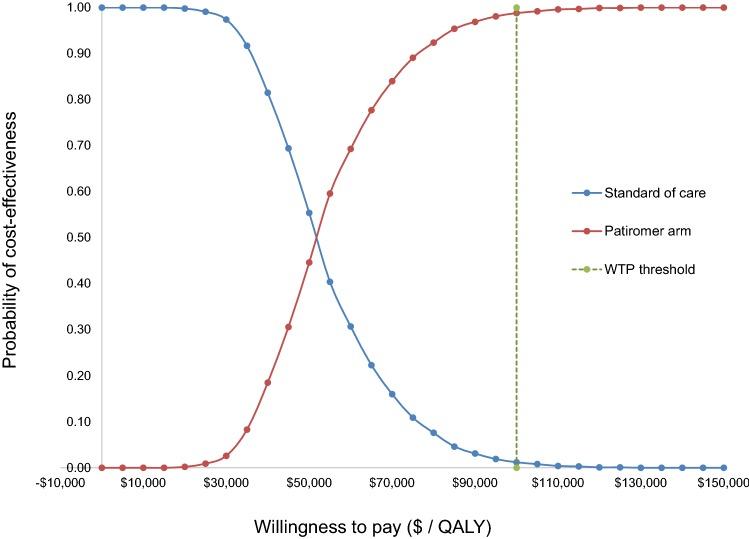
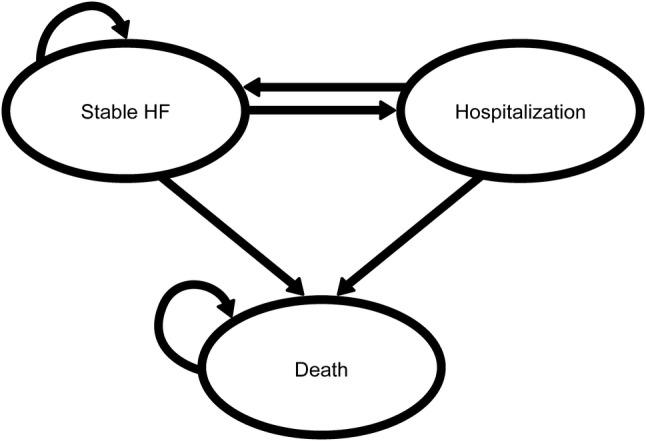
We performed a cost-effectiveness analysis of treatment with patiromer, spironolactone, and an angiotensin-converting enzyme inhibitor (ACEI) in patients with New York Heart Association (NYHA) class III-IV HF compared with ACEI alone. A Markov model was constructed to simulate a cohort of 65-year-old patients diagnosed with HF from the payer perspective across the lifetime horizon. Clinical inputs were derived from the RALES and OPAL-HK randomized trials of spironolactone and patiromer, respectively. Utility estimates and costs were derived from the literature and list prices. Outcomes assessed included hospitalization, life expectancy, and quality-adjusted life-years (QALYs), costs, and the incremental cost-effectiveness ratio (ICER). One-way and probability sensitivity analyses were performed to test the robustness of the model findings.
RESULTS
Treatment with patiromer-spironolactone-ACEI was projected to increase longevity compared with ACEI alone (5.29 vs. 4.62 life-years gained, respectively), greater QALYs (2.79 vs. 2.60), and costs (US$28,200 vs. US$18,200), giving an ICER of US$52,700 per QALY gained. The ICERs ranged from US$40,000 to US$85,800 per QALY gained in 1-way sensitivity analyses.
CONCLUSION
Our results suggest that the use of spironolactone-patiromer-ACEI may provide clinical benefit and good economic value in patients with NYHA class III-IV HF unable to tolerate spironolactone due to hyperkalemia.
背景与目的
某些心力衰竭(HF)患者因高钾血症而无法耐受螺内酯治疗。帕替洛尔是一种用于治疗高钾血症的新型药物,已被证明是有效、安全且耐受良好的。在因高钾血症而无法耐受螺内酯的 HF 患者中,使用帕替洛尔和螺内酯的潜在临床结果和经济价值尚不清楚。本分析的目的是对因高钾血症而无法使用螺内酯的 HF 患者使用帕替洛尔和螺内酯的潜在药物经济学价值进行建模。
方法
我们从支付者的角度,对与仅使用血管紧张素转换酶抑制剂(ACEI)相比,使用帕替洛尔、螺内酯和 ACEI 治疗纽约心脏协会(NYHA)III-IV 级 HF 患者的治疗进行了成本效果分析。构建了一个马尔可夫模型,以模拟从支付者角度来看,在终生范围内,65 岁的 HF 患者队列。临床输入数据来自螺内酯的 RALES 和帕替洛尔的 OPAL-HK 随机试验。效用估计值和成本来自文献和目录价格。评估的结果包括住院、预期寿命和质量调整生命年(QALY)、成本和增量成本效果比(ICER)。进行了单因素和概率敏感性分析,以检验模型结果的稳健性。
结果
与单独使用 ACEI 相比,使用帕替洛尔-螺内酯-ACEI 治疗预计会延长寿命(分别增加 5.29 和 4.62 年)、增加 QALY(分别增加 2.79 和 2.60)和增加成本(分别为 28200 美元和 18200 美元),ICER 为每获得一个 QALY 增加 52700 美元。在单因素敏感性分析中,ICER 范围从每获得一个 QALY 增加 40000 美元到 85800 美元不等。
结论
我们的研究结果表明,在因高钾血症而无法耐受螺内酯的 NYHA 分级 III-IV HF 患者中,使用螺内酯-帕替洛尔-ACEI 可能会带来临床获益和良好的经济价值。

 Zotero 插件