
澳大利亚新南威尔士州多个季节中人类呼吸道合胞病毒(RSV)的演变。
Evolution of Human Respiratory Syncytial Virus (RSV) over Multiple Seasons in New South Wales, Australia.
机构信息
Marie Bashir Institute for Infectious Diseases and Biosecurity, Charles Perkins Centre, School of Life and Environmental Sciences and Sydney Medical School, The University of Sydney, Sydney, NSW 2006, Australia.
The Kirby Institute, University of New South Wales, Randwick, NSW 2052, Australia.
出版信息
Viruses. 2018 Sep 6;10(9):476. doi: 10.3390/v10090476.
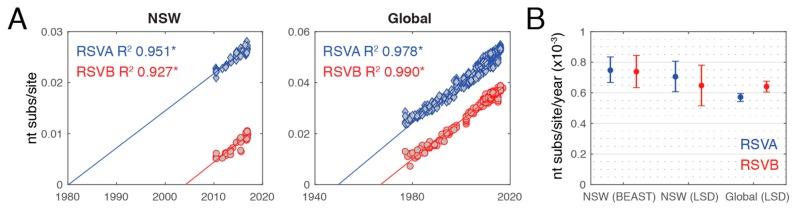
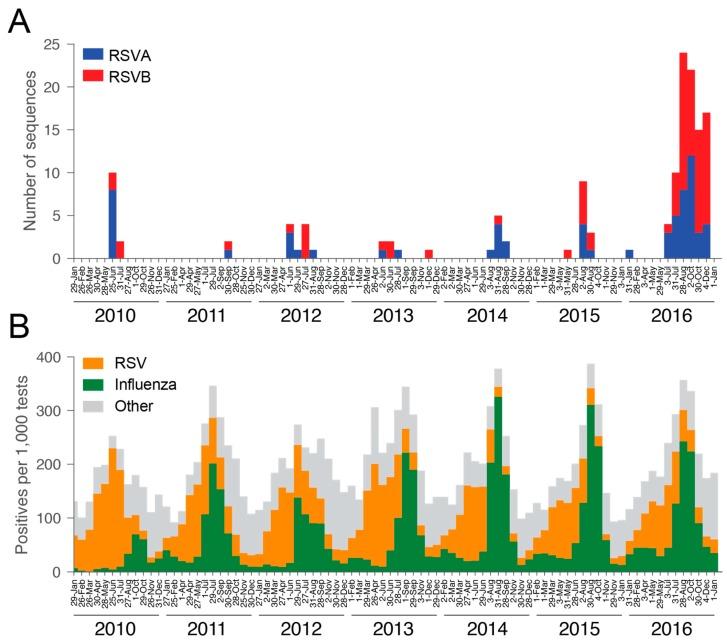
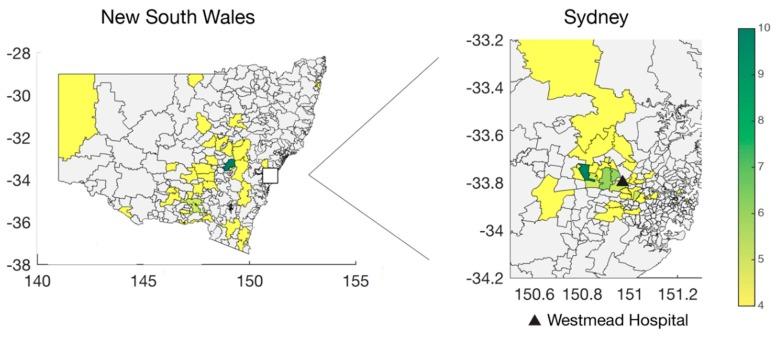
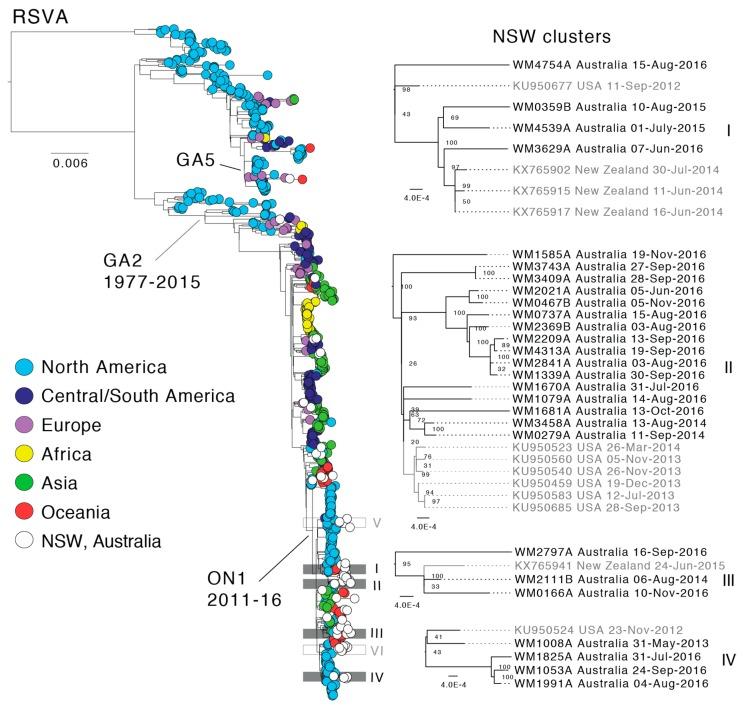
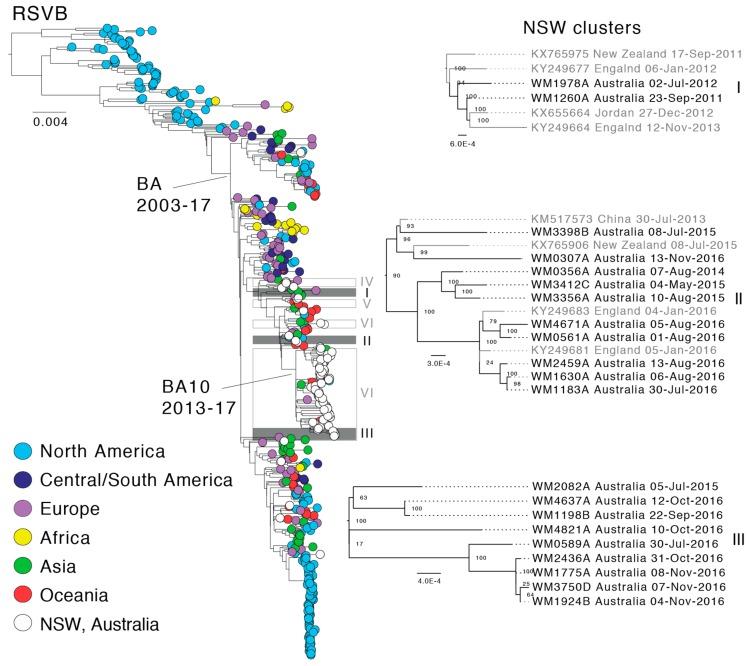
There is an ongoing global pandemic of human respiratory syncytial virus (RSV) infection that results in substantial annual morbidity and mortality. In Australia, RSV is a major cause of acute lower respiratory tract infections (ALRI). Nevertheless, little is known about the extent and origins of the genetic diversity of RSV in Australia, nor the factors that shape this diversity. We have conducted a genome-scale analysis of RSV infections in New South Wales (NSW). RSV genomes were successfully sequenced for 144 specimens collected between 2010⁻2016. Of these, 64 belonged to the RSVA and 80 to the RSVB subtype. Phylogenetic analysis revealed a wide diversity of RSV lineages within NSW and that both subtypes evolved rapidly in a strongly clock-like manner, with mean rates of approximately 6⁻8 × 10 nucleotide substitutions per site per year. There was only weak evidence for geographic clustering of sequences, indicative of fluid patterns of transmission within the infected population and no evidence of any clustering by patient age such that viruses in the same lineages circulate through the entire host population. Importantly, we show that both subtypes circulated concurrently in NSW with multiple introductions into the Australian population in each year and only limited evidence for multi-year persistence.
目前全球正流行人类呼吸道合胞病毒(RSV)感染,导致大量的年度发病率和死亡率。在澳大利亚,RSV 是急性下呼吸道感染(ALRI)的主要原因。尽管如此,对于澳大利亚 RSV 的遗传多样性的程度和来源,以及形成这种多样性的因素,人们知之甚少。我们对新南威尔士州(NSW)的 RSV 感染进行了基因组规模的分析。我们成功地对 2010 年至 2016 年间收集的 144 个标本进行了 RSV 基因组测序。其中,64 个属于 RSV-A 亚型,80 个属于 RSV-B 亚型。系统发育分析显示,NSW 内存在广泛的 RSV 谱系多样性,两种亚型均以强烈的钟形方式快速进化,平均每年每个位点约有 6-8×10 个核苷酸取代。序列仅存在微弱的地理聚类迹象,表明感染人群中存在流动的传播模式,没有任何按患者年龄聚类的证据,表明同一谱系的病毒在整个宿主人群中传播。重要的是,我们表明,这两种亚型在 NSW 同时流行,每年都有多次传入澳大利亚人群,只有有限的多年持续存在的证据。
 Zotero 插件