
基于自适应阈值的自动细胞分割(ACSAT)在大规模钙成像数据集上的应用。
Automatic Cell Segmentation by Adaptive Thresholding (ACSAT) for Large-Scale Calcium Imaging Datasets.
机构信息
Department of Physics, Harvard University, Cambridge, MA 02138.
Biomedical Engineering Department, Boston University, Boston, MA 02215.
出版信息
eNeuro. 2018 Sep 13;5(5). doi: 10.1523/ENEURO.0056-18.2018. eCollection 2018 Sep-Oct.
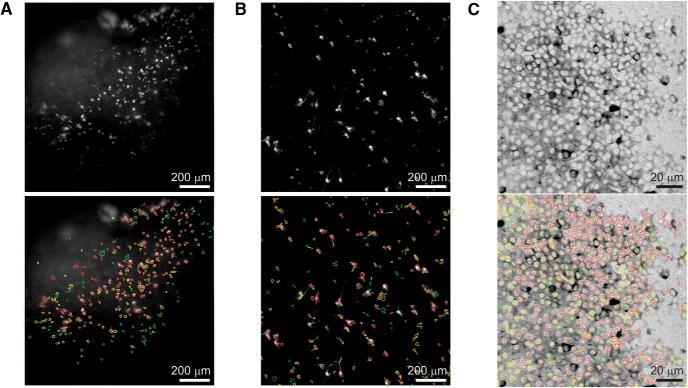
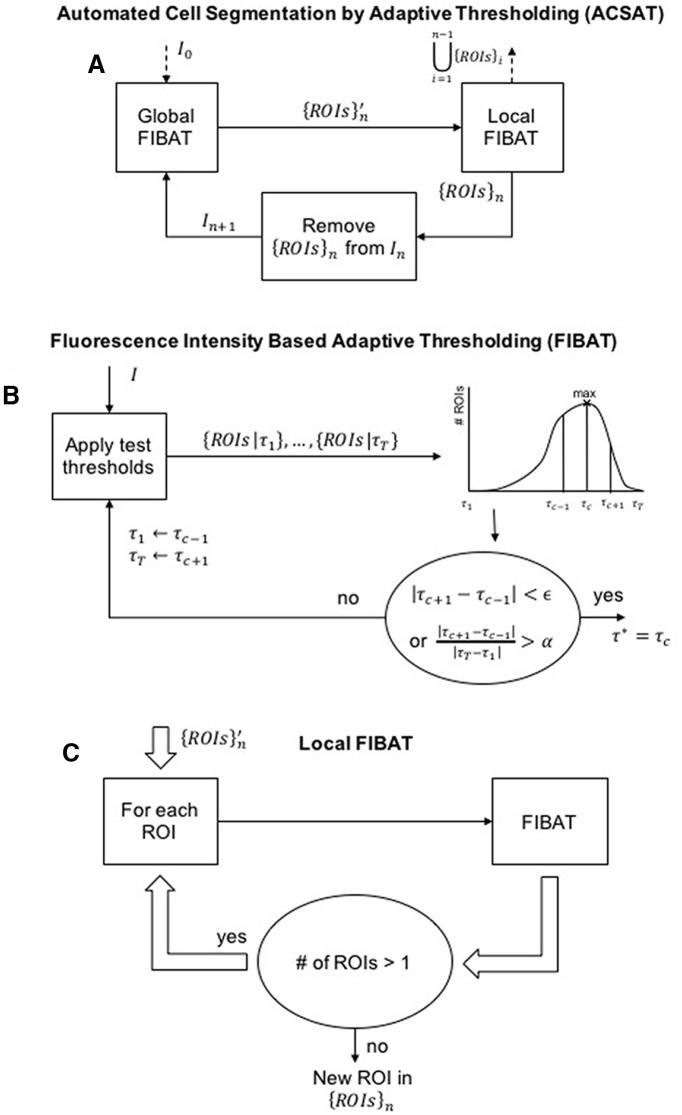
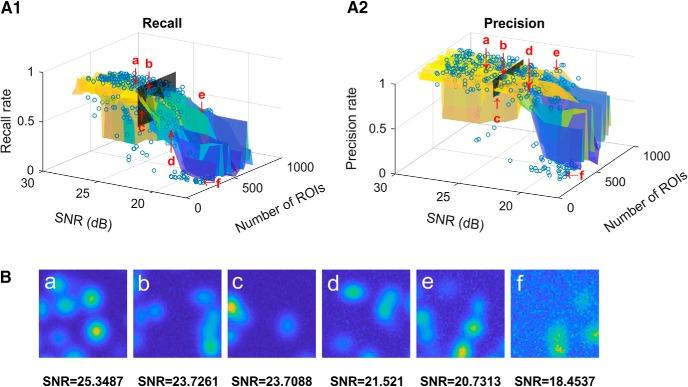
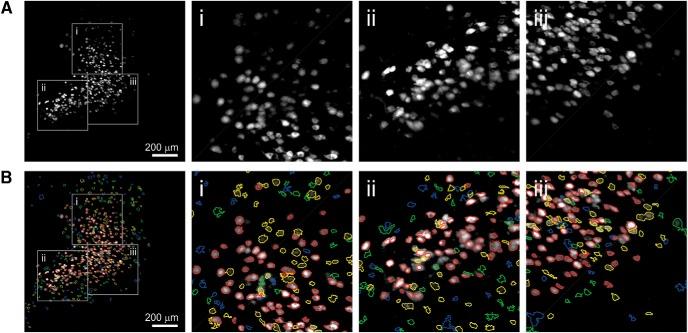
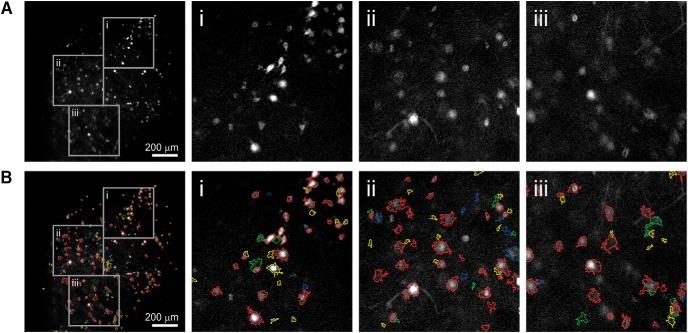
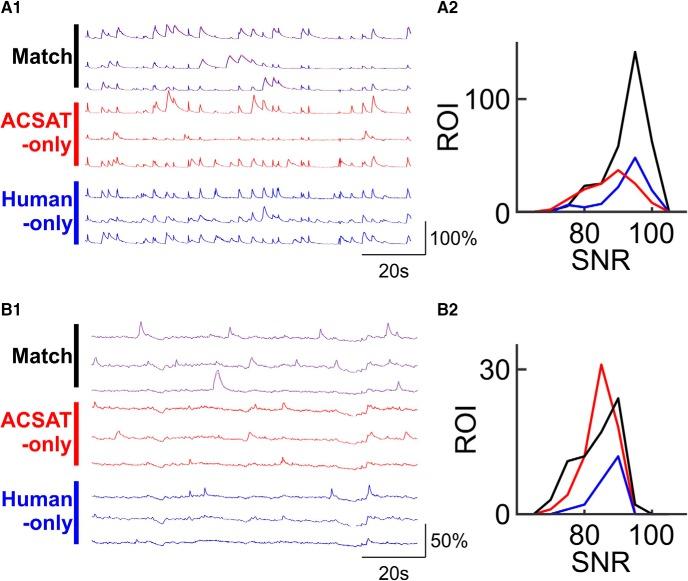
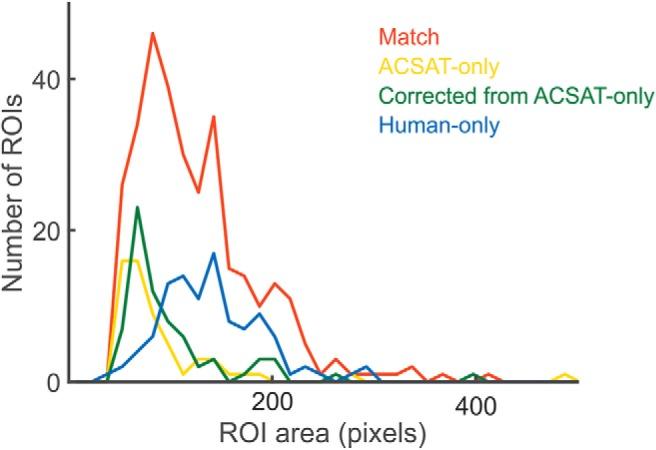
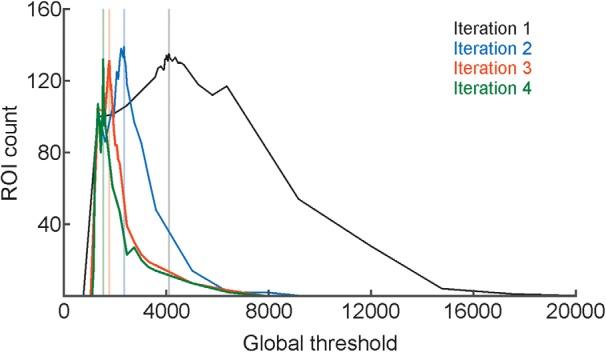
Advances in calcium imaging have made it possible to record from an increasingly larger number of neurons simultaneously. Neuroscientists can now routinely image hundreds to thousands of individual neurons. An emerging technical challenge that parallels the advancement in imaging a large number of individual neurons is the processing of correspondingly large datasets. One important step is the identification of individual neurons. Traditional methods rely mainly on manual or semimanual inspection, which cannot be scaled for processing large datasets. To address this challenge, we focused on developing an automated segmentation method, which we refer to as automated cell segmentation by adaptive thresholding (ACSAT). ACSAT works with a time-collapsed image and includes an iterative procedure that automatically calculates global and local threshold values during successive iterations based on the distribution of image pixel intensities. Thus, the algorithm is capable of handling variations in morphological details and in fluorescence intensities in different calcium imaging datasets. In this paper, we demonstrate the utility of ACSAT by testing it on 500 simulated datasets, two wide-field hippocampus datasets, a wide-field striatum dataset, a wide-field cell culture dataset, and a two-photon hippocampus dataset. For the simulated datasets with truth, ACSAT achieved >80% recall and precision when the signal-to-noise ratio was no less than ∼24 dB.
钙成像技术的进步使得同时记录越来越多神经元的活动成为可能。神经科学家现在可以常规地对数百到数千个单个神经元进行成像。与成像大量单个神经元的进展相平行的一个新兴技术挑战是处理相应的大数据集。一个重要步骤是识别单个神经元。传统方法主要依赖于手动或半自动检查,无法扩展到处理大数据集。为了解决这个挑战,我们专注于开发一种自动化的分割方法,我们称之为基于自适应阈值的自动细胞分割(ACSAT)。ACSAT 使用时间压缩图像,并包括一个迭代过程,该过程根据图像像素强度的分布,在连续的迭代中自动计算全局和局部阈值。因此,该算法能够处理不同钙成像数据集的形态细节和荧光强度的变化。在本文中,我们通过在 500 个模拟数据集、两个宽场海马数据集、一个宽场纹状体数据集、一个宽场细胞培养数据集和一个双光子海马数据集上进行测试,证明了 ACSAT 的实用性。对于具有真实信号的模拟数据集,当信噪比不小于约 24 dB 时,ACSAT 的召回率和精度均超过 80%。



 Zotero 插件