
尿液外泌体长链非编码 RNA 的表达谱可作为膀胱癌诊断和复发预测的新型无创生物标志物。
Expression signatures of exosomal long non-coding RNAs in urine serve as novel non-invasive biomarkers for diagnosis and recurrence prediction of bladder cancer.
机构信息
Department of Clinical Laboratory, The Second Hospital of Shandong University, Jinan, 250033, Shandong, China.
Tumor Marker Detection Engineering Laboratory of Shandong Province, Jinan, Shandong, China.
出版信息
Mol Cancer. 2018 Sep 29;17(1):142. doi: 10.1186/s12943-018-0893-y.
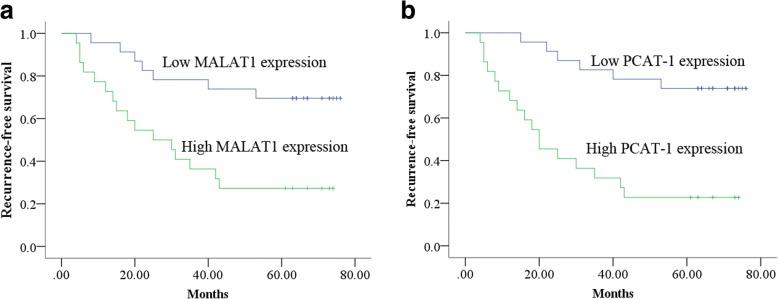
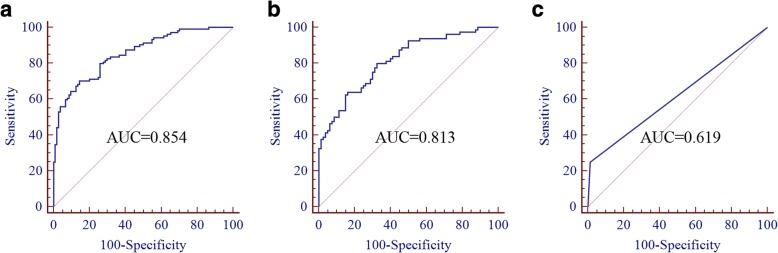
Recently, expression signatures of exosomal long non-coding RNAs (lncRNAs) have been proposed as potential non-invasive biomarkers for cancer detection. In this study, we aimed to develop a urinary exosome (UE)-derived lncRNA panel for diagnosis and recurrence prediction of bladder cancer (BC). Quantitative real-time polymerase chain reaction (qRT-PCR) was performed to screen and evaluate the expressions of eight candidate lncRNAs in a training set (208 urine samples) and a validation set (160 urine samples). A panel consisting of three differently expressed lncRNAs (MALAT1, PCAT-1 and SPRY4-IT1) was established for BC diagnosis in the training set, showing an area under the receiver-operating characteristic (ROC) curve (AUC) of 0.854. Subsequently, the performance of the panel was further verified with an AUC of 0.813 in the validation set, which was significantly higher than that of urine cytology (0.619). In addition, Kaplan-Meier analysis suggested that the up-regulation of PCAT-1 and MALAT1 was associated with poor recurrence-free survival (RFS) of non-muscle-invasive BC (NMIBC) (p < 0.001 and p = 0.002, respectively), and multivariate Cox proportional hazards regression analysis revealed that exosomal PCAT-1 overexpression was an independent prognostic factor for the RFS of NMIBC (p = 0.018). Collectively, our findings indicated that UE-derived lncRNAs possessed considerable clinical value in the diagnosis and prognosis of BC.
最近,外泌体长链非编码 RNA(lncRNA)的表达特征被提出作为癌症检测的潜在非侵入性生物标志物。在这项研究中,我们旨在开发用于膀胱癌(BC)诊断和复发预测的尿外泌体(UE)衍生的 lncRNA 谱。定量实时聚合酶链反应(qRT-PCR)用于在训练集(208 个尿液样本)和验证集(160 个尿液样本)中筛选和评估八个候选 lncRNA 的表达。在训练集中,由三个表达不同的 lncRNA(MALAT1、PCAT-1 和 SPRY4-IT1)组成的谱列用于 BC 诊断,其接收者操作特征(ROC)曲线下面积(AUC)为 0.854。随后,该谱列在验证集中的 AUC 为 0.813,进一步验证了其性能,明显高于尿细胞学(0.619)。此外,Kaplan-Meier 分析表明,PCAT-1 和 MALAT1 的上调与非肌肉浸润性 BC(NMIBC)的无复发生存率(RFS)较差相关(p<0.001 和 p=0.002),多变量 Cox 比例风险回归分析表明,外泌体 PCAT-1 过表达是 NMIBC RFS 的独立预后因素(p=0.018)。总的来说,我们的研究结果表明,UE 衍生的 lncRNA 在 BC 的诊断和预后中具有相当大的临床价值。
 Zotero 插件