
临床基因组测序中的拷贝数变异:在罕见病和不明原因疾病中的应用和解读。
Copy-number variants in clinical genome sequencing: deployment and interpretation for rare and undiagnosed disease.
机构信息
Illumina Inc., San Diego, CA, USA.
CombiMatrix Diagnostics (currently Invitae), Irvine, CA, USA.
出版信息
Genet Med. 2019 May;21(5):1121-1130. doi: 10.1038/s41436-018-0295-y. Epub 2018 Oct 8.
PURPOSE
Current diagnostic testing for genetic disorders involves serial use of specialized assays spanning multiple technologies. In principle, genome sequencing (GS) can detect all genomic pathogenic variant types on a single platform. Here we evaluate copy-number variant (CNV) calling as part of a clinically accredited GS test.
METHODS
We performed analytical validation of CNV calling on 17 reference samples, compared the sensitivity of GS-based variants with those from a clinical microarray, and set a bound on precision using orthogonal technologies. We developed a protocol for family-based analysis of GS-based CNV calls, and deployed this across a clinical cohort of 79 rare and undiagnosed cases.
RESULTS
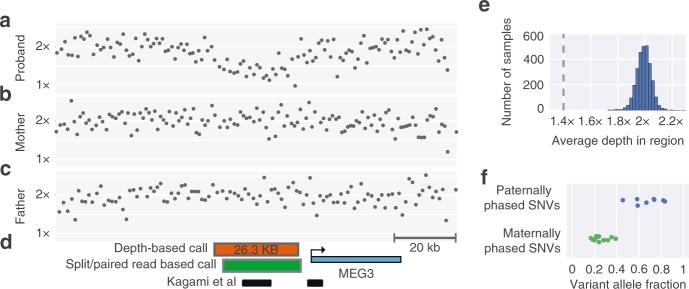
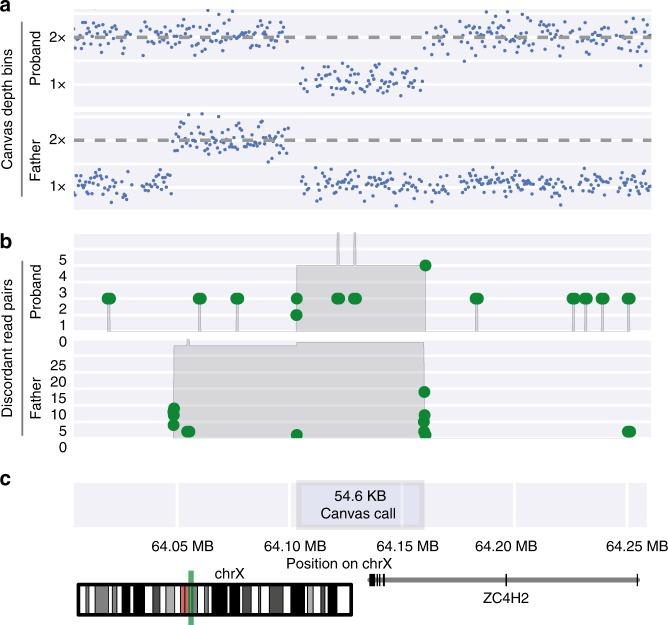
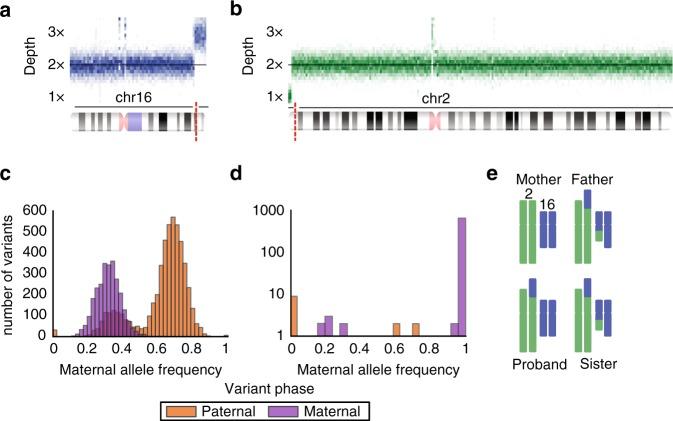
We found that CNV calls from GS are at least as sensitive as those from microarrays, while only creating a modest increase in the number of variants interpreted (~10 CNVs per case). We identified clinically significant CNVs in 15% of the first 79 cases analyzed, all of which were confirmed by an orthogonal approach. The pipeline also enabled discovery of a uniparental disomy (UPD) and a 50% mosaic trisomy 14. Directed analysis of select CNVs enabled breakpoint level resolution of genomic rearrangements and phasing of de novo CNVs.
CONCLUSION
Robust identification of CNVs by GS is possible within a clinical testing environment.
目的
目前,遗传疾病的诊断检测涉及到使用跨越多种技术的专门检测方法进行连续检测。原则上,基因组测序(GS)可以在单个平台上检测所有基因组致病性变异类型。在这里,我们评估了作为临床认可的 GS 测试的一部分的拷贝数变异(CNV)调用。
方法
我们对 17 个参考样本进行了 CNV 调用的分析验证,比较了基于 GS 的变体与来自临床微阵列的变体的灵敏度,并使用正交技术对精度设定了界限。我们开发了一种基于 GS 的 CNV 调用的家族分析方案,并在 79 例罕见和未确诊的临床队列中部署了该方案。
结果
我们发现,GS 的 CNV 调用至少与微阵列一样敏感,而只是略微增加了解释的变体数量(每个病例约 10 个 CNVs)。我们在分析的前 79 例中的 15%中发现了具有临床意义的 CNV,所有这些都通过正交方法得到了证实。该管道还能够发现单亲二体(UPD)和 50%镶嵌性三体 14。对特定 CNV 的定向分析能够实现基因组重排的断点水平分辨率和新生 CNV 的相位。
结论
在临床检测环境中,通过 GS 可以可靠地识别 CNV。
 Zotero 插件