
奥沙利铂诱导背根神经节神经元的 pH 值酸化。
Oxaliplatin induces pH acidification in dorsal root ganglia neurons.
机构信息
Department of Pharmaceutical Sciences, University of Piemonte Orientale, Via Bovio 6, 28100, Novara, Italy.
Experimental Neurology Unit, School of Medicine and Surgery, University of Milano-Bicocca, Via Cadore 48, 20900, Monza, Italy.
出版信息
Sci Rep. 2018 Oct 10;8(1):15084. doi: 10.1038/s41598-018-33508-6.
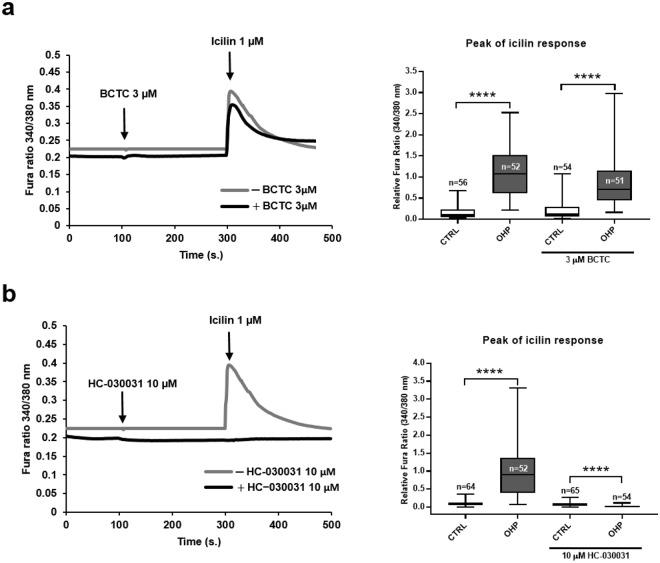
Oxaliplatin induced peripheral neurotoxicity is characterized by an acute cold-induced syndrome characterized by cramps, paresthesias/dysesthesias in the distal limbs and perioral region, that develops rapidly and lasts up to one week affecting nearly all the patients as well as by long-lasting symptoms. It has been previously shown that pharmacological or genetic ablation of TRPA1 responses reduces oxaliplatin-induced peripheral neurotoxicity in mouse models. In the present report, we show that treatment with concentrations of oxaliplatin similar to those found in plasma of treated patients leads to an acidification of the cytosol of mouse dorsal root ganglia neurons in culture and this in turn is responsible for sensitization of TRPA1 channels, thereby providing a mechanistic explanation to toxicity of oxaliplatin. Reversal of the acidification indeed leads to a significantly reduced activity of TRPA1 channels. Last, acidification occurs also in vivo after a single injection of therapeutically-relevant doses of oxaliplatin.
奥沙利铂诱导的周围神经毒性的特征是一种急性冷诱导综合征,表现为四肢远端和口周区域的痉挛、感觉异常/感觉迟钝,其发展迅速,持续长达一周,几乎影响所有患者,以及长期症状。先前已经表明,TRPA1 反应的药理学或基因消融可减少小鼠模型中奥沙利铂诱导的周围神经毒性。在本报告中,我们表明,用类似于在治疗患者的血浆中发现的浓度的奥沙利铂处理可导致培养的小鼠背根神经节神经元的细胞质酸化,这反过来又负责敏感化 TRPA1 通道,从而为奥沙利铂的毒性提供了一种机制解释。实际上,逆转酸化会导致 TRPA1 通道的活性显著降低。最后,在单次注射治疗相关剂量的奥沙利铂后,体内也会发生酸化。




 Zotero 插件