
智能手机使用对泪膜和眼表状态的影响。
The influences of smartphone use on the status of the tear film and ocular surface.
机构信息
Department of Ophthalmology, Chonnam National University Medical School and Hospital, Gwangju, Korea.
MSC Research Institute and Kim Seon Ho Eye Clinic, Gwangju, Korea.
出版信息
PLoS One. 2018 Oct 31;13(10):e0206541. doi: 10.1371/journal.pone.0206541. eCollection 2018.
PURPOSE
To investigate the influences of smartphone use on ocular symptoms, status of the tear film, and oxidative stress indices in the tears and at the ocular surface.
METHODS
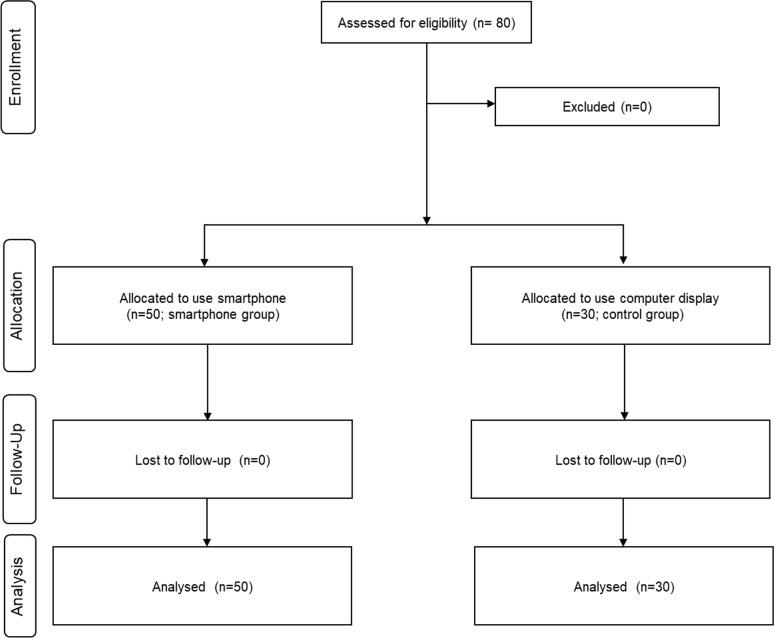
Eighty healthy volunteers were enrolled in the study. Subjective symptoms and asthenopia were evaluated using the ocular surface disease index (OSDI), visual analogue scale (VAS), and computer vision syndrome (CVS) score before and after smartphone or computer display (control) use. The status of the tear film was evaluated using fluorescein film break-up time (FBUT), non-invasive keratograph break up time (NIKBUT), Schirmer score, keratoepitheliopathy (KEP), and tear meniscus height (TMH). Oxidative stress markers in the tear film including hexanoyl lysine (HEL), 4-hydroxy-2-nonenal (4-HNE), malondialdehyde (MDA), and 8-oxo-2'-deoxyguanosine (8-OHdG) in the tear film were measured using ELISA. Reactive oxygen species (ROS) at the ocular surface were measured through 2',7'-dichloro-dihydrofluorescein diacetate. All measurements were conducted at baseline, and after use for 1 and 4 h.
RESULTS
All parameters showed no significant group-wise differences at baseline. Scores of OSDI, VAS, fatigue, burning sensation, and dryness showed significant increases after 1 and 4 h of smartphone use compared with those at baseline (all P < 0.05). The smartphone group showed higher OSDI, fatigue, burning, and dryness scores than the control group at 4 h. Smartphone use showed significantly decreased FBUT and NIBUT at 4 h than those at baseline (P < 0.01). In the smartphone group, the concentration of HEL significantly increased at 4 h compared with that at baseline and 1 h (P < 0.01). Both groups showed increased ROS with higher value in the smartphone group versus the control group at 4 h (P < 0.01).
CONCLUSIONS
Smartphone use could not only aggravate subjective symptom indices such as the OSDI, VAS, and CVS but also induce tear film instability and oxidative stress indices in the tears and at the ocular surface.
目的
探讨智能手机使用对眼部症状、泪膜状态和眼表氧化应激指标的影响。
方法
本研究纳入了 80 名健康志愿者。使用眼表疾病指数(OSDI)、视觉模拟评分(VAS)和计算机视觉综合征(CVS)评分在使用智能手机或计算机显示屏(对照组)前后评估主观症状和视疲劳。使用荧光素膜破裂时间(FBUT)、非侵入性角膜破裂时间(NIKBUT)、泪液分泌试验(Schirmer 试验)、角膜上皮病变(KEP)和泪膜月牙高度(TMH)评估泪膜状态。使用 ELISA 法测量泪膜中的氧化应激标志物包括己酰赖氨酸(HEL)、4-羟基-2-壬烯醛(4-HNE)、丙二醛(MDA)和 8-氧-2'-脱氧鸟苷(8-OHdG)。通过 2',7'-二氯二氢荧光素二乙酸酯测量眼表的活性氧(ROS)。所有测量均在基线时以及使用 1 和 4 h 后进行。
结果
所有参数在基线时无明显组间差异。与基线相比,使用智能手机 1 和 4 h 后 OSDI、VAS、疲劳、烧灼感和干燥感评分均显著升高(均 P < 0.05)。与对照组相比,智能手机组在 4 h 时 OSDI、疲劳、烧灼感和干燥感评分更高。与基线相比,智能手机组在 4 h 时 FBUT 和 NIBUT 显著降低(均 P < 0.01)。智能手机组在 4 h 时 HEL 浓度明显高于基线和 1 h(均 P < 0.01)。两组在 4 h 时 ROS 均增加,智能手机组高于对照组(均 P < 0.01)。
结论
智能手机的使用不仅会加重 OSDI、VAS 和 CVS 等主观症状指标,还会导致泪膜不稳定和眼表的氧化应激指标。



 Zotero 插件