
经皮穴位电刺激改善非小细胞肺癌患者行电视辅助胸腔镜肺叶切除术围手术期的免疫功能。
Transcutaneous Electrical Acupoint Stimulation Improves Immunological Function During the Perioperative Period in Patients With Non-Small Cell Lung Cancer Undergoing Video-Assisted Thoracic Surgical Lobectomy.
作者信息
Tu Qing, Yang Zhou, Gan Jianhui, Zhang Jian, Que Bin, Song Qiaofeng, Wang Yan
机构信息
1 Department of Anesthesiology, Tangshan People's Hospital, North China University of Science and Technology, Tangshan, China.
2 The Graduate School of North China University of Science and Technology, Tangshan, China.
出版信息
Technol Cancer Res Treat. 2018 Jan 1;17:1533033818806477. doi: 10.1177/1533033818806477.
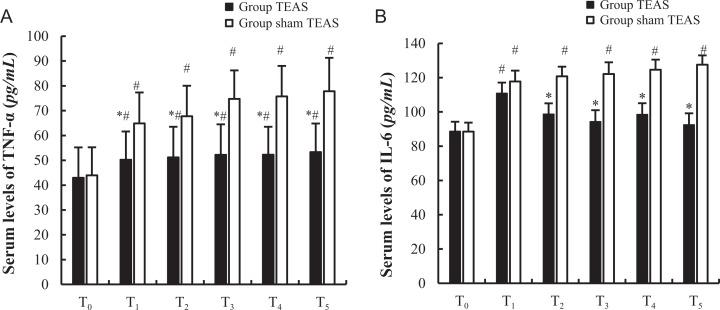
The immunological function of patients with malignant tumors may be suppressed during the perioperative period. However, details on the effects of transcutaneous electrical acupoint stimulation (TEAS) on immunological function are relatively lacking. We designed this study to examine the effects of TEAS on the immunological function of patients with non-small cell lung cancer (NSCLC) during the perioperative period. Participants (n = 144) were enrolled and randomly assigned into group TEAS or group sham TEAS. TEAS on bilateral Feishu (BL13), Hegu (L14), and Zusanli (ST36) was performed continuously throughout the procedure. The primary outcome was the quantities of natural killer (NK) cells at 30 minutes before induction (T), 5 minutes after intubation (T), at the beginning of the operation (T), at the beginning of the lobectomy (T), at the beginning of the lymphadenectomy (T), and immediately after extubation (T). The secondary outcomes were the serum levels of tumor necrosis factor-α (TNF-α) and interleukin-6 (IL-6) at T to T, the mean arterial pressure (MAP) and heart rate (HR), the intraoperative consumption of propofol and remifentanil, the incidence of hypoxemia, postoperative nausea and vomiting (PONV), and the length of hospital stay. The quantities of NK cells were decreased in group sham TEAS after intubation compared to that in group TEAS, while the quantities of NK cells in group TEAS were similar at T to T. Meanwhile, the quantities of NK cells in group sham TEAS at T ( P = .012), T ( P < .001), T ( P = .027), T ( P = .045), and T ( P = .021) were lower than those in group TEAS. In group TEAS, the serum levels of TNF-α were lower at T to T, while the levels of IL-6 were lower at T to T. Furthermore, the intraoperative MAP and HR were more stable, the total propofol and remifentanil consumptions were lower, and the length of hospital stay was shorter than those in group sham TEAS. The application of TEAS can effectively reverse the decrease in NK cells, decrease the serum levels of TNF-α and IL-6, maintain hemodynamic stability during the perioperative period, decrease the consumption of propofol and remifentanil, and shorten the length of the hospital stay.
恶性肿瘤患者在围手术期免疫功能可能受到抑制。然而,关于经皮穴位电刺激(TEAS)对免疫功能影响的详细信息相对较少。我们设计本研究以探讨TEAS对非小细胞肺癌(NSCLC)患者围手术期免疫功能的影响。招募了144名参与者并随机分为TEAS组或假TEAS组。在整个过程中持续对双侧肺俞(BL13)、合谷(LI4)和足三里(ST36)进行TEAS。主要结局指标为诱导前30分钟(T₀)、插管后5分钟(T₁)、手术开始时(T₂)、肺叶切除开始时(T₃)、淋巴结清扫开始时(T₄)以及拔管后即刻(T₅)自然杀伤(NK)细胞的数量。次要结局指标为T₀至T₅时血清肿瘤坏死因子-α(TNF-α)和白细胞介素-6(IL-6)水平、平均动脉压(MAP)和心率(HR)、术中丙泊酚和瑞芬太尼的消耗量、低氧血症发生率、术后恶心呕吐(PONV)以及住院时间。与TEAS组相比,假TEAS组插管后NK细胞数量减少,而TEAS组在T₀至T₅时NK细胞数量相似。同时,假TEAS组在T₁(P = 0.012)、T₂(P < 0.001)、T₃(P = 0.027)、T₄(P = 0.045)和T₅(P = 0.021)时NK细胞数量低于TEAS组。在TEAS组中,T₀至T₁时血清TNF-α水平较低,T₁至T₂时IL-6水平较低。此外,术中MAP和HR更稳定,丙泊酚和瑞芬太尼总消耗量较低,住院时间比假TEAS组短。应用TEAS可有效逆转NK细胞减少,降低血清TNF-α和IL-6水平,在围手术期维持血流动力学稳定,减少丙泊酚和瑞芬太尼的消耗量,并缩短住院时间。


 Zotero 插件