
Kindlin-2表达在实体瘤患者中的预后价值:一项荟萃分析。
Prognostic value of Kindlin-2 expression in patients with solid tumors: a meta-analysis.
作者信息
Liu Sheng, Chen Sheng, Ma Kaige, Shao Zengwu
机构信息
Department of Orthopaedics, Union Hospital, Tongji Medical College, Huazhong University of Science and Technology, Wuhan, 430022 China.
出版信息
Cancer Cell Int. 2018 Oct 22;18:166. doi: 10.1186/s12935-018-0651-7. eCollection 2018.
BACKGROUND
Kindlin-2 is one of the Kindlin family members which are evolutionarily conserved focal adhesion proteins with integrin β-binding affinity. Recently, accumulative studies have suggested that Kindlin-2 plays important roles in tumor biology. However, the prognostic significance of Kindlin-2 in patients with solid tumors remains controversial. Therefore, this study aimed to clarify the prognostic value of Kindlin-2 in solid tumors via meta-analysis.
METHODS
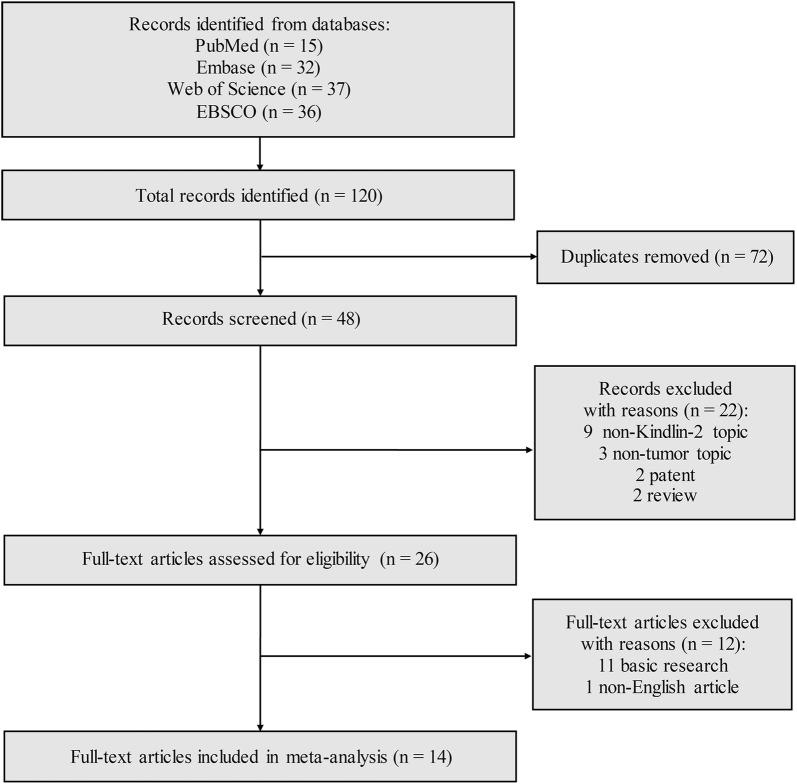
A comprehensive search was performed in PubMed, Embase, Web of Science and EBSCO for all relevant studies reporting the prognostic significance of Kindlin-2 expression in solid cancer patients. The summary hazard ratio (HR) and corresponding 95% confidence interval (CI) were calculated to estimate the association between Kindlin-2 expression with survival of solid cancer patients.
RESULTS
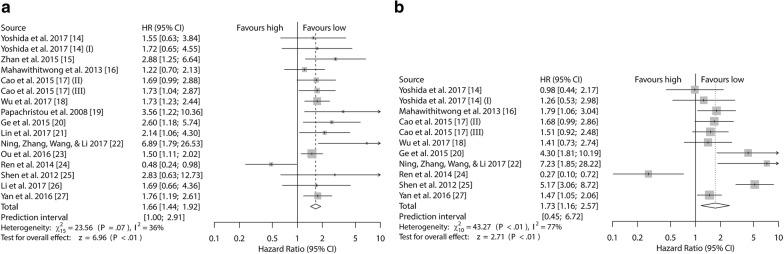
We included 14 eligible studies containing 1869 patients in our meta-analysis. The pooled results indicated that high Kindlin-2 expression was significantly associated with poor overall survival (OS) (pooled HR 1.66, 95% CI 1.44-1.92, < 0.0001), disease-free survival (DFS)/recurrence-free survival (RFS)/progression-free survival (PFS) (pooled HR 1.73, 95% CI 1.16-2.57, = 0.0067). For certain tumor types, high Kindlin-2 expression was significantly correlated with a poor outcome in patients with solid tumors, including pancreatic ductal adenocarcinoma (DFS/RFS/PFS), esophageal squamous cell carcinoma (OS, DFS/RFS/PFS), hepatocellular carcinoma (OS), clear cell renal cell carcinoma (OS), bladder cancer (OS, DFS/RFS/PFS), chondrosarcoma (OS), osteosarcoma (OS), gastric cancer (DFS/RFS/PFS), and glioma (OS).
CONCLUSIONS
Our meta-analysis demonstrated that high Kindlin-2 expression might indicate poor outcome in patients with solid tumors and could serve as a prognostic biomarker for solid cancer patients.
背景
Kindlin-2是Kindlin家族成员之一,是一种在进化上保守的粘着斑蛋白,具有整合素β结合亲和力。最近,越来越多的研究表明Kindlin-2在肿瘤生物学中发挥重要作用。然而,Kindlin-2在实体瘤患者中的预后意义仍存在争议。因此,本研究旨在通过荟萃分析阐明Kindlin-2在实体瘤中的预后价值。
方法
在PubMed、Embase、Web of Science和EBSCO中进行全面检索,以查找所有报告Kindlin-2表达在实体癌患者中的预后意义的相关研究。计算汇总风险比(HR)和相应的95%置信区间(CI),以评估Kindlin-2表达与实体癌患者生存之间的关联。
结果
我们的荟萃分析纳入了14项符合条件的研究,共1869例患者。汇总结果表明,Kindlin-2高表达与总体生存(OS)不良显著相关(汇总HR 1.66,95%CI 1.44-1.92,<0.0001),无病生存(DFS)/无复发生存(RFS)/无进展生存(PFS)也与之相关(汇总HR 1.73,95%CI 1.16-2.57,=0.0067)。对于某些肿瘤类型,Kindlin-2高表达与实体瘤患者的不良预后显著相关,包括胰腺导管腺癌(DFS/RFS/PFS)、食管鳞状细胞癌(OS、DFS/RFS/PFS)、肝细胞癌(OS)、透明细胞肾细胞癌(OS)、膀胱癌(OS、DFS/RFS/PFS)、软骨肉瘤(OS)、骨肉瘤(OS)、胃癌(DFS/RFS/PFS)和神经胶质瘤(OS)。
结论
我们的荟萃分析表明,Kindlin-2高表达可能预示实体瘤患者预后不良,可作为实体癌患者的预后生物标志物。



 Zotero 插件