
Kindlin蛋白在人类骨肉瘤中的预后意义
Prognostic implications of Kindlin proteins in human osteosarcoma.
作者信息
Ning Kai, Zhang Haoshaqiang, Wang Zhigang, Li Kun
机构信息
Department of Orthopedics Surgery Center, People's Hospital of Xinjiang Uygur Autonomous Region, Urumqi, People's Republic of China.
出版信息
Onco Targets Ther. 2017 Feb 7;10:657-665. doi: 10.2147/OTT.S125418. eCollection 2017.
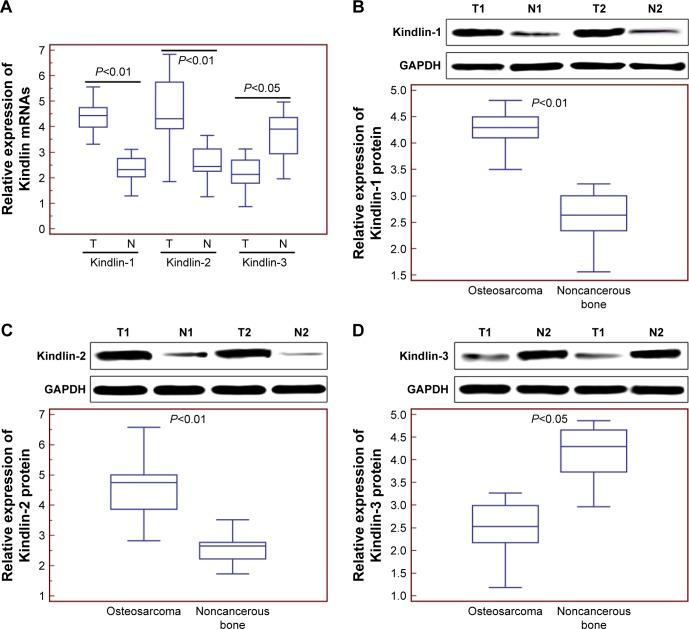
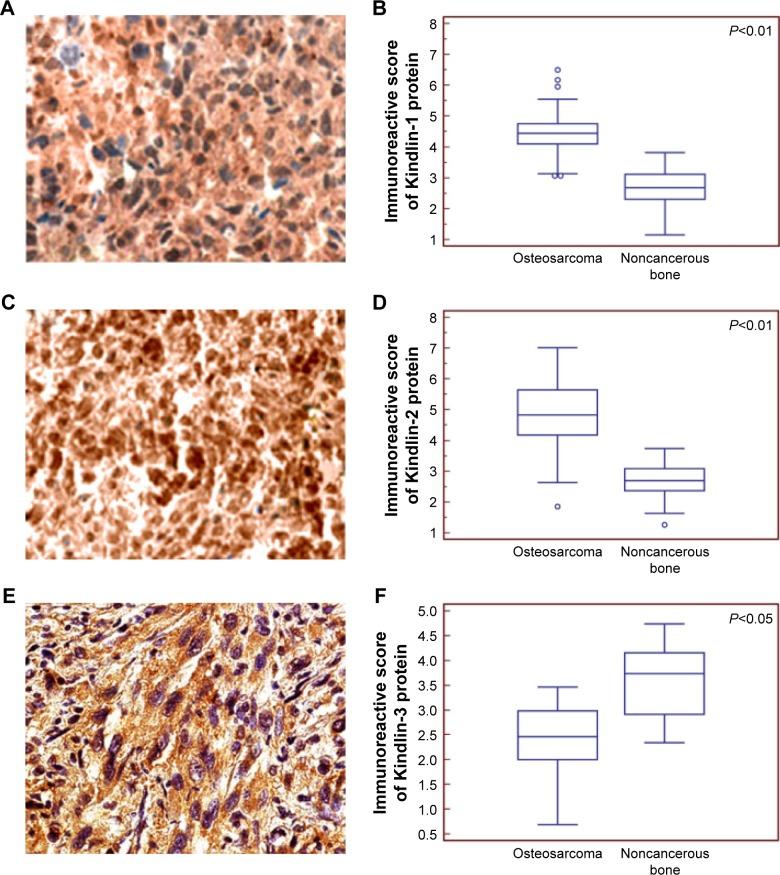
The Kindlin protein family, comprising Kindlin-1, Kindlin-2 and Kindlin-3, play important roles in various human cancers. Here, to explore the clinical significance of Kindlins in human osteosarcomas, quantitative real-time PCR and Western blot analyses were performed to detect the expression of Kindlin-1, Kindlin-2 and Kindlin-3 mRNAs and proteins in 20 self-pairs of osteosarcoma and adjacent noncancerous tissues. Then, immunohistochemistry was performed to examine subcellular localizations and expression patterns of Kindlin proteins in 100 osteosarcoma and matched adjacent noncancerous tissues. Kindlin-1, Kindlin-2 and Kindlin-3 protein immunostainings were localized in the cytoplasm, nucleus and cytoplasm, respectively, of tumor cells in primary osteosarcoma tissues. Statistically, the expression levels of Kindlin-1 and Kindlin-2 mRNAs and proteins in osteosarcoma tissues were all significantly higher (both <0.01), but those of Kindlin-3 mRNA and protein were both dramatically lower (both <0.05), than in matched adjacent noncancerous tissues. In addition, the overexpressions of Kindlin-1 and Kindlin-2 proteins were both significantly associated with high tumor grade (both =0.01), presence of metastasis (both =0.006), recurrence (both =0.006) and poor response to chemotherapy (both =0.02). Moreover, Kindlin-1 and Kindlin-2 expressions were both identified as independent prognostic factors for overall (both =0.01) and disease-free (=0.02 and 0.01, respectively) survivals of osteosarcoma patients. However, no associations were observed between Kindlin-3 expression and various clinicopathologic features and patients' prognosis. In conclusion, aberrant expression of Kindlin-1 and Kindlin-2 may function as reliable markers for progression and prognosis in osteosarcoma patients, especially for tumor recurrence.
包含Kindlin-1、Kindlin-2和Kindlin-3的Kindlin蛋白家族在多种人类癌症中发挥重要作用。在此,为探究Kindlins在人类骨肉瘤中的临床意义,进行了定量实时PCR和蛋白质印迹分析,以检测20对骨肉瘤及其相邻非癌组织中Kindlin-1、Kindlin-2和Kindlin-3 mRNA及蛋白质的表达。然后,进行免疫组织化学检测100例骨肉瘤及其配对的相邻非癌组织中Kindlin蛋白的亚细胞定位和表达模式。在原发性骨肉瘤组织中,Kindlin-1、Kindlin-2和Kindlin-3蛋白免疫染色分别定位于肿瘤细胞的细胞质、细胞核和细胞质。统计学分析显示,与配对的相邻非癌组织相比,骨肉瘤组织中Kindlin-1和Kindlin-2 mRNA及蛋白质的表达水平均显著更高(均<0.01),但Kindlin-3 mRNA和蛋白质的表达水平均显著更低(均<0.05)。此外,Kindlin-1和Kindlin-2蛋白的过表达均与高肿瘤分级(均=0.01)、转移的存在(均=0.006)、复发(均=0.006)以及对化疗反应不佳(均=0.02)显著相关。此外,Kindlin-1和Kindlin-2的表达均被确定为骨肉瘤患者总体生存(均=0.01)和无病生存(分别为=0.02和0.01)的独立预后因素。然而,未观察到Kindlin-3表达与各种临床病理特征及患者预后之间的关联。总之,Kindlin-1和Kindlin-2的异常表达可能作为骨肉瘤患者病情进展和预后的可靠标志物,尤其是对于肿瘤复发。

 Zotero 插件