
在“难以触及”的卡车司机中利用脸书进行健康促进:定性分析
Using Facebook for Health Promotion in "Hard-to-Reach" Truck Drivers: Qualitative Analysis.
作者信息
Sendall Marguerite C, McCosker Laura K, Crane Phil, Rowland Bevan, Fleming Marylou, Biggs Herbert C
机构信息
School of Public Health and Social Work, Faculty of Health, Queensland University of Technology, Brisbane, Australia.
School of Social Sciences, Faculty of Arts, Business and Law, University of the Sunshine Coast, Sippy Downs, Australia.
出版信息
J Med Internet Res. 2018 Nov 1;20(11):e286. doi: 10.2196/jmir.9689.
BACKGROUND
Workers in the road transport industry, and particularly truck drivers, are at increased risk of chronic diseases. Innovative health promotion strategies involving technologies such as social media may engage this "hard-to-reach" group. There is a paucity of evidence for the efficacy of social media technologies for health promotion in the Australian transport industry.
OBJECTIVE
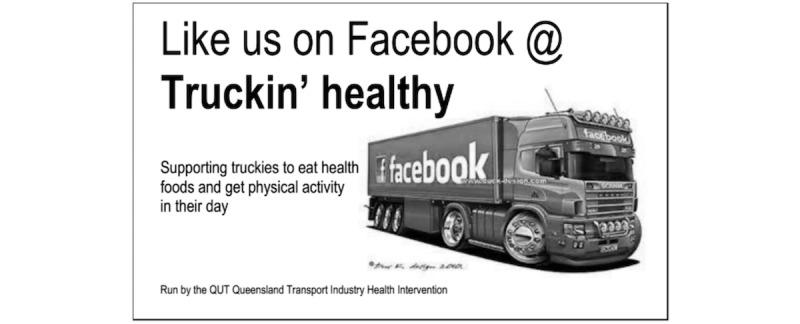
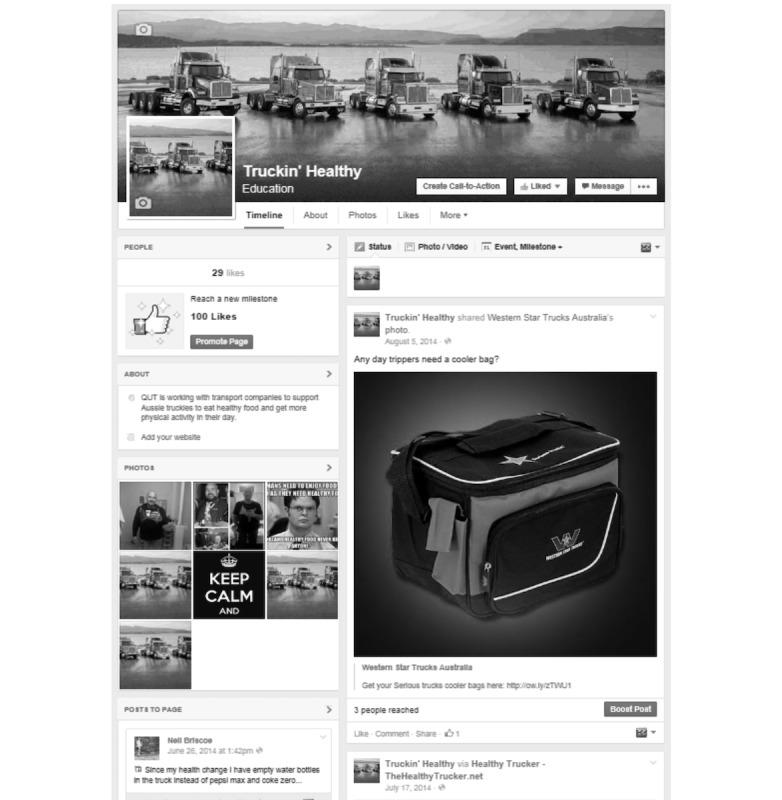
This study analyzed qualitative data from interviews and focus group discussions to evaluate a social media health promotion intervention, the Truckin' Healthy Facebook webpage, in selected Australian transport industry workplaces.
METHODS
We engaged 5 workplace managers and 30 truck drivers from 6 transport industry organizations in developing workplace health promotion strategies, including a social media intervention, within a Participatory Action Research approach. Mixed methods, including a pre- and postintervention manager survey, truck driver survey, key informant semistructured interviews, truck driver focus groups, and focused observation, were used to evaluate the social media intervention. We asked questions about workplace managers' and truck drivers' opinions, engagement, and satisfaction with the intervention. This paper focuses on qualitative data.
RESULTS
Of the workplace managers who reported implementing the social media intervention at their workplace, all (3/3, 100%) reported satisfaction with the intervention and expressed a keen interest in learning more about social media and how it may be used for workplace health promotion and other purposes. Truck drivers were poorly engaged with the intervention because (1) many believed they were the "wrong age" and lacked the necessary skills; (2) the cost of smartphone technology was prohibitive; (3) they confined their use of social media to nonwork-related purposes; and (4) many workplaces had "no Facebook" policies.
CONCLUSIONS
The use of social media as a health promotion intervention in transport industry workplaces has potential. Workplace interventions using social media can benefit from a Participatory Action Research approach. Involving managers and workers in the design of social media health promotion interventions and developing strategies to support and deliver the interventions helps to facilitate their success. The workers' profile, including their age and familiarity with social media, and work, workplace, and family context is important to consider in this process. Much more research needs to be undertaken to better understand the effective use of social media to engage "hard-to-reach" groups.
背景
道路运输行业的工人,尤其是卡车司机,患慢性病的风险更高。涉及社交媒体等技术的创新型健康促进策略可能会吸引这一“难以接触到”的群体。在澳大利亚运输行业,缺乏关于社交媒体技术促进健康效果的证据。
目的
本研究分析了访谈和焦点小组讨论中的定性数据,以评估澳大利亚选定运输行业工作场所的社交媒体健康促进干预措施——“健康卡车运输”脸书网页。
方法
我们采用参与式行动研究方法,与6个运输行业组织的5名工作场所经理和30名卡车司机合作,制定工作场所健康促进策略,包括社交媒体干预措施。采用混合方法,包括干预前后的经理调查、卡车司机调查、关键信息提供者半结构化访谈、卡车司机焦点小组讨论和重点观察,来评估社交媒体干预措施。我们询问了关于工作场所经理和卡车司机对干预措施的意见、参与度和满意度。本文重点关注定性数据。
结果
在报告在其工作场所实施社交媒体干预措施的工作场所经理中,所有人(3/3,100%)都对干预措施表示满意,并表示非常有兴趣了解更多关于社交媒体的信息,以及它如何用于工作场所健康促进和其他目的。卡车司机对干预措施的参与度很低,原因如下:(1)许多人认为自己年龄“不合适”,缺乏必要技能;(2)智能手机技术成本过高;(3)他们将社交媒体的使用局限于与工作无关的目的;(4)许多工作场所都有“禁止使用脸书”的政策。
结论
在运输行业工作场所使用社交媒体作为健康促进干预措施具有潜力。利用社交媒体的工作场所干预措施可受益于参与式行动研究方法。让经理和工人参与社交媒体健康促进干预措施的设计,并制定支持和实施这些干预措施的策略,有助于促进其成功。在此过程中,考虑工人的特征,包括他们的年龄和对社交媒体的熟悉程度,以及工作、工作场所和家庭背景非常重要。需要进行更多研究,以更好地了解如何有效利用社交媒体来吸引“难以接触到”的群体。
 Zotero 插件