
食草动物通过减缓巨藻碎屑的沉降速度来延长蓝碳转移。
Grazers extend blue carbon transfer by slowing sinking speeds of kelp detritus.
机构信息
UWA Oceans Institute & School of Biological Sciences, University of Western Australia, Perth, Australia.
Department of Science and Environment, Roskilde University, Roskilde, Denmark.
出版信息
Sci Rep. 2018 Nov 21;8(1):17180. doi: 10.1038/s41598-018-34721-z.
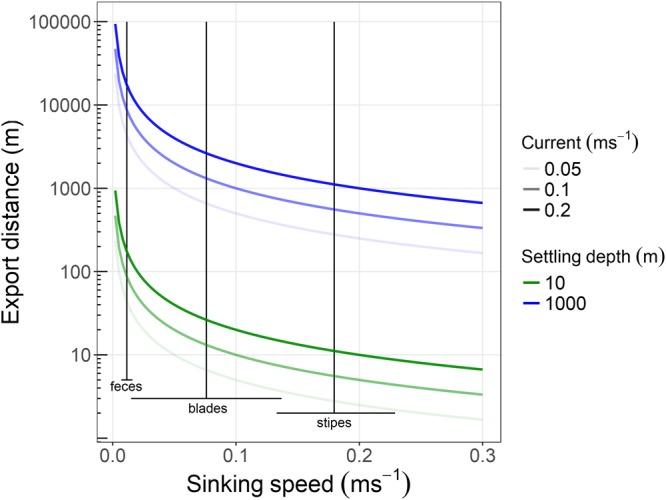
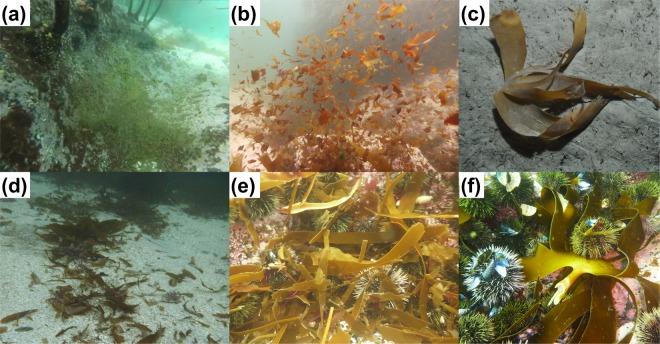
Marine plant communities such as kelp forests produce significant amounts of detritus, most of which is exported to areas where it can constitute an important trophic subsidy or potentially be sequestered in marine sediments. Knowing the vertical transport speed of detrital particles is critical to understanding the potential magnitude and spatial extent of these linkages. We measured sinking speeds for Laminaria hyperborea detritus ranging from whole plants to small fragments and sea urchin faecal pellets, capturing the entire range of particulate organic matter produced by kelp forests. Under typical current conditions, we determined that this organic material can be transported 10 s of m to 10 s of km. We show how the conversion of kelp fragments to sea urchin faeces, one of the most pervasive processes in kelp forests globally, increases the dispersal potential of detritus by 1 to 2 orders of magnitude. Kelp detritus sinking speeds were also faster than equivalent phytoplankton, highlighting its potential for rapid delivery of carbon to deep areas. Our findings support arguments for a significant contribution from kelp forests to subsidizing deep sea communities and the global carbon sink.
海洋植物群落,如海带林,会产生大量碎屑,其中大部分被输出到可以构成重要营养物质补贴或可能被海洋沉积物封存的区域。了解碎屑颗粒的垂直输运速度对于理解这些联系的潜在规模和空间范围至关重要。我们测量了从整个植物到小碎片和海胆粪便球的大黄菜叶碎屑的下沉速度,这些都属于海带林产生的整个范围的颗粒有机物。在典型的当前条件下,我们确定这些有机物质可以被输送 10 到 100 公里。我们展示了海带碎片转化为海胆粪便(这是全球海带林中最普遍的过程之一)如何将碎屑的扩散潜力提高 1 到 2 个数量级。海带碎屑的下沉速度也比同等的浮游植物快,这突出了其将碳快速输送到深海区的潜力。我们的研究结果支持了海带林对深海群落和全球碳汇的重要贡献的论点。


 Zotero 插件