
泰国产超广谱β-内酰胺酶细菌的表型和基因型特征
Phenotypic and genotypic characterizations of extended-spectrum beta-lactamase-producing in Thailand.
作者信息
Bubpamala Jiranun, Khuntayaporn Piyatip, Thirapanmethee Krit, Montakantikul Preecha, Santanirand Pitak, Chomnawang Mullika T
机构信息
Department of Microbiology, Faculty of Pharmacy, Mahidol University, Bangkok, Thailand,
Department of Pharmacy, Faculty of Pharmacy, Mahidol University, Bangkok, Thailand.
出版信息
Infect Drug Resist. 2018 Nov 5;11:2151-2157. doi: 10.2147/IDR.S174506. eCollection 2018.
PURPOSE
Extended-spectrum β-lactamases (ESBLs) have become an issue in community worldwide due to an increase in antibiotic resistance over the past decade. This study was aimed to investigate the phenotypic and genotypic characteristics of ESBL-producing in Thailand.
MATERIALS AND METHODS
In this study, all clinical isolates collected from tertiary hospitals in Thailand were identified as by biochemical tests and MALDI-TOF mass spectrometry. ESBL-producing was preliminary screened with disk diffusion method by cephalosporin disks and confirmed by the method of combination disk diffusion. Antimicrobial susceptibility test was used to determine MIC values of all ESBL-producing . For genotypic detection, a variety of ESBL genes were determined by PCR. Moreover, multilocus sequence typing (MLST) analysis was performed on internal portions of seven housekeeping genes for the diversity and phylogenetic relatedness of clonal group.
RESULTS
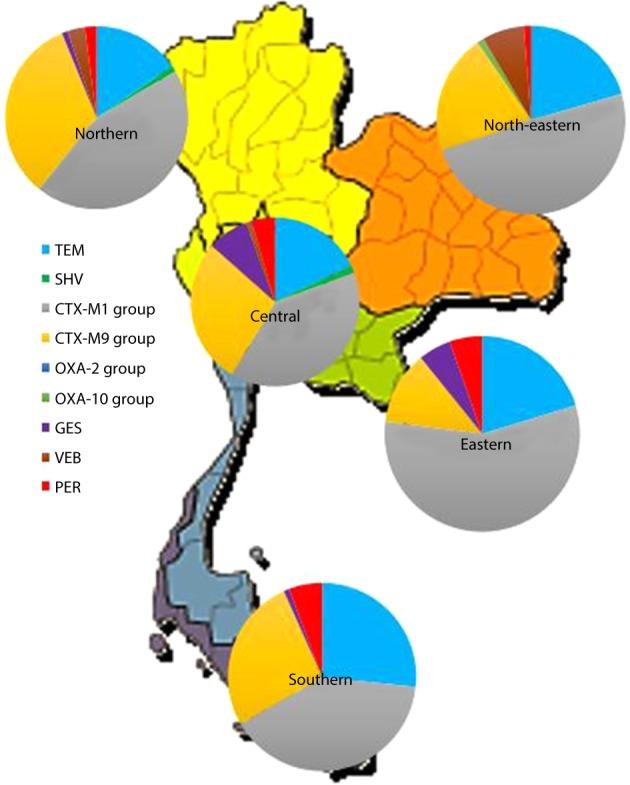
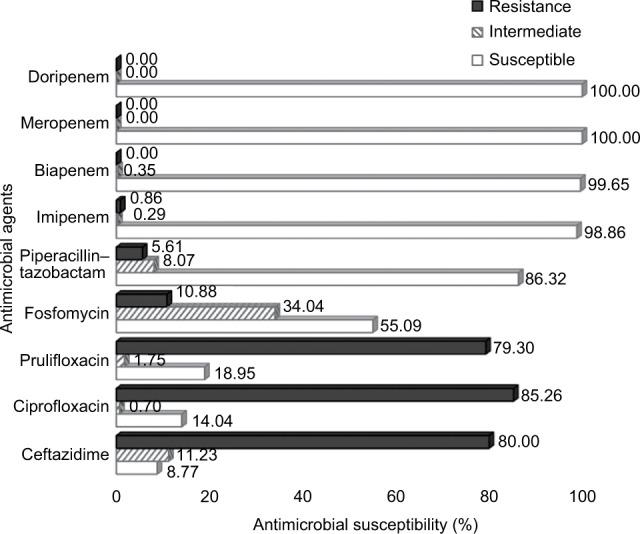
Of the 285 ESBL-producing , most were susceptible to carbapenems. These strains showed a high resistance rate to ciprofloxacin (85.26%). The most frequently detected gene was group at about 71.23% followed by group (38.95%). The , , , , and genes were identified in 31.93%, 5.96%, 4.56%, 3.51%, and 0.70% of ESBL-producing isolates, respectively. The OXA-10 gene was detected in only one strain. ESBL-producing isolates with high antimicrobial resistance were further investigated. Among those, sequence type ST38 was mostly found, followed by ST405, ST410, and ST131. It is noteworthy that the gene was mainly detected in all four ST-type clones (ST38, ST405, ST410, and ST131).
CONCLUSION
This study provided a recent evidence of the genetic diversity of ESBL-producing in Thailand. In addition, the profile related to antimicrobial resistance pattern in this region was also demonstrated.
目的
在过去十年中,由于抗生素耐药性增加,超广谱β-内酰胺酶(ESBLs)已成为全球范围内社区面临的一个问题。本研究旨在调查泰国产ESBLs细菌的表型和基因型特征。
材料与方法
在本研究中,从泰国三级医院收集的所有临床分离株通过生化试验和基质辅助激光解吸电离飞行时间质谱法鉴定为细菌。产ESBLs细菌先用头孢菌素纸片通过纸片扩散法进行初步筛选,并通过组合纸片扩散法进行确认。采用药敏试验测定所有产ESBLs细菌的最低抑菌浓度(MIC)值。对于基因型检测,通过聚合酶链反应(PCR)测定多种ESBL基因。此外,对七个管家基因的内部区域进行多位点序列分型(MLST)分析,以了解细菌克隆群的多样性和系统发育相关性。
结果
在285株产ESBLs细菌中,大多数对碳青霉烯类敏感。这些菌株对环丙沙星显示出较高的耐药率(85.26%)。最常检测到的基因是CTX-M组,约占71.23%,其次是TEM组(38.95%)。SHV、OXA-1、OXA-2、PER和VEB基因分别在31.93%、5.96%、4.56%、3.51%和0.70%的产ESBLs分离株中被鉴定出来。仅在一株菌株中检测到OXA-10基因。对具有高抗菌耐药性的产ESBLs细菌分离株进行了进一步研究。其中,最常见的序列类型是ST38,其次是ST405、ST410和ST131。值得注意的是,CTX-M基因主要在所有四种ST型克隆(ST38、ST405、ST410和ST131)中被检测到。
结论
本研究提供了泰国产ESBLs细菌遗传多样性的最新证据。此外,还展示了该地区与抗菌耐药模式相关的概况。
 Zotero 插件