
县级收入不平等与中国幸福感的心理关联机制。
Psychological Mechanisms Linking County-Level Income Inequality to Happiness in China.
机构信息
School of Economics and Management, Beijing Jiaotong University, No.3 Shangyuancun, Haidian District, Beijing 100044, China.
School of Economics, Wuhan University of Technology, 122 Luoshi Road, Wuhan 430070, China.
出版信息
Int J Environ Res Public Health. 2018 Nov 27;15(12):2667. doi: 10.3390/ijerph15122667.
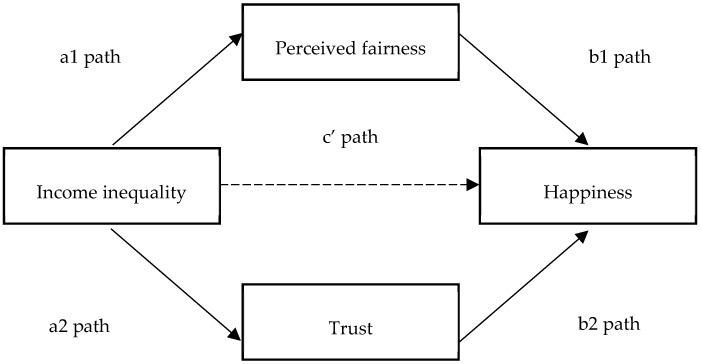
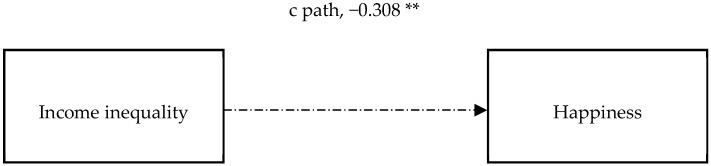
In China, income levels and living standards have improved significantly, but many Chinese citizens still do not feel any happier. This phenomenon may be attributed to increased income inequality. Using data from the 2013 Chinese General Social Survey (CGSS), we employed multilevel structural equation modeling (MSEM) to investigate the impact of county-level income inequality on individual-level happiness in China and multilevel mediation analysis with structural equation modeling (MMSEM) to explore the mechanisms through which income inequality impacted happiness. A negative relationship between income inequality and happiness was found. The negative association between them was explained by two psychological mechanisms, i.e., fairness and trust. The findings explained a "Chinese puzzle," i.e., why people do not feel happier despite improved income and living standards. Our findings may provide a reference for policy makers to implement policies designed to improve individual happiness. What is important now is to reduce income inequality, and to potentially improve perceptions of fairness and trust in China.
在中国,收入水平和生活水平有了显著提高,但许多中国公民仍然感觉不那么幸福。这种现象可能归因于收入不平等的加剧。我们使用了 2013 年中国综合社会调查(CGSS)的数据,采用多层次结构方程模型(MSEM)研究了县级收入不平等对中国个体幸福感的影响,以及采用结构方程模型的多层次中介分析(MMSEM)探讨了收入不平等影响幸福感的机制。结果发现收入不平等与幸福感呈负相关。这两者之间的负相关关系可以通过两种心理机制来解释,即公平和信任。这些发现解释了一个“中国谜题”,即为什么人们的收入和生活水平提高了,但幸福感却没有提高。我们的研究结果可能为政策制定者提供参考,制定旨在提高个人幸福感的政策。现在重要的是要减少收入不平等,并有可能改善中国的公平感和信任感。


 Zotero 插件