
益生元低聚半乳糖通过靶向肠-脑轴对术后认知功能障碍和神经炎症的影响。
Effects of prebiotic galacto-oligosaccharide on postoperative cognitive dysfunction and neuroinflammation through targeting of the gut-brain axis.
作者信息
Yang Xu-Dong, Wang Li-Kuan, Wu Hai-Yin, Jiao Liang
机构信息
Department of Anesthesiology, Peking University School and Hospital of Stomatology, #22 Zhongguancun South Avenue, Beijing, 100081, China.
National Engineering Laboratory for Digital and Material Technology of Stomatology, Beijing Key Laboratory of Digital Stomatology, #22 Zhongguancun South Avenue, Beijing, 100081, China.
出版信息
BMC Anesthesiol. 2018 Nov 30;18(1):177. doi: 10.1186/s12871-018-0642-1.
BACKGROUND
Surgery-induced neuroinflammation plays an important role in postoperative cognitive dysfunction (POCD). Gut microbiota is a key regulator of neurological inflammation. Nurturing with prebiotics is an effective microbiota manipulation that can regulate host immunity and cognition. The aim of the present study was to test whether administration of the prebiotic Bimuno® (galactooligosaccharide (B-GOS) mixture) could ameliorate POCD and attenuate surgery-induced neuroinflammation through the microbiota-brain-axis.
METHODS
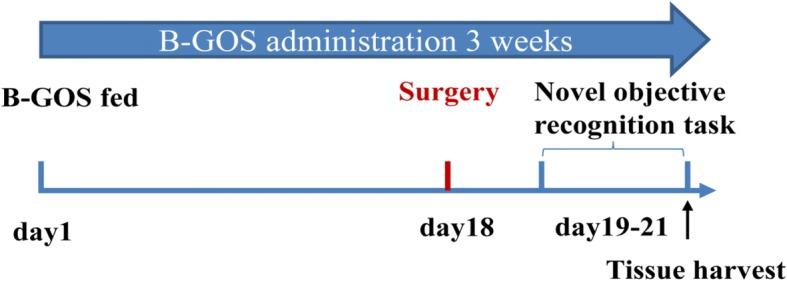
Adult rats undergoing abdominal surgery under isoflurane anesthesia were fed with water or prebiotic B-GOS supplementation (15 g/L) for 3 weeks. Novel objective recognition task was employed for testing cognitive changes on postoperative day three. Expression of microglial marker Iba-1 in the hippocampus was assessed by immunohistochemical staining. Expression levels of phenotypic gene markers of activated microglia (M1: iNOS, CD68, CD32; M2: Ym1, CD206, and SOCS3) in hippocampus were determined by quantitative polymerase chain reaction (qPCR). Inflammatory cytokines in the hippocampus were assessed using enzyme-linked immunosorbent assay (ELISA). Feces were collected for microbial community analysis.
RESULTS
Rats exhibited an impairment in novel objective recognition 3 days after surgery compared with control rats (P < .01). In the hippocampus, expressions of Iba-1 and M1 markers of surgical rats were significantly upregulated. Similarly, expressions of SOCS3 and CD206 in the hippocampus were upregulated. Additionally, increasing levels of IL-6 and IL-4 were evident in the hippocampus. Administration of B-GOS significantly alleviated cognitive decline induced by surgery (P < .01). B-GOS-fed rats showed a significantly downregulated activation of microglia and expressions of M1-related genes and SOCS3 and IL-6. While there was no significant difference in expressions of CD206 and Ym1 and IL-4 between the surgical and B-GOS groups. Analysis of gut microbiome found that administration of B-GOS induced a significant change beta diversity of the gut microbiome and proliferation of Bifidobacterium and other potentially anti-inflammatory microbes.
CONCLUSIONS
Administration of B-GOS has a beneficial effect on regulating neuroinflammatory and cognitive impairment in a rat model of abdominal surgery and was associated with the manipulation of gut microbiota.
背景
手术诱导的神经炎症在术后认知功能障碍(POCD)中起重要作用。肠道微生物群是神经炎症的关键调节因子。益生元培养是一种有效的微生物群调控方法,可调节宿主免疫和认知。本研究的目的是测试给予益生元Bimuno®(低聚半乳糖(B-GOS)混合物)是否可以通过微生物群-脑轴改善POCD并减轻手术诱导的神经炎症。
方法
成年大鼠在异氟烷麻醉下接受腹部手术,分别给予水或补充益生元B-GOS(15 g/L)3周。采用新颖目标识别任务测试术后第3天的认知变化。通过免疫组织化学染色评估海马中微胶质细胞标志物Iba-1的表达。通过定量聚合酶链反应(qPCR)测定海马中活化微胶质细胞(M1:诱导型一氧化氮合酶、CD68、CD32;M2:Ym1、CD206和细胞因子信号转导抑制因子3)的表型基因标志物的表达水平。使用酶联免疫吸附测定(ELISA)评估海马中的炎性细胞因子。收集粪便进行微生物群落分析。
结果
与对照大鼠相比,大鼠在手术后3天的新颖目标识别能力受损(P <.01)。在海马中,手术大鼠的Iba-1和M1标志物的表达显著上调。同样,海马中细胞因子信号转导抑制因子3和CD206的表达上调。此外,海马中白细胞介素-6和白细胞介素-4水平明显升高。给予B-GOS显著减轻了手术诱导的认知衰退(P <.01)。喂食B-GOS的大鼠显示微胶质细胞的活化以及与M1相关基因、细胞因子信号转导抑制因子3和白细胞介素-6的表达显著下调。而手术组和B-GOS组之间,Ym1、CD206的表达以及白细胞介素-4水平无显著差异。肠道微生物组分析发现,给予B-GOS诱导肠道微生物组的β多样性发生显著变化,并使双歧杆菌和其他潜在的抗炎微生物增殖。
结论
给予B-GOS对腹部手术大鼠模型中的神经炎症和认知障碍调节具有有益作用,并且与肠道微生物群的调控有关。



 Zotero 插件