
一种用于评估野外疟蚊交配竞争力的转基因工具。
A transgenic tool to assess Anopheles mating competitiveness in the field.
机构信息
Harvard T.H. Chan School of Public Health, Department of Immunology and Infectious Diseases, Boston, MA, USA.
出版信息
Parasit Vectors. 2018 Dec 24;11(Suppl 2):651. doi: 10.1186/s13071-018-3218-5.
BACKGROUND
Malaria parasites, transmitted by the bite of an anopheline mosquito, pose an immense public health burden on many tropical and subtropical regions. The most important malaria vectors in sub-Saharan Africa are mosquitoes of the Anopheles gambiae complex including An. gambiae (sensu stricto). Given the increasing rates of insecticide resistance in these mosquitoes, alternative control strategies based on the release of genetically modified males are being evaluated to stop transmission by these disease vectors. These strategies rely on the mating competitiveness of release males, however currently there is no method to determine male mating success without sacrificing the female. Interestingly, unlike other insects, during mating An. gambiae males transfer their male accessory glands (MAGs) seminal secretions as a coagulated mating plug which is deposited in the female atrium.
RESULTS
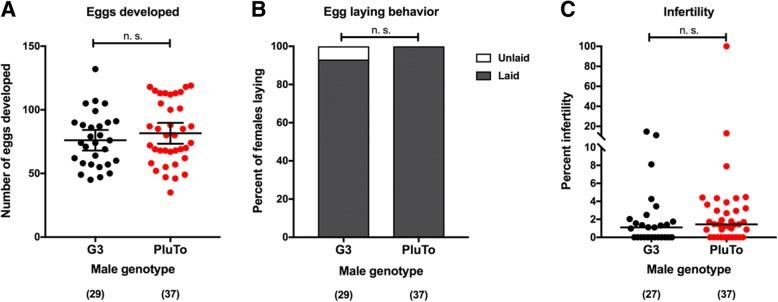
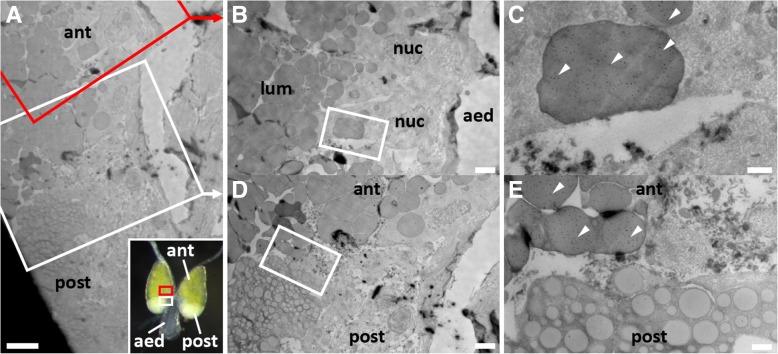
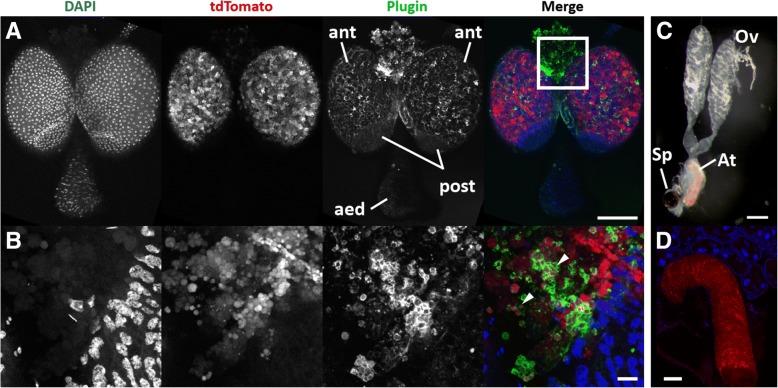
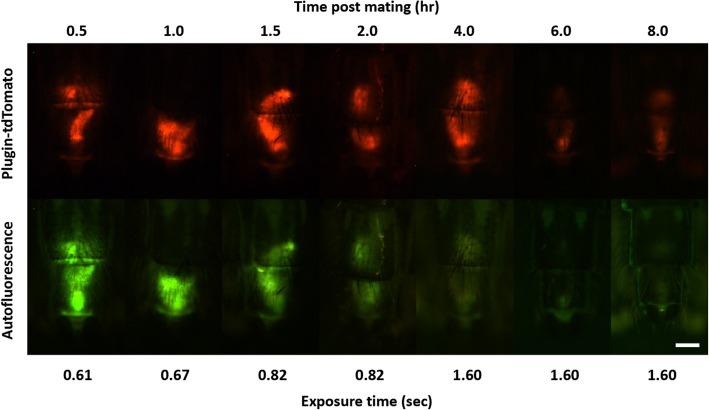
Here we exploit this male reproductive feature and validate the use of a MAG-specific promoter to fluorescently label the mating plug and visualize the occurrence of insemination in vivo. We used the promoter region of the major mating plug protein, Plugin, to control the expression of a Plugin-tdTomato (PluTo) fusion protein, hypothesizing that this fusion protein could be incorporated into the plug for sexual transfer to the female. Anopheles gambiae PluTo transgenic males showed strong red fluorescence specifically in the MAGs and with a pattern closely matching endogenous Plugin expression. Moreover, the fusion protein was integrated into the mating plug and transferred to the female atrium during mating where it could be visualized microscopically in vivo without sacrificing the female. PluTo males were equally as competitive at mating as wild type males, and females mated to these males did not show any reduction in reproductive fitness.
CONCLUSION
The validation of the first MAG-specific promoter in transgenic An. gambiae facilitates the live detection of successful insemination hours after copulation has occurred. This provides a valuable tool for the assessment of male mating competitiveness not only in laboratory experiments but also in semi-field and field studies aimed at testing the feasibility of releasing genetically modified mosquitoes for disease control.
背景
疟原虫通过疟蚊的叮咬传播,对许多热带和亚热带地区的公共卫生造成了巨大的负担。撒哈拉以南非洲最重要的疟疾传播媒介是冈比亚按蚊复合体中的蚊子,包括冈比亚按蚊(狭义)。鉴于这些蚊子的杀虫剂耐药率不断上升,正在评估基于释放遗传修饰雄性的替代控制策略来阻止这些疾病传播媒介的传播。这些策略依赖于释放雄性的交配竞争力,然而目前没有不牺牲雌性就能确定雄性交配成功率的方法。有趣的是,与其他昆虫不同,在交配过程中,冈比亚按蚊雄性会将其雄性附腺(MAGs)精液分泌物作为凝结的交配栓转移到雌性心房中。
结果
在这里,我们利用这种雄性生殖特征,验证了使用 MAG 特异性启动子来荧光标记交配栓并在体内可视化授精发生的用途。我们使用主要交配栓蛋白 Plugin 的启动子区域来控制 Plugin-tdTomato(PluTo)融合蛋白的表达,假设该融合蛋白可以整合到栓中进行性传递给雌性。冈比亚按蚊 PluTo 转基因雄性在 MAGs 中表现出强烈的红色荧光,与内源性 Plugin 表达模式非常匹配。此外,融合蛋白整合到交配栓中,并在交配过程中转移到雌性心房中,在不牺牲雌性的情况下可以在体内进行显微镜下观察。PluTo 雄性在交配方面与野生型雄性同样具有竞争力,与这些雄性交配的雌性在繁殖力方面没有任何降低。
结论
在转基因冈比亚按蚊中第一个 MAG 特异性启动子的验证促进了在交配后数小时成功授精的活体检测。这为评估雄性交配竞争力提供了一个有价值的工具,不仅可以在实验室实验中使用,还可以在半野外和野外研究中使用,旨在测试释放遗传修饰蚊子进行疾病控制的可行性。

 Zotero 插件