
miR-3470b 通过直接靶向乳鼠叙利亚仓鼠肾细胞中线粒体抗病毒信号蛋白(MAVS)促进牛暂时热病毒复制。
MiR-3470b promotes bovine ephemeral fever virus replication via directly targeting mitochondrial antiviral signaling protein (MAVS) in baby hamster Syrian kidney cells.
机构信息
College of Animal Science and Technology, Jilin Agricultural University, Changchun, 130118, People's Republic of China.
Key Laboratory of Animal Resistant Biology of Shandong, Ruminant Diseases Research Center, College of Life Sciences, Shandong Normal University, Jinan, 250014, People's Republic of China.
出版信息
BMC Microbiol. 2018 Dec 27;18(1):224. doi: 10.1186/s12866-018-1366-6.
BACKGROUND
Bovine ephemeral fever virus (BEFV), the causative agent of bovine ephemeral fever, is an economically important pathogen of cattle and water buffalo. MicroRNAs (miRNAs) are endogenous 21-23 nt small non-coding RNA molecules that binding to a multiple of target mRNAs and functioning in the regulation of viral replication including the miRNA-mediated antiviral defense. However, the reciprocal interaction between bovine ephemeral fever virus replication and host miRNAs still remain poorly understood. The aim of our study herein was to investigate the exact function of miR-3470b and its molecular mechanisms during BEFV infection.
RESULTS
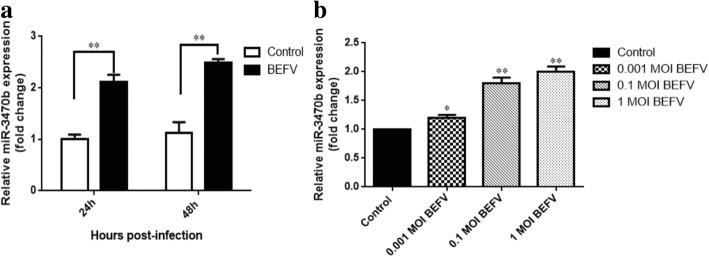
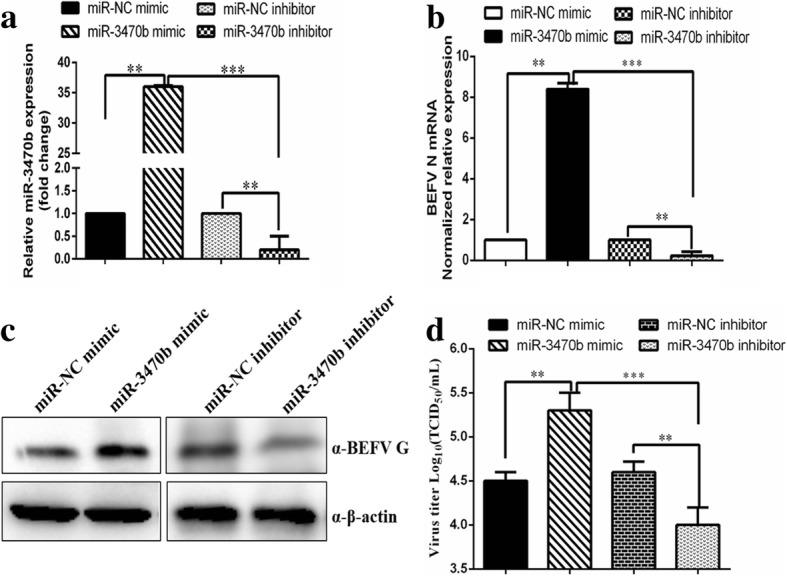
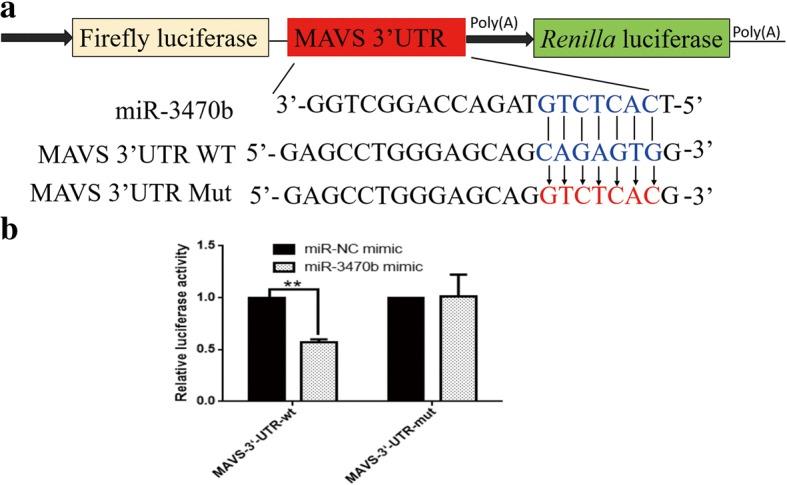
In this study, we found a set of microRNAs induced by BEFV infection using small RNA deep sequencing, and further identified BEFV infection could significantly up-regulate the miR-3470b expression in Baby Hamster Syrian Kidney cells (BHK-21) after 24 h and 48 h post-infection (pi) compared to normal BHK-21 cells without BEFV infection. Additionally, the target association between miR-3470b and mitochondrial antiviral signaling protein (MAVS) was predicted by target gene prediction tools and further validated using a dual-luciferase reporter assay, and the expression of MAVS mRNA and protein levels was negatively associated with miR-3470b levels. Furthermore, the miR-3470b mimic transfection significantly contributed to increase the BEFV N mRNA, G protein level and viral titer, respectively, whereas the miR-3470b inhibitor had the opposite effect on BEFV replication. Moreover, the overexpression of MAVS or silencing of miR-3470b by its inhibitors suppressed BEFV replication, and knockdown of MAVS by small interfering RNA also promoted the replication of BEFV.
CONCLUSIONS
Our findings is the first to reveal that miR-3470b as a novel host factor regulates BEFV replication via directly targeting the MAVS gene in BHK-21 cells and may provide a potential strategy for developing effective antiviral therapy.
背景
牛暂时热病毒(BEFV)是牛暂时热的病原体,是牛和水牛的一种具有经济重要性的病原体。microRNAs(miRNAs)是内源性的 21-23nt 小分子非编码 RNA 分子,与多个靶标 mRNAs 结合,在病毒复制中发挥作用,包括 miRNA 介导的抗病毒防御。然而,牛暂时热病毒复制与宿主 miRNAs 之间的相互作用仍知之甚少。本研究旨在探讨 miR-3470b 在 BEFV 感染过程中的确切作用及其分子机制。
结果
在本研究中,我们使用小 RNA 深度测序发现了一组由 BEFV 感染诱导的 microRNAs,并进一步鉴定出 BEFV 感染后 24 小时和 48 小时,与未感染 BEFV 的正常 BHK-21 细胞相比,BHK-21 细胞中 miR-3470b 的表达显著上调。此外,靶基因预测工具预测了 miR-3470b 与线粒体抗病毒信号蛋白(MAVS)之间的靶标关联,并通过双荧光素酶报告基因检测进一步验证,MAVS mRNA 和蛋白水平的表达与 miR-3470b 水平呈负相关。此外,miR-3470b 模拟物转染分别显著促进了 BEFV N mRNA、G 蛋白水平和病毒滴度的增加,而 miR-3470b 抑制剂则对 BEFV 复制产生相反的影响。此外,MAVS 的过表达或 miR-3470b 抑制剂的沉默抑制了 BEFV 的复制,而通过小干扰 RNA 敲低 MAVS 也促进了 BEFV 的复制。
结论
本研究首次发现,miR-3470b 作为一种新的宿主因子,通过直接靶向 BHK-21 细胞中的 MAVS 基因来调节 BEFV 复制,这可能为开发有效的抗病毒治疗提供了一种潜在的策略。


 Zotero 插件