
调控蜜蜂蜂王繁殖与健康的假定雄蜂交配因子综述
Putative Drone Copulation Factors Regulating Honey Bee () Queen Reproduction and Health: A Review.
作者信息
Brutscher Laura M, Baer Boris, Niño Elina L
机构信息
Department of Entomology and Nematology, University of California, Davis, CA 95616, USA.
Centre for Integrative Bee Research, Department of Entomology, University of California, Riverside, CA 92521, USA.
出版信息
Insects. 2019 Jan 8;10(1):8. doi: 10.3390/insects10010008.
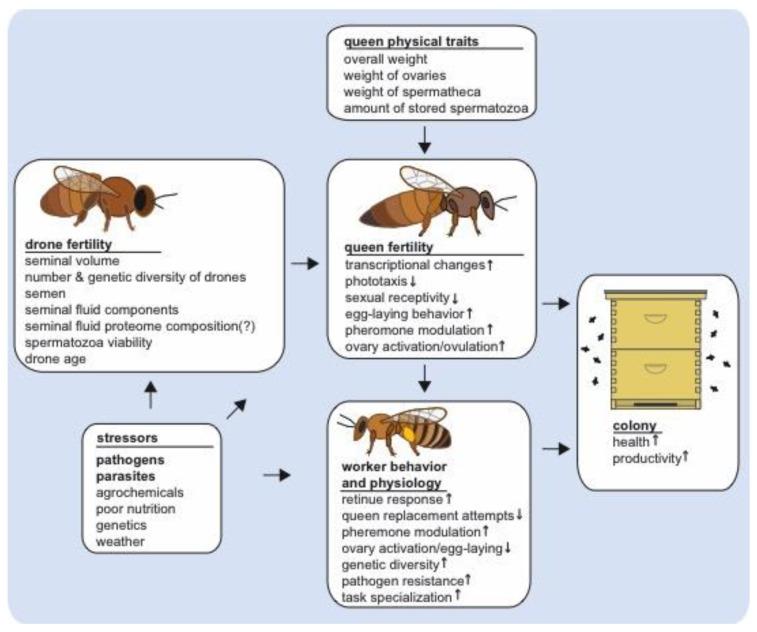
Honey bees are major pollinators of agricultural and non-agricultural landscapes. In recent years, honey bee colonies have exhibited high annual losses and commercial beekeepers frequently report poor queen quality and queen failure as the primary causes. Honey bee colonies are highly vulnerable to compromised queen fertility, as each hive is headed by one reproductive queen. Queens mate with multiple drones (male bees) during a single mating period early in life in which they obtain enough spermatozoa to fertilize their eggs for the rest of their reproductive life span. The process of mating initiates numerous behavioral, physiological, and molecular changes that shape the fertility of the queen and her influence on the colony. For example, receipt of drone semen can modulate queen ovary activation, pheromone production, and subsequent worker retinue behavior. In addition, seminal fluid is a major component of semen that is primarily derived from drone accessory glands. It also contains a complex mixture of proteins such as proteases, antioxidants, and antimicrobial proteins. Seminal fluid proteins are essential for inducing post-mating changes in other insects such as and thus they may also impact honey bee queen fertility and health. However, the specific molecules in semen and seminal fluid that initiate post-mating changes in queens are still unidentified. Herein, we summarize the mating biology of honey bees, the changes queens undergo during and after copulation, and the role of drone semen and seminal fluid in post-mating changes in queens. We then review the effects of seminal fluid proteins in insect reproduction and potential roles for honey bee drone seminal fluid proteins in queen reproduction and health. We finish by proposing future avenues of research. Further elucidating the role of drone fertility in queen reproductive health may contribute towards reducing colony losses and advancing honey bee stock development.
蜜蜂是农业和非农业景观的主要传粉者。近年来,蜂群每年都有很高的损失率,商业养蜂人经常报告蜂王质量差和蜂王失败是主要原因。蜂群极易受到蜂王繁殖力受损的影响,因为每个蜂巢都由一只生殖蜂王领导。蜂王在生命早期的单一交配期内与多只雄蜂(雄蜂)交配,在此期间它们获得足够的精子,以在其剩余的繁殖寿命中为卵子受精。交配过程引发了许多行为、生理和分子变化,这些变化塑造了蜂王的繁殖力及其对蜂群的影响。例如,接受雄蜂精液可以调节蜂王卵巢的激活、信息素的产生以及随后工蜂的侍从行为。此外,精液是精液的主要成分,主要来自雄蜂的附腺。它还含有蛋白质的复杂混合物,如蛋白酶、抗氧化剂和抗菌蛋白。精液蛋白对于诱导其他昆虫(如 )交配后的变化至关重要,因此它们也可能影响蜜蜂蜂王的繁殖力和健康。然而,精液和精浆中引发蜂王交配后变化的具体分子仍未确定。在此,我们总结了蜜蜂的交配生物学、蜂王在交配期间和交配后所经历的变化,以及雄蜂精液和精浆在蜂王交配后变化中的作用。然后,我们回顾了精液蛋白在昆虫繁殖中的作用以及蜜蜂雄蜂精液蛋白在蜂王繁殖和健康中的潜在作用。我们最后提出了未来的研究方向。进一步阐明雄蜂繁殖力在蜂王生殖健康中的作用可能有助于减少蜂群损失并推动蜜蜂种群发展。
 Zotero 插件