
蛋白激酶 D2 和 D3 在乳腺癌中调节多条癌症相关通路的致癌功能。
Oncogenic functions of protein kinase D2 and D3 in regulating multiple cancer-related pathways in breast cancer.
机构信息
Jiangsu Key Laboratory for Molecular and Medical Biotechnology, College of Life Science, Nanjing Normal University, Nanjing, China.
The Key Laboratory of Developmental Genes and Human Disease, Ministry of Education, Institute of Life Sciences, Southeast University, Nanjing, China.
出版信息
Cancer Med. 2019 Feb;8(2):729-741. doi: 10.1002/cam4.1938. Epub 2019 Jan 16.
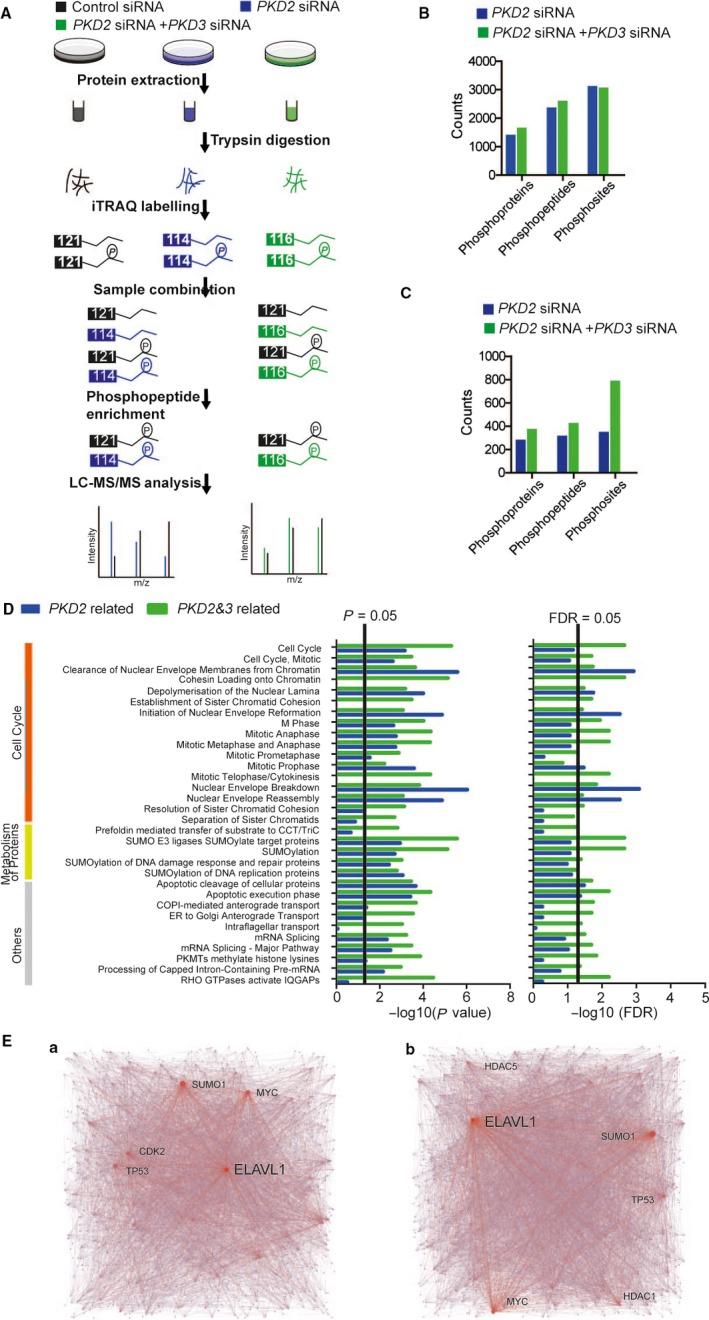
Protein Kinase D (PKD) family contains PKD1, PKD2, and PKD3 in human. Compared to consistent tumor-suppressive functions of PKD1 in breast cancer, how PKD2/3 functions in breast cancer are not fully understood. In the current study, we found that PKD2 and PKD3 but not PKD1 were preferentially overexpressed in breast cancer and involved in regulating cell proliferation and metastasis. Integrated phosphoproteome, transcriptome, and interactome showed that PKD2 was associated with multiple cancer-related pathways, including adherent junction, regulation of actin cytoskeleton, and cell cycle-related pathways. ELAVL1 was identified as a common hub-node in networks of PKD2/3-regulated phosphoproteins and genes. Silencing ELAVL1 inhibited breast cancer growth in vitro and in vivo. Direct interaction between ELAVL1 and PKD2 or PKD3 was demonstrated. Suppression of PKD2 led to ELAVL1 translocation from the cytoplasm to the nucleus without significant affecting ELAVL1 expression. Taken together, we characterized the oncogenic functions of PKD2/3 in breast cancer and their association with cancer-related pathways, which shed lights on the oncogenic roles and mechanisms of PKDs in breast cancer.
蛋白激酶 D(PKD)家族在人类中包含 PKD1、PKD2 和 PKD3。与 PKD1 在乳腺癌中一致的肿瘤抑制功能相比,PKD2/3 在乳腺癌中的功能尚未完全阐明。在本研究中,我们发现 PKD2 和 PKD3 而非 PKD1 在乳腺癌中优先过表达,并参与调节细胞增殖和转移。整合磷酸蛋白质组、转录组和相互作用组表明,PKD2 与多个与癌症相关的途径有关,包括黏着连接、肌动蛋白细胞骨架调节和细胞周期相关途径。ELAVL1 被鉴定为 PKD2/3 调节的磷酸化蛋白和基因网络中的共同枢纽节点。沉默 ELAVL1 抑制了体外和体内乳腺癌的生长。证明了 ELAVL1 与 PKD2 或 PKD3 之间的直接相互作用。抑制 PKD2 导致 ELAVL1 从细胞质向细胞核转位,而对 ELAVL1 表达没有明显影响。综上所述,我们描述了 PKD2/3 在乳腺癌中的致癌功能及其与癌症相关途径的关联,这为 PKDs 在乳腺癌中的致癌作用和机制提供了新的认识。



 Zotero 插件