
分析不同健身设施类型及内部的金黄色葡萄球菌分子流行病学特征。
Characterizing the molecular epidemiology of Staphylococcus aureus across and within fitness facility types.
机构信息
Kent State University, College of Podiatric Medicine, 6000 Rockside Woods Blvd. N, Independence, OH, 44131, USA.
Department of Biostatistics, Environmental Health Sciences and Epidemiology, Kent State University, College of Public Health, Kent, OH, USA.
出版信息
BMC Infect Dis. 2019 Jan 18;19(1):69. doi: 10.1186/s12879-019-3699-7.
BACKGROUND
Staphylococcus aureus is a common bacterium found in the nose and throat of healthy individuals, and presents risk factors for infection and death. We investigated environmental contamination of fitness facilities with S. aureus in order to determine molecular types and antibiotic susceptibility profiles of contaminates that may be transmitted to facility patrons.
METHODS
Environmental swabs (n = 288) were obtained from several fitness facilities (n = 16) across Northeast Ohio including cross-fit type facilities (n = 4), traditional iron gyms (n = 4), community center-based facilities (n = 5), and hospital-associated facilities (n = 3). Samples were taken from 18 different surfaces at each facility and were processed within 24 h using typical bacteriological methods. Positive isolates were subjected to antibiotic susceptibility testing and molecular characterization (PVL and mecA PCR, and spa typing).
RESULTS
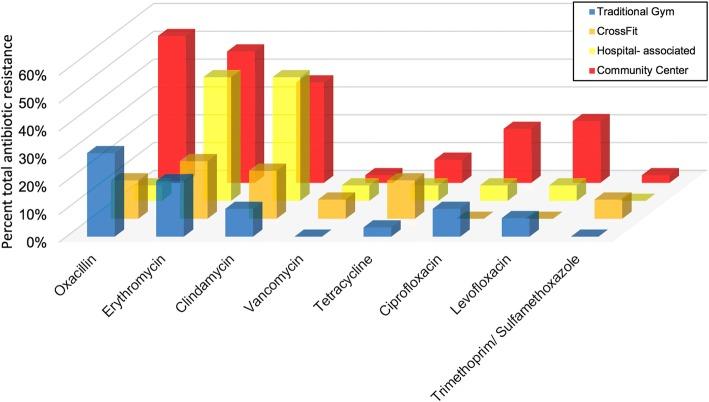
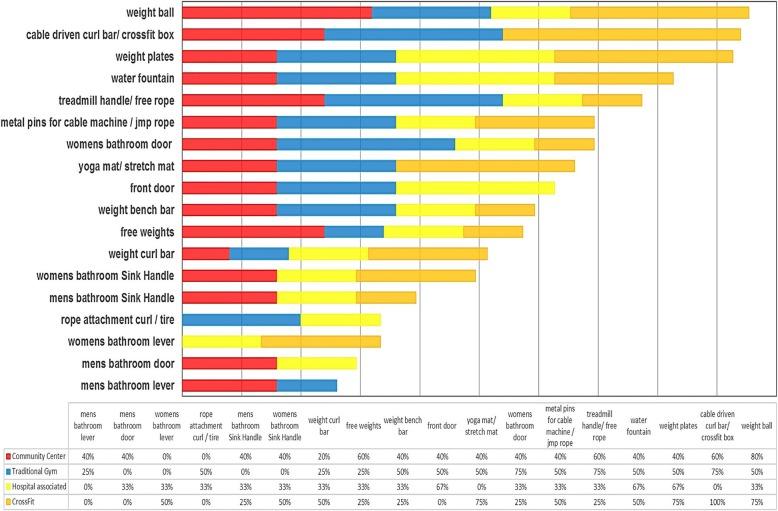
The overall prevalence of S. aureus on environmental surfaces in the fitness facilities was 38.2% (110/288). The most commonly colonized surfaces were the weight ball (62.5%), cable driven curl bar, and CrossFit box (62.5%), as well as the weight plates (56.3%) and treadmill handle (50%). Interestingly, the bathroom levers and door handles were the least contaminated surfaces in both male and female restroom facilities (18.8%). Community gyms (40.0%) had the highest contamination prevalence among sampled surfaces with CrossFit (38.9%), traditional gyms (38.9%), and hospital associated (33.3%) contaminated less frequently, though the differences were not significant (p = 0.875). The top spa types found overall were t008 (12.7%), t267 (10.0%), t160, t282, t338 (all at 5.5%), t012 and t442 (4.5%), and t002 (3.6%). t008 and t002 was found in all fitness facility types accept Crossfit, with t267 (25%), t548, t377, t189 (all 10.7%) the top spa types found within crossfit. All samples were resistant to benzylpenicillin, with community centers having significantly more strains resistant to oxacillin (52.8%), erythromycin (47%), clindamycin (36%), and ciprofloxacin (19%). Overall, 36.3% of isolates were multidrug resistant.
CONCLUSIONS
Our pilot study indicates that all facility types were contaminated by S. aureus and MRSA, and that additional studies are needed to characterize the microbiome structure of surfaces at different fitness facility types and the patrons at these facilities.
背景
金黄色葡萄球菌是健康个体鼻腔和喉咙中常见的细菌,存在感染和死亡的危险因素。我们调查了健身设施的环境污染情况,以确定可能传播给设施使用者的污染物的分子类型和抗生素敏感性特征。
方法
从俄亥俄州东北部的多个健身设施(n=16)中获得环境拭子(n=288),包括交叉式设施(n=4)、传统铁健身房(n=4)、社区中心设施(n=5)和医院相关设施(n=3)。在每个设施中,从 18 个不同的表面采集样本,并在 24 小时内使用典型的细菌学方法进行处理。阳性分离株进行抗生素敏感性试验和分子特征分析(PVL 和 mecA PCR,以及 spa 分型)。
结果
健身设施环境表面金黄色葡萄球菌的总体流行率为 38.2%(110/288)。最常定植的表面是重量球(62.5%)、电缆驱动卷曲棒和 CrossFit 盒(62.5%),以及重量盘(56.3%)和跑步机把手(50%)。有趣的是,浴室杠杆和门把手是男女洗手间设施中污染最少的表面(18.8%)。社区健身房(40.0%)的污染率最高,交叉式(38.9%)、传统健身房(38.9%)和医院相关(33.3%)污染较少,但差异无统计学意义(p=0.875)。总体而言,发现的主要 spa 类型是 t008(12.7%)、t267(10.0%)、t160、t282、t338(均为 5.5%)、t012 和 t442(4.5%)以及 t002(3.6%)。t008 和 t002 存在于所有健身设施类型中,除了 Crossfit,而 t267(25%)、t548、t377、t189(均为 10.7%)是 Crossfit 内发现的主要 spa 类型。所有样本均对苯唑西林耐药,社区中心对苯唑西林的耐药率显著更高(52.8%)、红霉素(47%)、克林霉素(36%)和环丙沙星(19%)。总体而言,36.3%的分离株为多药耐药菌。
结论
我们的初步研究表明,所有设施类型都被金黄色葡萄球菌和耐甲氧西林金黄色葡萄球菌污染,需要进一步研究来描述不同健身设施类型的表面微生物组结构以及这些设施的使用者。

 Zotero 插件