
利用干细胞衍生系统和 CRISPR/Cas9 技术对病毒性传染病中的宿主-病毒相互作用进行建模。
Modeling Host-Virus Interactions in Viral Infectious Diseases Using Stem-Cell-Derived Systems and CRISPR/Cas9 Technology.
机构信息
Institute of Molecular Biotechnology of the Austrian Academy of Sciences (IMBA), Vienna Biocenter (VBC), Dr. Bohr-Gasse 3, 1030 Vienna, Austria.
Department of Biological Sciences, Korea Advanced Institute of Science and Technology (KAIST), Daejeon 34141, Korea.
出版信息
Viruses. 2019 Jan 30;11(2):124. doi: 10.3390/v11020124.
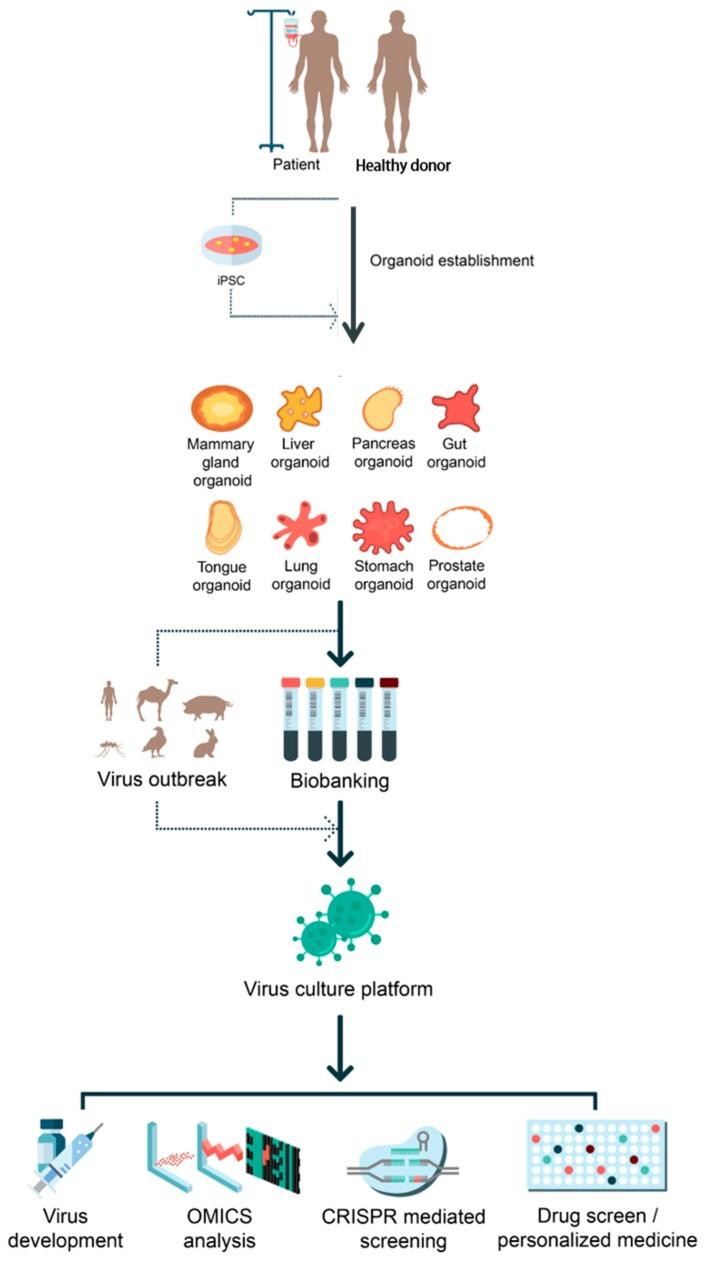
Pathologies induced by viral infections have undergone extensive study, with traditional model systems such as two-dimensional (2D) cell cultures and in vivo mouse models contributing greatly to our understanding of host-virus interactions. However, the technical limitations inherent in these systems have constrained efforts to more fully understand such interactions, leading to a search for alternative in vitro systems that accurately recreate in vivo physiology in order to advance the study of viral pathogenesis. Over the last decade, there have been significant technological advances that have allowed researchers to more accurately model the host environment when modeling viral pathogenesis in vitro, including induced pluripotent stem cells (iPSCs), adult stem-cell-derived organoid culture systems and CRISPR/Cas9-mediated genome editing. Such technological breakthroughs have ushered in a new era in the field of viral pathogenesis, where previously challenging questions have begun to be tackled. These include genome-wide analysis of host-virus crosstalk, identification of host factors critical for viral pathogenesis, and the study of viral pathogens that previously lacked a suitable platform, e.g., noroviruses, rotaviruses, enteroviruses, adenoviruses, and Zika virus. In this review, we will discuss recent advances in the study of viral pathogenesis and host-virus crosstalk arising from the use of iPSC, organoid, and CRISPR/Cas9 technologies.
病毒感染引起的病理学已经得到了广泛的研究,传统的模型系统,如二维(2D)细胞培养和体内小鼠模型,极大地促进了我们对宿主-病毒相互作用的理解。然而,这些系统固有的技术限制限制了我们更全面地理解这些相互作用的努力,因此需要寻找替代的体外系统,以准确再现体内生理学,从而推进病毒发病机制的研究。在过去的十年中,出现了一些重大的技术进步,使研究人员能够在体外模拟病毒发病机制时更准确地模拟宿主环境,包括诱导多能干细胞(iPSC)、成人干细胞衍生的类器官培养系统和 CRISPR/Cas9 介导的基因组编辑。这些技术突破开创了病毒发病机制领域的新纪元,使以前具有挑战性的问题开始得到解决。这些问题包括对宿主-病毒相互作用的全基因组分析、鉴定对病毒发病机制至关重要的宿主因素,以及研究以前缺乏合适平台的病毒病原体,例如诺如病毒、轮状病毒、肠道病毒、腺病毒和寨卡病毒。在这篇综述中,我们将讨论使用 iPSC、类器官和 CRISPR/Cas9 技术在病毒发病机制和宿主-病毒相互作用研究方面的最新进展。
 Zotero 插件