
基因工程 T 细胞治疗恶性脑胶质瘤:克服免疫治疗的障碍。
Genetically Engineered T-Cells for Malignant Glioma: Overcoming the Barriers to Effective Immunotherapy.
机构信息
Department of Neurological Surgery, University of California, San Francisco, San Francisco, CA, United States.
George Washington University School of Medicine and Health Sciences, Washington, DC, United States.
出版信息
Front Immunol. 2019 Jan 22;9:3062. doi: 10.3389/fimmu.2018.03062. eCollection 2018.
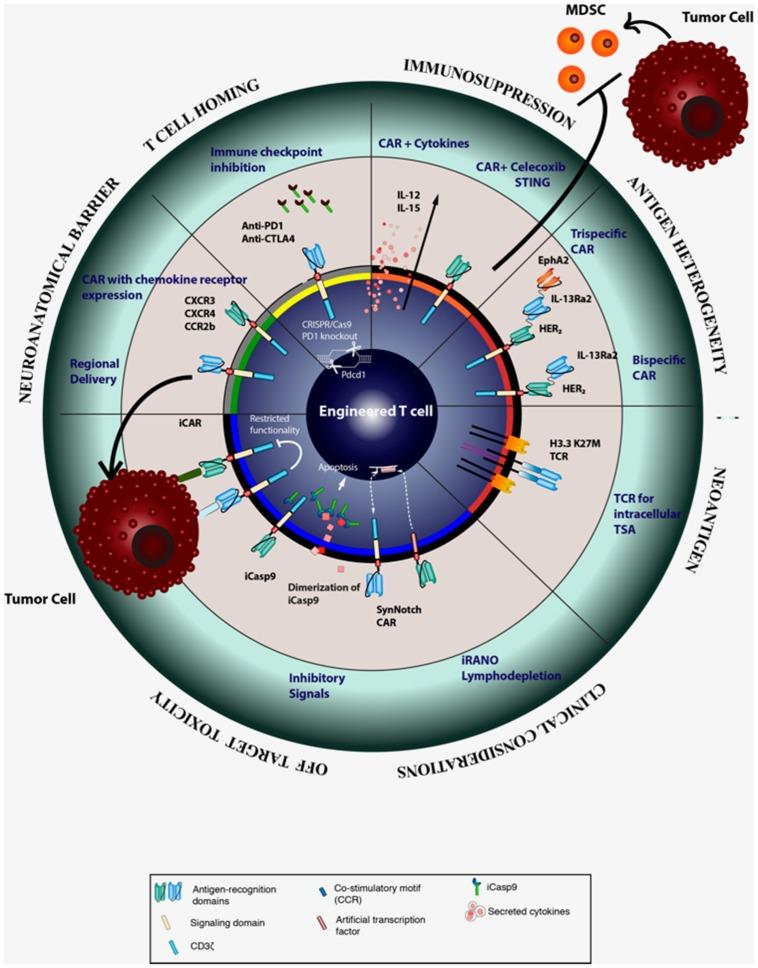
Malignant gliomas carry a dismal prognosis. Conventional treatment using chemo- and radiotherapy has limited efficacy with adverse events. Therapy with genetically engineered T-cells, such as chimeric antigen receptor (CAR) T-cells, may represent a promising approach to improve patient outcomes owing to their potential ability to attack highly infiltrative tumors in a tumor-specific manner and possible persistence of the adaptive immune response. However, the unique anatomical features of the brain and susceptibility of this organ to irreversible tissue damage have made immunotherapy especially challenging in the setting of glioma. With safety concerns in mind, multiple teams have initiated clinical trials using CAR T-cells in glioma patients. The valuable lessons learnt from those trials highlight critical areas for further improvement: tackling the issues of the antigen presentation and T-cell homing in the brain, immunosuppression in the glioma microenvironment, antigen heterogeneity and off-tumor toxicity, and the adaptation of existing clinical therapies to reflect the intricacies of immune response in the brain. This review summarizes the up-to-date clinical outcomes of CAR T-cell clinical trials in glioma patients and examines the most pressing hurdles limiting the efficacy of these therapies. Furthermore, this review uses these hurdles as a framework upon which to evaluate cutting-edge pre-clinical strategies aiming to overcome those barriers.
恶性胶质瘤预后不良。采用化疗和放疗的传统治疗方法疗效有限,且伴有不良反应。基因工程 T 细胞(如嵌合抗原受体 (CAR) T 细胞)的治疗可能代表了一种改善患者预后的有前途的方法,因为它们具有以肿瘤特异性方式攻击高度浸润性肿瘤的潜在能力,并且可能持续存在适应性免疫反应。然而,大脑的独特解剖结构和该器官对不可逆组织损伤的敏感性使得免疫疗法在胶质瘤治疗中特别具有挑战性。出于安全性考虑,多个团队已经在胶质瘤患者中启动了 CAR T 细胞的临床试验。这些试验中吸取的宝贵经验教训突出了进一步改进的关键领域:解决脑内抗原呈递和 T 细胞归巢、胶质瘤微环境中的免疫抑制、抗原异质性和肿瘤外毒性以及现有临床疗法的适应性,以反映大脑中免疫反应的复杂性。本综述总结了 CAR T 细胞治疗胶质瘤患者的临床试验的最新临床结果,并探讨了限制这些疗法疗效的最紧迫障碍。此外,本综述还利用这些障碍作为评估旨在克服这些障碍的前沿临床策略的框架。

 Zotero 插件