
关于孕激素受体状态对乳腺癌患者调节性T细胞群体的分析。
Analysis of Treg cell population in patients with breast cancer with respect to progesterone receptor status.
作者信息
Dziobek Konrad, Biedka Marta, Nowikiewicz Tomasz, Szymankiewicz Maria, Łukaszewska Ewelina, Dutsch-Wicherek Magdalena
机构信息
Department of Oncological Gynecology, Maria Sklodowska-Curie Memorial Cancer Centre and Institute of Oncology, Krakow Branch, Krakow.
Department of Radiotherapy, Professor Franciszek Lukaszczyk Oncology Center in Bydgoszcz, Poland.
出版信息
Contemp Oncol (Pozn). 2018;22(4):236-239. doi: 10.5114/wo.2018.80038. Epub 2018 Dec 31.
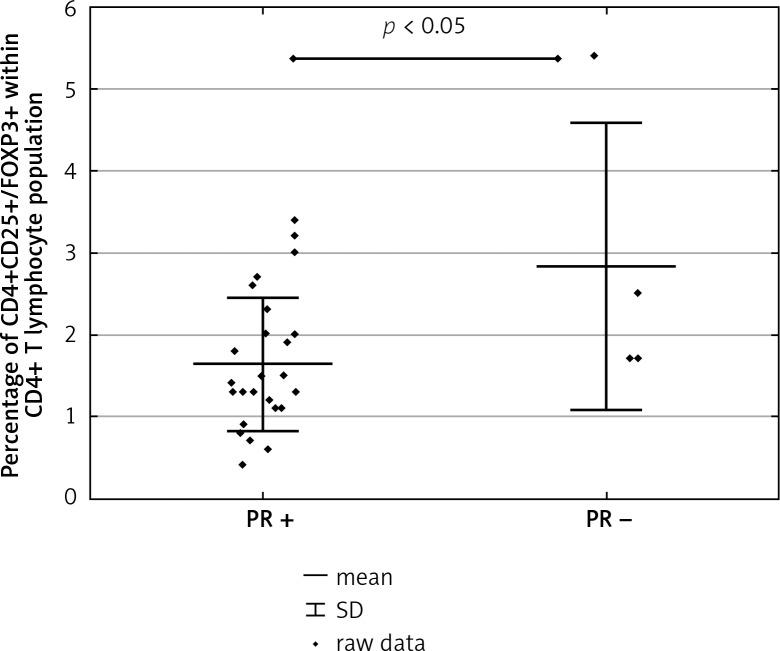
Breast cancer is the most frequently diagnosed type of cancer in women worldwide. Both the development and progression of breast cancer are related to tumour evasion of the immune system through a process called cancer immune-editing, in which regulatory lymphocytes play an important role. The infiltration of Treg cells in patients with breast cancer has been proposed as an independent unfavourable prognostic factor. In the present study, we aimed to evaluate the percentages of the Treg cell populations in the peripheral blood of patients with breast cancer with respect to progesterone receptor expression. Peripheral blood samples were collected from 27 patients with breast cancer treated in the Clinical Department of Breast Cancer and Reconstructive Surgery of the Professor Franciszek Lukaszczyk Oncological Centre, Bydgoszcz. Flow cytometry was used to evaluate the percentage of CD25+/FOXP3+/CD127 (-/low) T cells within CD3+/CD4+ T cells. The presence of CD25+/FOXP3+/CD127 (-/low) T cells within CD3+/CD4+ T cells was identified in all the examined blood samples. A statistically significantly higher percentage of CD25+/FOXP3+/CD127 (-/low) T cells within CD3+/CD4+ T cells was observed in progesterone receptor (PR)-negative breast cancer patients when compared to PR-positive breast cancer patients. The observed high percentage of CD25+/FOXP3+/CD127 (-/low) T cells within CD3+/CD4+ T cells in PR (-) breast cancer patients when compared to PR (+) breast cancer patients seems to confirm the unfavourable prognostic significance of these cells in breast cancer patients. This may indicate a rationale for combining standard oncological treatment in breast cancer patients with Treg-depleting therapy.
乳腺癌是全球女性中最常被诊断出的癌症类型。乳腺癌的发生和发展都与肿瘤通过一种称为癌症免疫编辑的过程逃避免疫系统有关,在这个过程中调节性淋巴细胞发挥着重要作用。乳腺癌患者中调节性T细胞(Treg)的浸润已被提出是一个独立的不良预后因素。在本研究中,我们旨在评估乳腺癌患者外周血中Treg细胞群体的百分比与孕激素受体表达的关系。从比得哥什弗朗齐歇克·卢卡什奇克肿瘤中心乳腺癌与重建外科临床科室接受治疗的27例乳腺癌患者中采集外周血样本。采用流式细胞术评估CD3+/CD4+ T细胞中CD25+/FOXP3+/CD127(-/低)T细胞的百分比。在所有检测的血样中均鉴定出CD3+/CD4+ T细胞中存在CD25+/FOXP3+/CD127(-/低)T细胞。与孕激素受体(PR)阳性的乳腺癌患者相比,PR阴性的乳腺癌患者中CD3+/CD4+ T细胞内CD25+/FOXP3+/CD127(-/低)T细胞的百分比在统计学上显著更高。与PR(+)乳腺癌患者相比,PR(-)乳腺癌患者中CD3+/CD4+ T细胞内观察到的高百分比CD25+/FOXP3+/CD127(-/低)T细胞似乎证实了这些细胞在乳腺癌患者中的不良预后意义。这可能为将乳腺癌患者的标准肿瘤治疗与Treg清除疗法相结合提供了理论依据。
 Zotero 插件