
评估碳纤维纳米材料暴露下的成纤维细胞的弹性杨氏模量和细胞毒性变化。
Evaluation of the elastic Young's modulus and cytotoxicity variations in fibroblasts exposed to carbon-based nanomaterials.
机构信息
Departamento de Ingeniería Eléctrica y Electrónica, Universidad de Los Andes, Bogotá D.C., Colombia.
Centro de Microelectrónica, Universidad de los Andes (CMUA), Bogotá D.C, Colombia.
出版信息
J Nanobiotechnology. 2019 Feb 23;17(1):32. doi: 10.1186/s12951-019-0460-8.
BACKGROUND
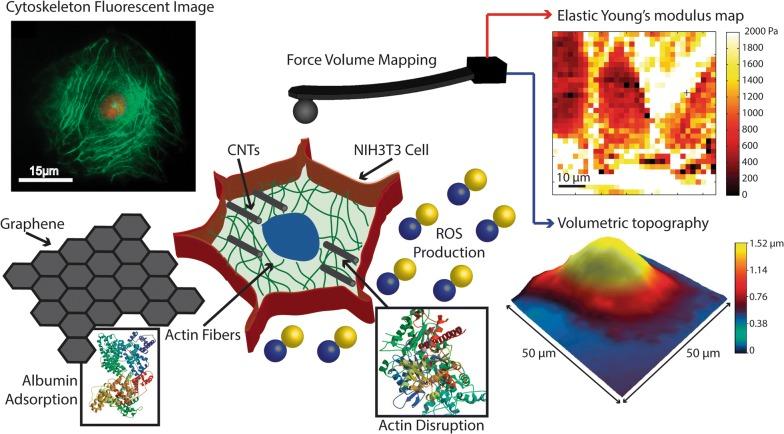
The conventional approaches to assess the potential cytotoxic effects of nanomaterials (NMs) mainly rely on in vitro biochemical assays. These assays are strongly dependent on the properties of the nanomaterials, for example; specific surface area (SSA), size, surface defects, and surface charge, and the host response. The NMs properties can also interfere with the reagents of the biochemical and optical assays leading to skewed interpretations and ambiguous results related to the NMs toxicity. Here, we proposed a structured approach for cytotoxicity assessment complemented with cells' mechanical responses represented as the variations of elastic Young's modulus in conjunction with conventional biochemical tests. Monitoring the mechanical properties responses at various times allowed understanding the effects of NMs to the filamentous actin cytoskeleton. The elastic Young's modulus was estimated from the force volume maps using an atomic force microscope (AFM).
RESULTS
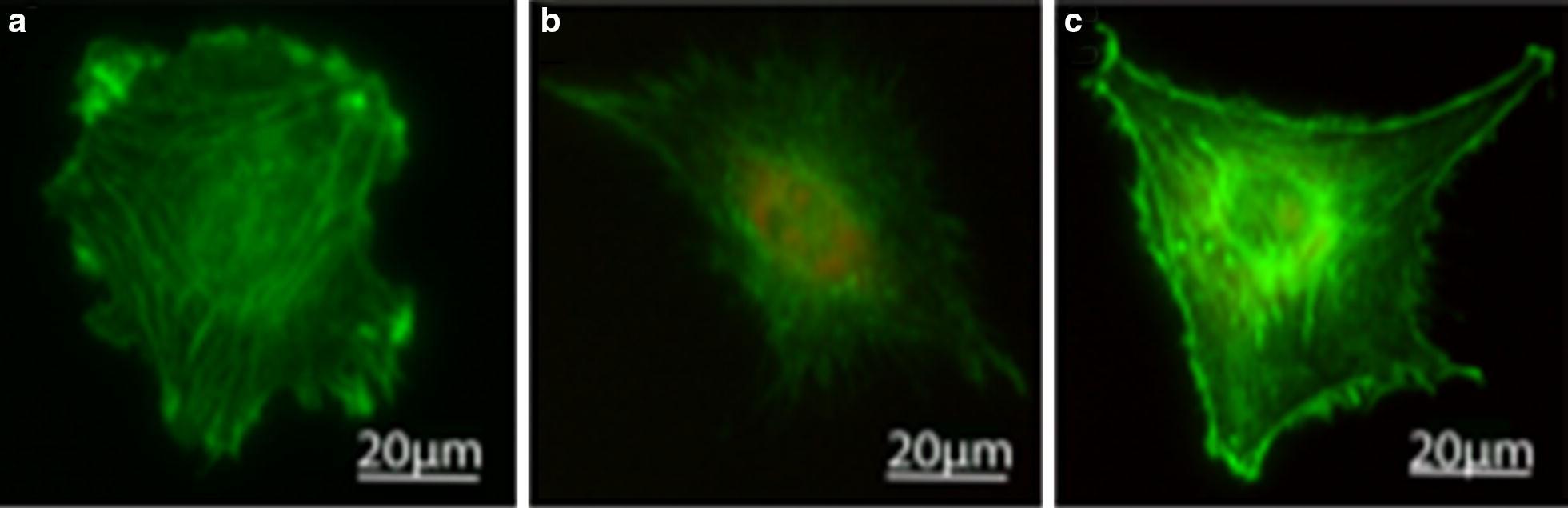
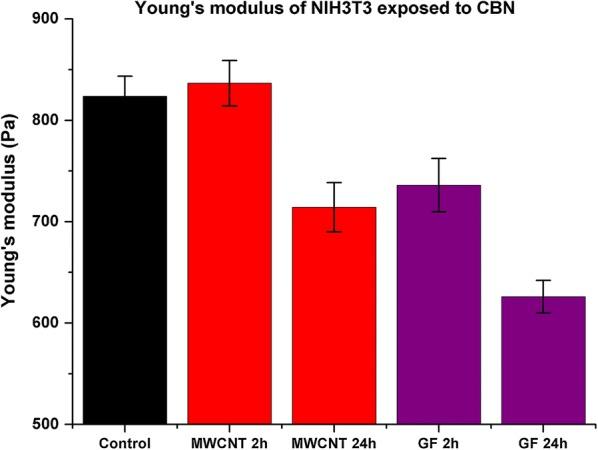
Our results show a significant decrease on Young's modulus, ~ 20%, in cells exposed to low concentrations of graphene flakes (GF), ~ 10% decrease for cells exposed to low concentrations of multiwalled carbon nanotubes (MWCNTs) than the control cells. These considerable changes were directly correlated to the disruption of the cytoskeleton actin fibers. The length of the actin fibers in cells exposed to GF was 50% shorter than the fibers of the cells exposed to MWCNT. Applying both conventional biochemical approach and cells mechanics, we were able to detect differences in the actin networks induced by MWCNT inside the cells and GF outside the cell's membrane. These results contrast with the conventional live/dead assay where we obtained viabilities greater than 80% after 24 h; while the elasticity dramatically decreased suggesting a fast-metabolic stress generation.
CONCLUSIONS
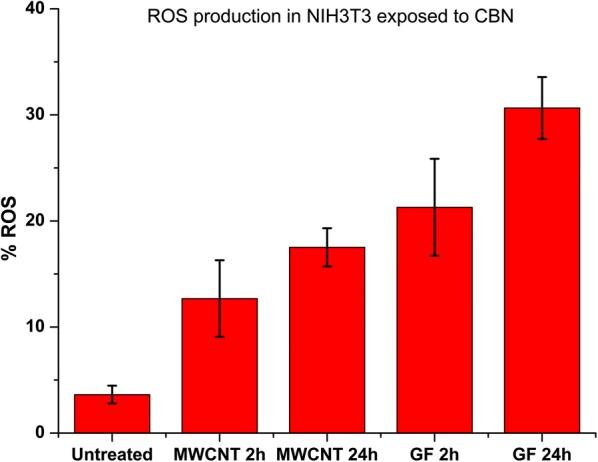
We confirmed the production of radical oxygen species (ROS) on cells exposed to CBNs, which is related to the disruption of the cytoskeleton. Altogether, the changes in mechanical properties and the length of F-actin fibers confirmed that disruption of the F-actin cytoskeleton is a major consequence of cellular toxicity. We evidenced the importance of not just nanomaterials properties but also the effect of the location to assess the cytotoxic effects of nanomaterials.
背景
评估纳米材料(NMs)潜在细胞毒性的传统方法主要依赖于体外生化分析。这些分析强烈依赖于纳米材料的特性,例如比表面积(SSA)、尺寸、表面缺陷和表面电荷,以及宿主反应。纳米材料的特性也会干扰生化和光学分析的试剂,导致与纳米材料毒性相关的扭曲解释和模糊结果。在这里,我们提出了一种评估细胞毒性的结构化方法,该方法结合细胞的机械响应进行补充,表现为弹性杨氏模量的变化,同时结合传统的生化测试。在不同时间监测机械性能的响应可以了解 NMs 对丝状肌动蛋白细胞骨架的影响。使用原子力显微镜(AFM)从力体积图中估算出弹性杨氏模量。
结果
我们的结果表明,在暴露于低浓度石墨烯片(GF)的细胞中,杨氏模量显著下降约 20%,而在暴露于低浓度多壁碳纳米管(MWCNT)的细胞中,杨氏模量下降约 10%,低于对照细胞。这些相当大的变化与细胞骨架肌动蛋白纤维的破坏直接相关。暴露于 GF 的细胞中的肌动蛋白纤维长度比暴露于 MWCNT 的细胞中的纤维短 50%。应用传统的生化方法和细胞力学,我们能够检测到 MWCNT 在内细胞和 GF 在外细胞膜中诱导的肌动蛋白网络的差异。这些结果与传统的活/死测定法形成对比,在 24 小时后,我们获得了大于 80%的存活率;而弹性显著降低表明快速产生代谢应激。
结论
我们证实了暴露于 CBNs 的细胞中活性氧(ROS)的产生,这与细胞骨架的破坏有关。总的来说,机械性能的变化和 F-肌动蛋白纤维的长度证实了 F-肌动蛋白细胞骨架的破坏是细胞毒性的主要后果。我们证明了不仅要考虑纳米材料的特性,还要考虑位置的影响,以评估纳米材料的细胞毒性。




 Zotero 插件