
老年患者心脏瓣膜病的临床、超声特征及长期预后
Clinical, sonographic characteristics and long-term prognosis of valvular heart disease in elderly patients.
作者信息
Song Feier, Liu Fang-Zhou, Liang Yuan-Feng, Tse Gary, Li Xin, Liao Hong-Tao, Chen Ji-Yan
机构信息
Department of Cardiology, Guangdong Cardiovascular Institute, Guangdong Provincial Key Laboratory of Coronary Heart Disease Prevention, Guangdong Provincial People's Hospital, Guangdong Academy of Medical Sciences, Guangzhou, China.
Department of Cardiology, Guangdong Cardiovascular Institute, Guangdong Provincial People's Hospital, Guangdong Academy of Medical Sciences, Guangzhou, China.
出版信息
J Geriatr Cardiol. 2019 Jan;16(1):33-41. doi: 10.11909/j.issn.1671-5411.2019.01.007.
BACKGROUND
Valvular heart disease (VHD) is expected to become more prevail as the population ages and disproportionately affects older adults. However, direct comparison of clinical characteristics, sonographic diagnosis, and outcomes in VHD patients aged over 65 years is scarce. The objective of this study was to evaluate the differences in clinical characteristics and prognosis in two age-groups of geriatric patients with VHD.
METHODS
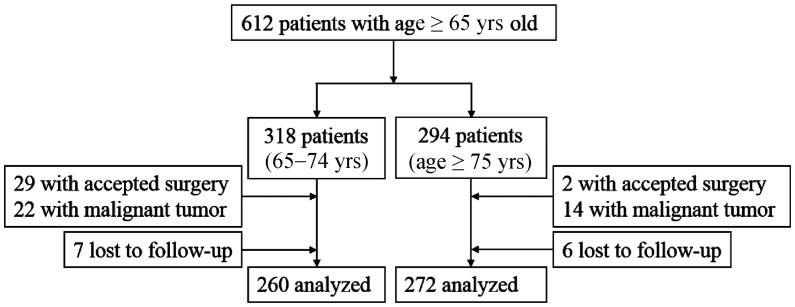
We retrospectively enrolled consecutive individuals aged ≥ 65 years from Guangdong Provincial People's Hospital and screened for VHD using transthoracic echocardiography (TTE) or transesophageal echocardiography (TEE). Finally, 260 (48.9%) patients were in the 65-74 years group, and 272 (51.1%) were in the ≥ 75-year group. Factors that affected long-term survival was explored. A multivariable Cox hazards regression was performed to identify the predictors of major adverse cardiac events (MACEs) in each group.
RESULTS
In our population, the older group were more likely to have chronic obstructive pulmonary disease (COPD), degenerative VHD, but with less rheumatic VHD, aortic stenosis (AS) and mitral stenosis (MS). Compared with those aged 65-74 years, the older group had a higher incidence of all-cause death (10.0% . 16.5%, = 0.027), ischemic stroke (13.5% 20.2%, = 0.038) and MACEs (37.3% 48.2%, = 0.011) at long-term follow-up. In multivariable Cox regression analysis, mitral regurgitation, a history of COPD, chronic kidney disease, diabetes, hypertension, atrial fibrillation and New York Heart Association (NYHA) functional class were identified as independent predictors of MACEs in the older group.
CONCLUSION
Advanced age profoundly affect prognosis and different predictors were associated with MACEs in geriatric patients with VHD.
背景
随着人口老龄化,心脏瓣膜病(VHD)预计将变得更加普遍,且对老年人的影响尤为严重。然而,关于65岁以上VHD患者的临床特征、超声诊断及预后的直接比较却很少。本研究的目的是评估老年VHD患者两个年龄组在临床特征和预后方面的差异。
方法
我们回顾性纳入了广东省人民医院年龄≥65岁的连续患者,并使用经胸超声心动图(TTE)或经食管超声心动图(TEE)筛查VHD。最终,65 - 74岁组有260例(48.9%)患者,≥75岁组有272例(51.1%)患者。探讨了影响长期生存的因素。进行多变量Cox风险回归分析以确定每组主要不良心脏事件(MACE)的预测因素。
结果
在我们的研究人群中,年龄较大的组更易患慢性阻塞性肺疾病(COPD)、退行性VHD,但风湿性VHD、主动脉瓣狭窄(AS)和二尖瓣狭窄(MS)较少。与65 - 74岁的患者相比,年龄较大的组在长期随访中全因死亡(10.0%对16.5%,P = 0.027)、缺血性卒中(13.5%对20.2%,P = 0.038)和MACE(37.3%对48.2%,P = 0.011)的发生率更高。在多变量Cox回归分析中,二尖瓣反流、COPD病史、慢性肾病、糖尿病、高血压、心房颤动和纽约心脏协会(NYHA)功能分级被确定为年龄较大组MACE的独立预测因素。
结论
高龄深刻影响老年VHD患者的预后,且不同的预测因素与MACE相关。

 Zotero 插件