
1990年至2019年中国非风湿性心脏瓣膜病疾病负担的变化趋势及其预测:全球疾病负担研究的结果
Changing trends of the disease burden of non-rheumatic valvular heart disease in China from 1990 to 2019 and its predictions: Findings from global burden of disease study.
作者信息
Zheng Xiaoxin, Guan Qing, Lin Xiuquan
机构信息
Department of Cardiology, Shengli Clinical Medical College of Fujian Medical University, Fujian Provincial Hospital, Fuzhou, Fujian, China.
Fujian Provincial Key Laboratory of Cardiovascular Disease, Fujian Cardiovascular Institute, Fujian Provincial Center for Geriatrics, Fujian Clinical Medical Research Center for Cardiovascular Diseases, Fuzhou, Fujian, China.
出版信息
Front Cardiovasc Med. 2023 Jan 19;9:912661. doi: 10.3389/fcvm.2022.912661. eCollection 2022.
OBJECTIVE
China has an increasing burden of non-rheumatic valvular heart disease (NRVHD) as the aging of the population is deepening. The aim was to assess the age and sex-specific prevalence and DALYs of NRVHD in China from 1990 to 2019 and to predict the burden in the next 25 years.
METHODS
The Global Burden of Disease Study (2019) was used to extract the data of age- and sex-specific incidence, mortality, and disability-adjusted life years (DALYs) of NRVHD in China, 1990-2019. We estimated the annual percentage change (EAPC) to access the temporal trends of the disease burden of NRVHD. The R package called Nordpred was used to perform an age-period-cohort analysis to predict the prevalence of NRVHD in the next 25 years.
RESULTS
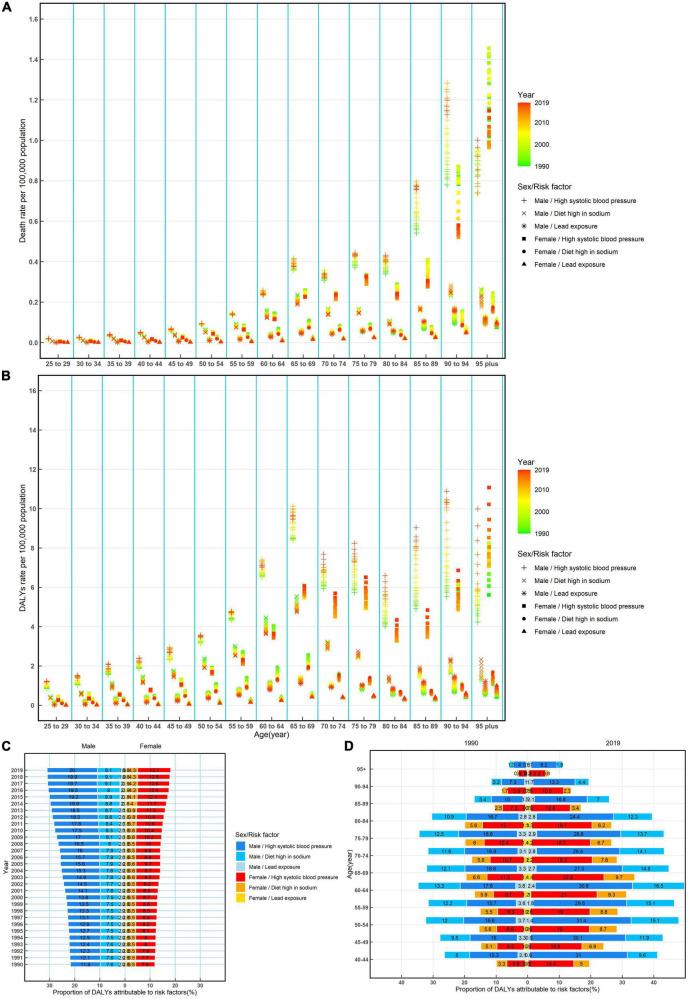
The number of incident cases of NRVHD increased from 93.16 thousand in 1990 to 325.05 thousand in 2019. Overall upward trends were observed in the age-standardized incidence rate (ASIR) from 1990 to 2019. Significant temporal trends in mortality and DALYs of NRVHD were observed. High systolic blood pressure, high sodium diet, and lead exposure were the main driving forces for NRVHD. In the next 25 years, the number of new cases and deaths of NRVHD should continue to increase to 390.64 thousand and 10.0 thousand, respectively. The ASIR should show an upward trend, while the ASMR should show a downward trend among men and women.
CONCLUSION
In China, the overall rates of NRVHD have increased over the past 30 years, and there has been a substantial increase in the burden of NRVHD due to population growth and aging and will continue to increase in the next 25 years. Our results can help shape a multifactorial approach and public policy to reduce the NRVHD burden throughout China.
目的
随着人口老龄化的加剧,中国非风湿性心脏瓣膜病(NRVHD)的负担日益加重。本研究旨在评估1990年至2019年中国NRVHD的年龄和性别特异性患病率及伤残调整生命年(DALYs),并预测未来25年的疾病负担。
方法
利用全球疾病负担研究(2019)提取1990 - 2019年中国NRVHD的年龄和性别特异性发病率、死亡率及伤残调整生命年数据。我们估算年度百分比变化(EAPC)以了解NRVHD疾病负担的时间趋势。使用名为Nordpred的R包进行年龄-时期-队列分析,以预测未来25年NRVHD的患病率。
结果
NRVHD的发病例数从1990年的9.316万例增加到2019年的32.505万例。1990年至2019年期间,年龄标准化发病率(ASIR)呈总体上升趋势。观察到NRVHD死亡率和DALYs有显著的时间趋势。收缩压升高、高钠饮食和铅暴露是NRVHD的主要驱动因素。在未来25年中,NRVHD的新发病例数和死亡数预计将分别继续增加至39.064万例和1.0万例。ASIR应呈上升趋势,而男性和女性的年龄标准化死亡率(ASMR)应呈下降趋势。
结论
在中国,过去30年NRVHD的总体发病率有所上升,由于人口增长和老龄化,NRVHD的疾病负担大幅增加,并将在未来25年继续上升。我们的研究结果有助于形成多因素方法和公共政策,以减轻中国各地的NRVHD负担。


 Zotero 插件