
宝莲碱 A 有效缓解哮喘模型小鼠的过敏性肺部炎症。
Bulleyaconitine A Effectively Relieves Allergic Lung Inflammation in a Murine Asthmatic Model.
机构信息
School of Preclinical Medicine, Wannan Medical College, Wuhu, Anhui, China (mainland).
College of Life Sciences, Anhui Normal University, Wuhu, Anhui, China (mainland).
出版信息
Med Sci Monit. 2019 Mar 4;25:1656-1662. doi: 10.12659/MSM.915427.
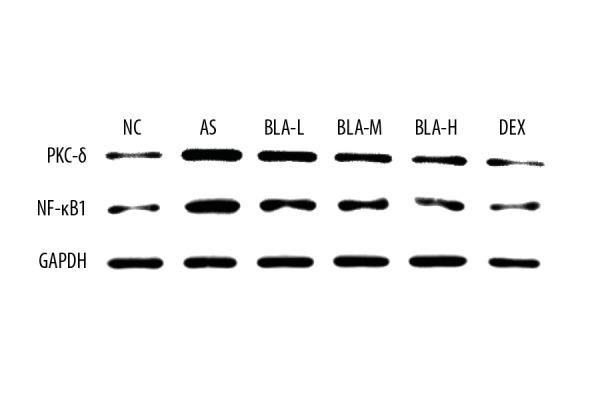
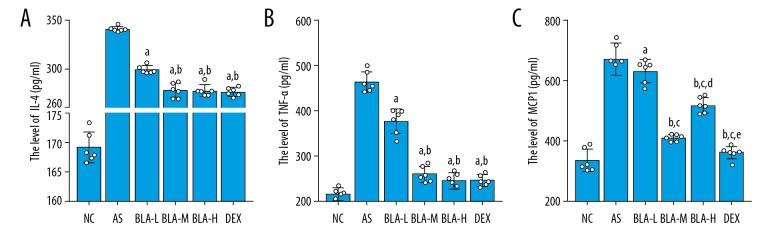
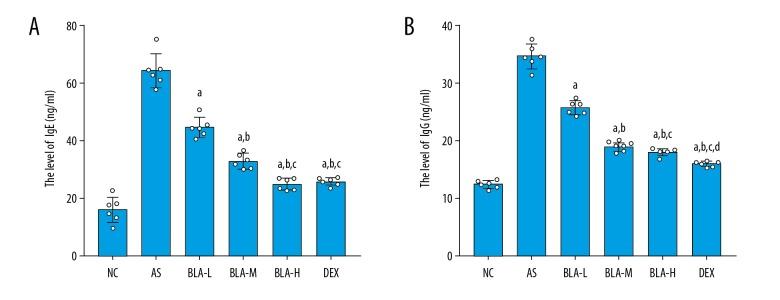
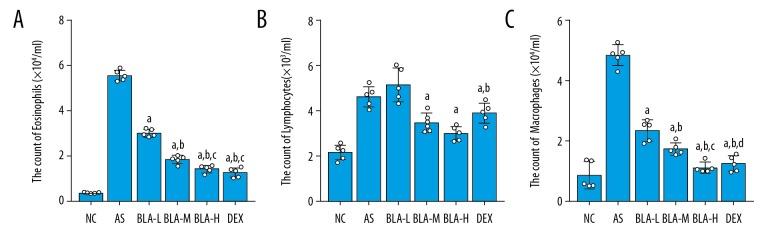
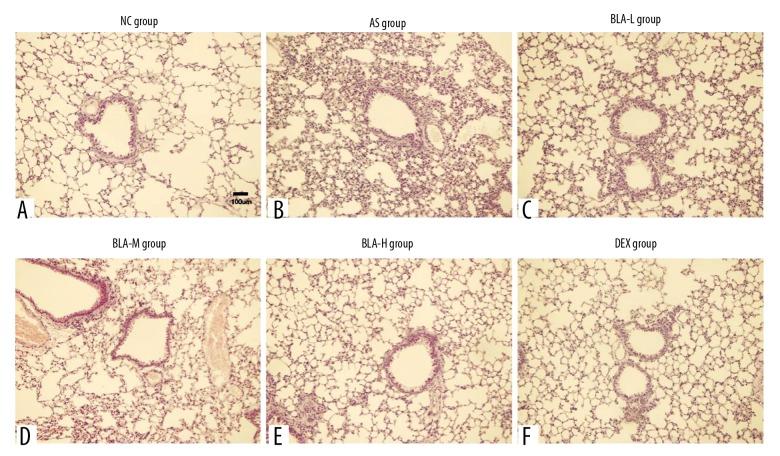
BACKGROUND Bulleyaconitine A (BLA) has been widely used as analgesic against chronic inflammatory pain in China. However, its potential therapeutic role in asthma remains unclear. The purpose of this study was to investigate the effect of BLA on airway inflammation in mice with allergic asthma. MATERIAL AND METHODS Specific-pathogen-free (SPF) female Balb/c mice were randomly divided into the following 6 groups: (1) Control group (NC), (2) Asthma group (AS), (3) BLA-L group, (4) BLA-M group, (5) BLA-H group, and (6) Dexamethasone group. An asthma mouse model was established by administration of ovalbumin (OVA) and mice were sacrificed within 24 h after the last challenge. Enzyme-linked immunosorbent assay (ELISA) method was used to determine the relative expression levels of IgE and IgG in mouse serum. In addition, bronchoalveolar lavage fluid (BALF) was collected and IL-4, TNF-α, and MCP-1 levels were determined by ELISA. Furthermore, eosinophils, lymphocytes, and macrophages in BALF were classified and analyzed, and inflammatory cell infiltration in the airways of mice was determined by hematoxylin-eosin (HE) staining. The expression of NF-κB1 and PKC-δ in mouse lung tissue was determined by Western blot analysis. RESULTS The levels of serum IgE and IgG in BLA- or Dex- treated mice were significantly reduced compared to those in the asthma (AS) group (P<0.01), whereas the levels of cytokines IL-4, TNF-α, and MCP-1 were significantly decreased (P<0.01). HE-staining showed that BLA significantly reduced inflammatory cell infiltration and mucus secretion in lung tissue. Moreover, BLA inhibited the expression of NF-κB1 and PKC-d via the NF-κB signaling pathway in the lung. CONCLUSIONS Our data show that BLA activates PKC-δ/NF-κB to reduce airway inflammation in allergic asthma mice.
背景
博莱霉素 A(BLA)在中国被广泛用作治疗慢性炎症性疼痛的药物。然而,其在哮喘中的潜在治疗作用尚不清楚。本研究旨在探讨 BLA 对过敏性哮喘小鼠气道炎症的影响。
材料和方法
无特定病原体(SPF)雌性 Balb/c 小鼠随机分为以下 6 组:(1)对照组(NC)、(2)哮喘组(AS)、(3)BLA-L 组、(4)BLA-M 组、(5)BLA-H 组和(6)地塞米松组。通过给予卵清蛋白(OVA)建立哮喘小鼠模型,并在最后一次攻击后 24 小时内处死小鼠。酶联免疫吸附试验(ELISA)法测定小鼠血清中 IgE 和 IgG 的相对表达水平。此外,收集支气管肺泡灌洗液(BALF),通过 ELISA 测定 IL-4、TNF-α和 MCP-1 水平。进一步对 BALF 中的嗜酸性粒细胞、淋巴细胞和巨噬细胞进行分类和分析,并通过苏木精-伊红(HE)染色法测定小鼠气道中炎症细胞的浸润情况。Western blot 分析测定小鼠肺组织中 NF-κB1 和 PKC-δ的表达。
结果
与哮喘组(AS)相比,BLA 或地塞米松处理组小鼠血清 IgE 和 IgG 水平明显降低(P<0.01),细胞因子 IL-4、TNF-α和 MCP-1 水平明显降低(P<0.01)。HE 染色显示,BLA 明显减轻了肺组织中炎症细胞浸润和粘液分泌。此外,BLA 通过肺组织中的 NF-κB 信号通路抑制 NF-κB1 和 PKC-d 的表达。
结论
我们的数据表明,BLA 通过激活 PKC-δ/NF-κB 减轻过敏性哮喘小鼠的气道炎症。
 Zotero 插件