
一种基于荧光共振能量转移的海藻糖二霉菌酸酯荧光类似物,用于探测分枝杆菌的菌膜重塑酶。
A FRET-Based Fluorogenic Trehalose Dimycolate Analogue for Probing Mycomembrane-Remodeling Enzymes of Mycobacteria.
作者信息
Holmes Nathan J, Kavunja Herbert W, Yang Yong, Vannest B Dillon, Ramsey Claudia N, Gepford Dana M, Banahene Nicholas, Poston Anne W, Piligian Brent F, Ronning Donald R, Ojha Anil K, Swarts Benjamin M
机构信息
Department of Chemistry and Biochemistry, Central Michigan University, Mount Pleasant, Michigan 48859, United States.
Division of Genetics, Wadsworth Center, New York State Department of Health, Albany, New York 12208, United States.
出版信息
ACS Omega. 2019 Feb 28;4(2):4348-4359. doi: 10.1021/acsomega.9b00130. Epub 2019 Feb 27.
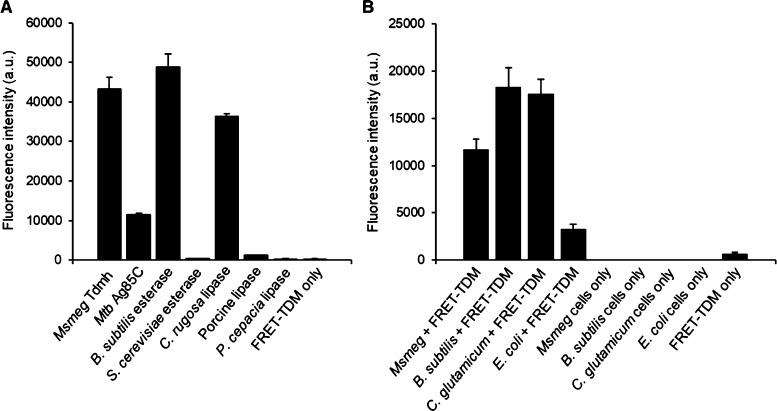
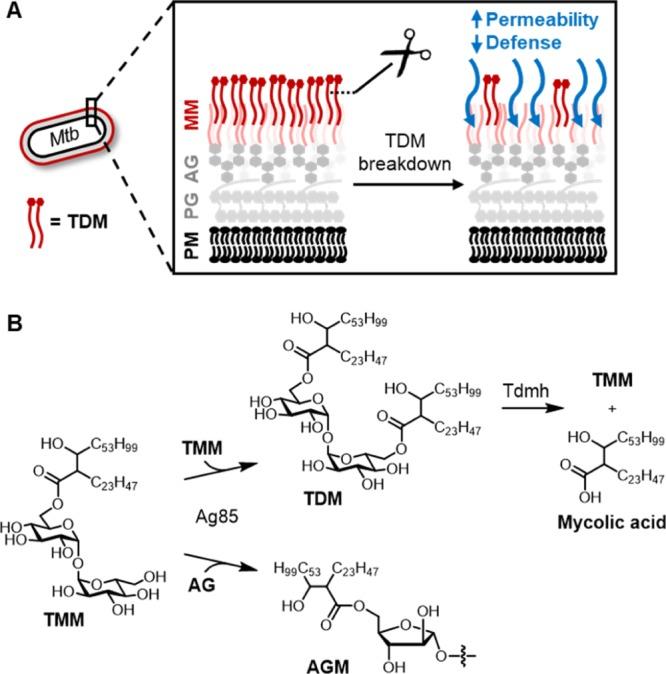
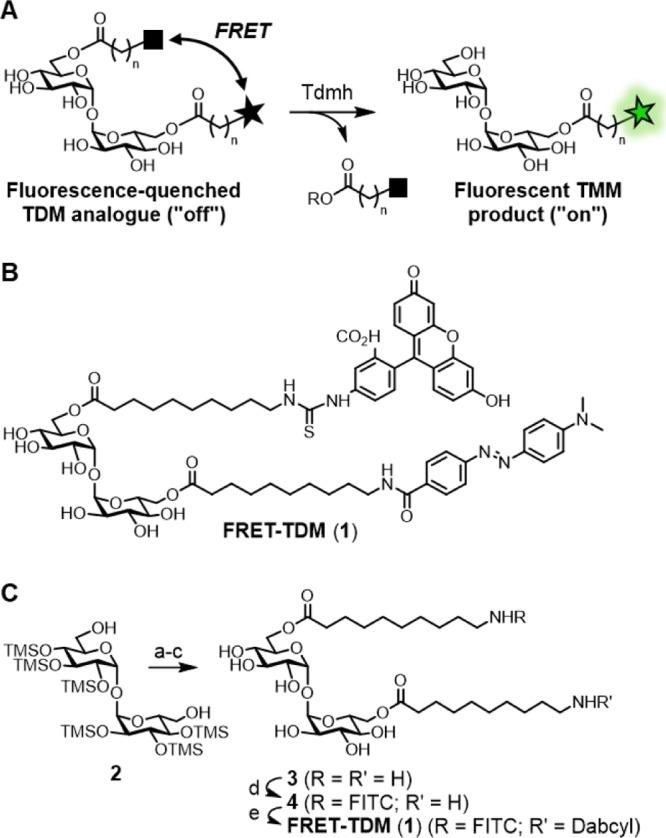
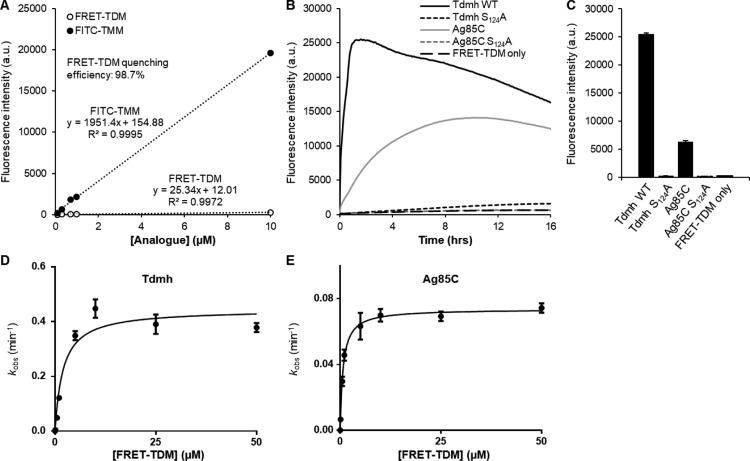
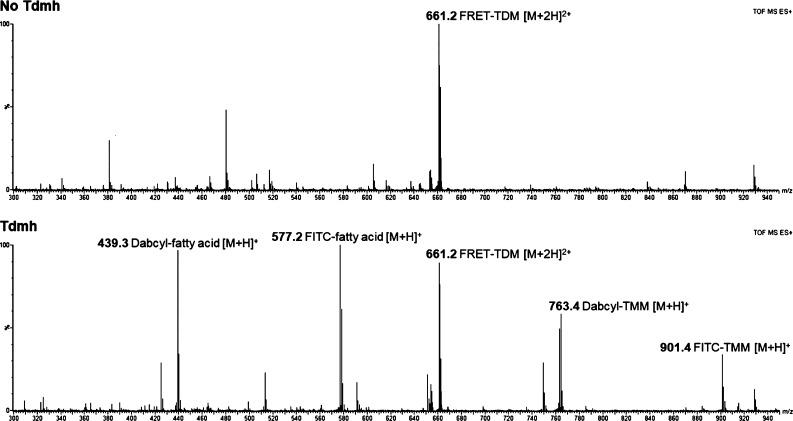
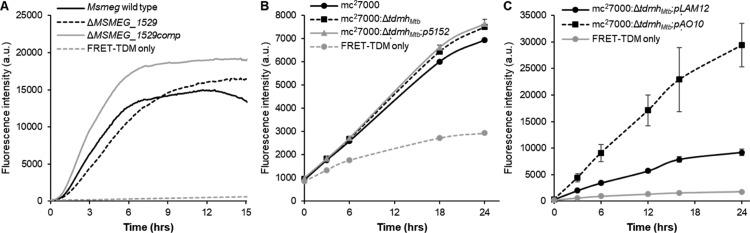
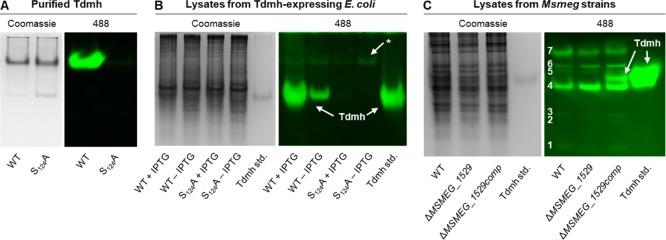
The mycobacterial outer membrane, or mycomembrane, is essential for the viability and virulence of and related pathogens. The mycomembrane is a dynamic structure, whose chemical composition and biophysical properties can change during stress to give an advantage to the bacterium. However, the mechanisms that govern mycomembrane remodeling and their significance to mycobacterial pathogenesis are still not well characterized. Recent studies have shown that trehalose dimycolate (TDM), a major glycolipid of the mycomembrane, is broken down by the mycobacteria-specific enzyme TDM hydrolase (Tdmh) in response to nutrient deprivation, a process which appears to modulate the mycomembrane to increase nutrient acquisition, but at the expense of stress tolerance. Tdmh activity thus balances the growth of during infection in a manner that is contingent upon host immunity. Current methods to probe Tdmh activity are limited, impeding the development of inhibitors and the investigation of the role of Tdmh in bacterial growth and persistence. Here, we describe the synthesis and evaluation of FRET-TDM, which is a fluorescence-quenched analogue of TDM that is designed to fluoresce upon hydrolysis by Tdmh and potentially other trehalose ester-degrading hydrolases involved in mycomembrane remodeling. We found that FRET-TDM was efficiently activated in vitro by recombinant Tdmh, generating a 100-fold increase in fluorescence. FRET-TDM was also efficiently activated in the presence of whole cells of and , but the observed signal was predominantly Tdmh-independent, suggesting that physiological levels of Tdmh are low and that other mycobacterial enzymes also hydrolyze the probe. The latter notion was confirmed by employing a native protein gel-based fluorescence assay to profile FRET-TDM-activating enzymes from lysates. On the other hand, FRET-TDM was capable of detecting the activity of Tdmh in cells when it was overexpressed. Together, our data demonstrate that FRET-TDM is a convenient and sensitive in vitro probe of Tdmh activity, which will be beneficial for Tdmh enzymatic characterization and inhibitor screening. In more complex samples, for example, live cells or cell lysates, FRET-TDM can serve as a tool to probe Tdmh activity at elevated enzyme levels, and it may facilitate the identification and characterization of related hydrolases that are involved in mycomembrane remodeling. Our study also provides insights as to how the structure of FRET-TDM or related fluorogenic probes can be optimized to achieve improved specificity and sensitivity for detecting mycobacteria.
分枝杆菌外膜,即霉菌膜,对于分枝杆菌及相关病原体的生存能力和毒力至关重要。霉菌膜是一种动态结构,其化学成分和生物物理特性在应激过程中会发生变化,从而赋予细菌优势。然而,调控霉菌膜重塑的机制及其对分枝杆菌致病作用的意义仍未得到充分表征。最近的研究表明,海藻糖二霉菌酸酯(TDM)是霉菌膜的主要糖脂,在营养剥夺时会被分枝杆菌特异性酶TDM水解酶(Tdmh)分解,这一过程似乎会调节霉菌膜以增加营养获取,但以应激耐受性为代价。因此,Tdmh活性以一种取决于宿主免疫力的方式平衡感染期间分枝杆菌的生长。目前探测Tdmh活性的方法有限,这阻碍了抑制剂的开发以及对Tdmh在细菌生长和存活中作用的研究。在此,我们描述了FRET-TDM的合成与评估,FRET-TDM是TDM的一种荧光淬灭类似物,设计用于在被Tdmh及可能参与霉菌膜重塑的其他海藻糖酯降解水解酶水解时发出荧光。我们发现重组Tdmh在体外能有效激活FRET-TDM,使荧光增强100倍。在结核分枝杆菌和耻垢分枝杆菌的全细胞存在时,FRET-TDM也能被有效激活,但观察到的信号主要与Tdmh无关,这表明Tdmh的生理水平较低,且其他分枝杆菌酶也能水解该探针。通过基于天然蛋白质凝胶的荧光测定法分析结核分枝杆菌裂解物中激活FRET-TDM的酶,证实了后一种观点。另一方面,当FRET-TDM过表达时,它能够检测细胞中Tdmh的活性。总之我们的数据表明,FRET-TDM是一种方便且灵敏的体外Tdmh活性探针,这将有利于Tdmh的酶学表征和抑制剂筛选。在更复杂的样品中,例如活细胞或细胞裂解物中,FRET-TDM可作为一种工具,用于在酶水平升高时探测Tdmh活性,并且它可能有助于鉴定和表征参与霉菌膜重塑的相关水解酶。我们的研究还为如何优化FRET-TDM或相关荧光探针的结构以提高检测分枝杆菌的特异性和灵敏度提供了见解。
 Zotero 插件