
家用厨房海绵中微生物群落的研究:产超广谱β-内酰胺酶(ESBL)细菌的证据。
Study on microbial communities in domestic kitchen sponges: Evidence of and Extended Spectrum Beta Lactamase (ESBL) producing bacteria.
作者信息
Marotta Stefania Maria, Giarratana Filippo, Calvagna Anastasia, Ziino Graziella, Giuffrida Alessandro, Panebianco Antonio
机构信息
Department of Veterinary Sciences, University of Messina, Italy.
出版信息
Ital J Food Saf. 2019 Feb 11;7(4):7672. doi: 10.4081/ijfs.2018.7672. eCollection 2018 Dec 31.
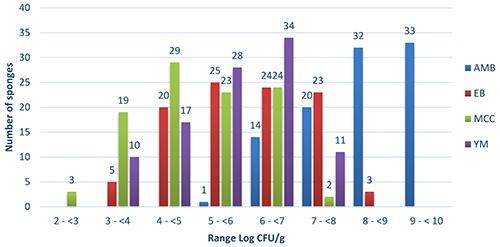
Domestic environment, in particular, kitchen setting is a well-established source of microbial contamination. Kitchen sponges represent an important vehicle of microbial transmission and maintenance of spoilage bacteria and pathogenic strains responsible for food borne diseases. The aim of this study was to evaluate the microbial communities of 100 'in-use' kitchen sponges, improving the knowledge on their role in cross-contamination in domestic environment and transmission of ESBLproducing strains. Sponges were processed for: aerobic mesophilic bacteria (AMB), (EB), yeasts and molds (YM), coagulase-positive staphylococci (CPS), micrococci (MCC), anaerobic sulfite reducing bacteria (ASR), and for the detection of , spp. and . A total of 309 enterobacteria strains were identified and then processed for ESBL (Extended Spectrum Beta Lactamase) phenotypical expression. A high contamination level of kitchen sponges was observed (mean value AMB 8.25±1.1; EB 5.89±1.2; YM 5.57±1.1; MCC 4.82±0.1 log CFU/g). Identified enterobacteria strains revealed several opportunistic and pathogenic agents such as (28%), (23.3%), and other strains in lower percentage. was found in only one sponge (1%). A total of 69 (22.3%) enterobacteria resulted ESBL+, with the following prevalence: (50%), (30%), (25%), (25%), (20%), (20.7%), (20.1%). Results confirm the potential role of kitchen sponges as vehicle for food-borne pathogens such as, for the first time, infectious agents and spoilage microorganisms. The observed high contamination level and the presence of several ESBLs opportunistic pathogens, stresses the necessity to improve a proper education of the consumers on the effective treatment to reduce their microbial loads.
国内环境,尤其是厨房环境,是公认的微生物污染源。厨房海绵是微生物传播以及导致食源性疾病的腐败细菌和致病菌株滋生的重要媒介。本研究旨在评估100块“在用”厨房海绵的微生物群落,增进对其在家庭环境交叉污染及产超广谱β-内酰胺酶(ESBL)菌株传播中所起作用的了解。对海绵进行了如下检测:需氧嗜温菌(AMB)、肠杆菌(EB)、酵母菌和霉菌(YM)、凝固酶阳性葡萄球菌(CPS)、微球菌(MCC)、厌氧亚硫酸盐还原菌(ASR),并检测了大肠埃希菌、肺炎克雷伯菌和奇异变形杆菌。共鉴定出309株肠杆菌菌株,随后对其进行ESBL(超广谱β-内酰胺酶)表型表达检测。观察到厨房海绵的污染水平很高(AMB平均值8.25±1.1;EB 5.89±1.2;YM 5.57±1.1;MCC 4.82±0.1 log CFU/g)。鉴定出的肠杆菌菌株显示出多种机会致病菌和病原菌,如大肠埃希菌(28%)、肺炎克雷伯菌(23.3%),以及其他比例较低的菌株。仅在一块海绵中发现奇异变形杆菌(1%)。共有69株(22.3%)肠杆菌为ESBL阳性,其流行率如下:肺炎克雷伯菌(50%)、大肠埃希菌(30%)、奇异变形杆菌(25%)、阴沟肠杆菌(25%)、产气肠杆菌(20%)、弗劳地枸橼酸杆菌(20.7%)、粘质沙雷氏菌(20.1%)。结果证实厨房海绵作为食源性病原体传播媒介的潜在作用,首次发现其可传播感染因子和腐败微生物。观察到的高污染水平以及多种ESBL机会致病菌的存在,强调有必要加强对消费者进行有效处理以降低微生物负荷的适当教育。


 Zotero 插件