
PIN1信号网络的致癌性劫持
Oncogenic Hijacking of the PIN1 Signaling Network.
作者信息
Zannini Alessandro, Rustighi Alessandra, Campaner Elena, Del Sal Giannino
机构信息
National Laboratory CIB, Trieste, Italy.
Department of Life Sciences, University of Trieste, Trieste, Italy.
出版信息
Front Oncol. 2019 Feb 25;9:94. doi: 10.3389/fonc.2019.00094. eCollection 2019.
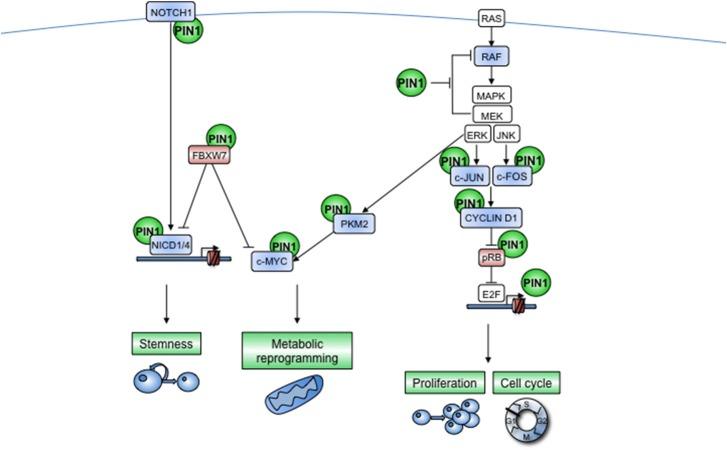
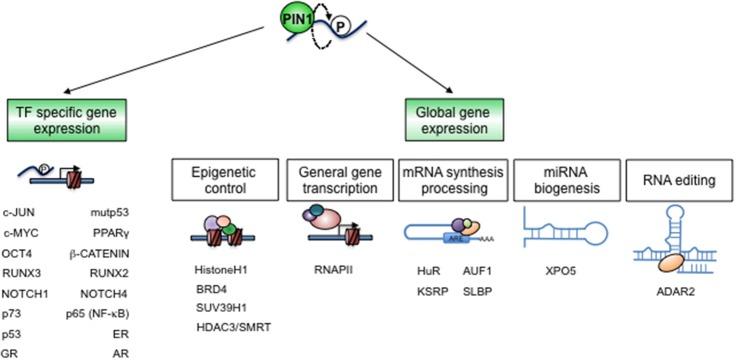
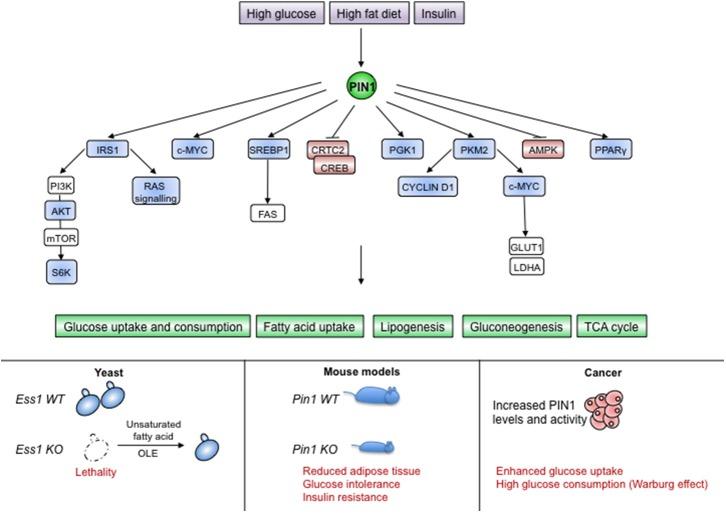
Cellular choices are determined by developmental and environmental stimuli through integrated signal transduction pathways. These critically depend on attainment of proper activation levels that in turn rely on post-translational modifications (PTMs) of single pathway members. Among these PTMs, post-phosphorylation prolyl-isomerization mediated by PIN1 represents a unique mechanism of spatial, temporal and quantitative control of signal transduction. Indeed PIN1 was shown to be crucial for determining activation levels of several pathways and biological outcomes downstream to a plethora of stimuli. Of note, studies performed in different model organisms and humans have shown that hormonal, nutrient, and oncogenic stimuli simultaneously affect both PIN1 activity and the pathways that depend on PIN1-mediated prolyl-isomerization, suggesting the existence of evolutionarily conserved molecular circuitries centered on this isomerase. This review focuses on molecular mechanisms and cellular processes like proliferation, metabolism, and stem cell fate, that are regulated by PIN1 in physiological conditions, discussing how these are subverted in and hijacked by cancer cells. Current status and open questions regarding the use of PIN1 as biomarker and target for cancer therapy as well as clinical development of PIN1 inhibitors are also addressed.
细胞选择是由发育和环境刺激通过整合的信号转导途径决定的。这些途径严重依赖于达到适当的激活水平,而这又依赖于单个途径成员的翻译后修饰(PTM)。在这些PTM中,由PIN1介导的磷酸化后脯氨酰异构化代表了一种对信号转导进行空间、时间和定量控制的独特机制。事实上,PIN1已被证明对于确定多种途径的激活水平以及大量刺激下游的生物学结果至关重要。值得注意的是,在不同模式生物和人类中进行的研究表明,激素、营养和致癌刺激同时影响PIN1活性以及依赖于PIN1介导的脯氨酰异构化的途径,这表明存在以这种异构酶为中心的进化保守分子回路。本综述重点关注在生理条件下由PIN1调节的分子机制和细胞过程,如增殖、代谢和干细胞命运,讨论这些过程在癌细胞中是如何被颠覆和劫持的。还讨论了将PIN1用作癌症治疗生物标志物和靶点的现状及未解决的问题,以及PIN1抑制剂的临床开发情况。


 Zotero 插件